Showing posts with label WWII. Show all posts

Friday, December 26, 2025

No Longer AWOL - Life Throws a Curveball

 I'm back. It's been almost a month since my last post, but I have more than just holiday mayhem to blame for my absence. 

Alright, I admit that I didn't post in the first two weeks because I hadn't finished anything worth writing about, or basically anything at all. 

And then, my husband had surgery on Monday, December 15, Mother Nature blew into Colorado causing massive power outages, my husband had emergency surgery on Friday, December 19, due to complications (aka a blood clot), Christmas wasn't slowing down for anyone, and here we are...but I do have a couple of books finished to report on and things are looking up.

The Literal Backstory (not for the squeamish, potentially too much info)

It all began... back in November 2024 when Jeff was playing pickleball with daughter Emily and hurt his hip. After many doctor visits, x-rays, and MRIs, the diagnosis was that he had a couple of things going on.

Arthritis in his hip that means hip replacement is probably in his future. But the biggie was that a couple of discs in the lower back had disintegrated (due to age) so much that they were causing a bulge on his spinal column. He had multiple injections of steroids to try to avoid surgery, but they didn’t help much or for long. When we went to Baltimore and Gettysburg, walking was painful, but standing was worse. Despite that, we did have a great trip.

His neurosurgeon and he agreed that surgery was the best option for the long term. He was originally scheduled for surgery on January 6, but there was a cancellation and since the pain was worsening daily, he took the cancellation. On Monday, December 15 he had a 5-hour surgery to clean out the corroded disks and replace them with a combo substance that is held together with pins and rods while the new stuff fuses together to create bone (a six-week process before he can start PT). The surgery went well and Jeff came home on Wednesday, December 17. However, by end of day on Thursday, he was experiencing sharp pain in his right thigh, and he had stopped being able to pee. We called the doctor at 6 am on Friday, right when Xcel turned off the power to our house, and they said to go to the ER at the hospital in Louisville (CO not KY) where Jeff had the surgery. Emily came over and drove us down because we couldn’t open the garage door because the power was out.

An MRI revealed that Jeff had a hematoma (aka blood clot) above the surgical site and it was pressing on the spinal column, inhibiting the valve that opens and closes, enabling him to pee, and causing the pain. The doc and team went in a second time. An MRI after the second surgery showed that they got most of the problem but not all, so they put in two drains and put him on a blood clotting med post-surgery. 

The drains worked well, and they were removed on Sunday, and he came home in the afternoon. So far, he is doing well, although he has to have a catheter until Jan 2 (that was the earliest appt we could get), while his bladder heals from being stretched. He will be seeing a hematologist in late Jan to check whether he has any blood-clotting issues that might surface in the event of future surgeries.

The big concern now is that there is not permanent nerve damage, but his spirits are good and he hasn’t experienced the kind of pain that he did last week. So, fingers crossed that all will be well.

The moral of the story...go for a walk instead of playing pickleball!

What I've Been Reading

Reading is truly the best medicine. Audiobooks kept me company on the solo trips to the hospital, and regular books provided a welcome respite from worry and fatigue. I was able to read in a cold, dark house while the wind raged due to my around-the-neck reading light.


The Autobiography of Santa Claus, by Jeff Guinn - a solid 3-star holiday book. The premise if very cute, and this reads like a young YA novel, providing a good survey of the past 2000 years of European/North American Christian history. The story starts in Turkey with St Nicholas as a big-hearted orphan boy who falls in love with giving gifts (using the money left to him when his parents died) to those less fortunate. The magic is that Nicholas is blessed with seemingly eternal life and the ability to move around very quickly--he acquires a wife and helpers, some of whom are quite notorious (e.g., Attila the Hun, King Arthur, Leonardo da Vinci, Ben Franklin). We learn how his reality adjusted to the myths about him--e.g., why he acquired reindeer and how they learned to fly. There is a running and tiresome joke about his girth and love of food. 

I don't mean to sound negative--I enjoyed reading this book. It was easy and earnest and feel good, all of which I needed and appreciated. However, I probably would not read anything more in this series--it is first in a series dubbed The Christmas Chronicles.


Selected Tales from Beatrix Potter - this was a gift from Michelle, by GoodReads buddy and host of True Book Talk, last Xmas, and I loved every story and especially Potter's charming and iconic illustrations. In addition to rereading about poor Peter Rabbit, I also read about Timmy Tiptoes, the Pie and the Patty-Pan, and Johnny Town-Mouse. This lovely book now has a place of honor on my shelf with the china Potter figurines my mother gave me when I was pregnant with my first baby.


The Last Bookshop in London, by Madeline Martin - loved this book so much that I almost gave it 5 stars. I do wish GoodReads allowed half stars! Here's the GoodReads blurb:

Inspired by the true World War II history of the few bookshops to survive the Blitz, The Last Bookshop in London is a timeless story of wartime loss, love and the enduring power of literature.

August 1939: London prepares for war as Hitler’s forces sweep across Europe. Grace Bennett has always dreamed of moving to the city, but the bunkers and blackout curtains that she finds on her arrival were not what she expected. And she certainly never imagined she’d wind up working at Primrose Hill, a dusty old bookshop nestled in the heart of London.

Through blackouts and air raids as the Blitz intensifies, Grace discovers the power of storytelling to unite her community in ways she never dreamed—a force that triumphs over even the darkest nights of the war.

Grace is a wonderful heroine who discusses the magic of reading and does her bit in the war by ensuring that others can find solace, comfort, and courage in books. 

My brother Mark recently sent me an article in the San Francisco Chronicle about How reading can help older adults boost brain health and moods. It was an interesting article, but one of the main takeaways for me is that reading is actually a social activity. Even if you aren't in a book club or engage with something like GoodReads, you are still making connections with the author, the characters and their stories, and the countless other people who have read and loved the book.

I also really enjoyed reading about the Blitz in London. Interesting side note, Grace and her love interest (an RAF pilot) get to know each other over the years through their letters. They actually only occasionally meet up when he has leave. This exactly mirrors my own parents' courtship--they met and dated once or twice and then wrote to each other for over a year. My dad gave my mom books to read and my mom recommended music for my dad to listen to. 

Madeline Martin has a slew of similar books that all look equally good, so new favorite author?

What I've Been Watching

Thanks to everyone who posted about The Diplomat. Before Jeff's surgery we had made it through season 1 and had just started season 2. So good. 


Also, we started Nobody Wants This at about the same time and got about as far. Through season 1 and a few episodes in season 2. It stars Kristen Bell, who I thought was great as Veronica Mars, and the rabbi looked and sounded so familiar I had to IMBD him and discovered he was Dave Rygalski (Lane's first boyfriend) in Gilmore Girls (aka Adam Brody). The writing is absolutely excellent and the cast delivers!


I've also been watching Netflix Xmas rom-coms with daughters and Jeff when he finally came home--they're easy, uncomplicated, and just fun. My favorite was Jingle Bell Heist, but I also liked A Merry Little Ex-Mas with Alicia Silverstone, My Secret Santa, Christmas at the Chalet, and Christmas on the Alpaca Farm. This is the absolute first year I have indulged, but I needed indulgence to get me through the past two weeks.

Thursday, July 31, 2025

July Key Words: Bee Balm, Italian Art in WWII, Civil War Stories


Garden Notes

This week's star native is Bee Balm (aka Wild Bergamot). This fragrant perennial comes in lots of colors, has spikey flowers, and it blooms for a long time. Right now, my native garden is mostly yellow and purple, with my Bee Balm providing the purple canvas on which the yellow blooms can shine. 


Bee Balm is a perfect native alternative to the ever-popular Butterfly Bush, which is actually an import from Asia, which means it may look stunning, but it isn't helping the local ecosystem and is invasive.

Bee Balm is also an edible plant. John Forti, author of The Heirloom Gardener, says:

All aerial parts of the plant can be used fresh. The tender leaves can be chopped finely and added to salads and summer vegetable dishes or made into teas and balms. However, the flowers (particularly the red ones) are my favorite edible part of the plant; they are full of an Earl Grey–like floral nectar and offer a fun kid candy from the garden. They are beautiful frozen into ice cubes for summer drinks or turned into a simple syrup for refreshing cocktails and confections. 


On to Books...


The Last Masterpiece, by Laura Moretti - Moretti is an art historian and historical novelist who focuses on the Renaissance and Italy, and I have read just about all of her books. This latest is set during WWII, featuring two young women, an Austrian and an American, on opposite sides of the war but both working to preserve the art treasures of the Italian Renaissance from destruction and looting during the war.

I loved it. In fact, I think it might be my favorite of Moretti's novels. The Nazi part of the story begins in Florence, with Eva, the Austrian woman, newly arrived with a job to photograph the paintings and sculptures that the German art historians are cataloging and putting into storage, with the help of the local Italian art historians. Her father is actually heading up the operation to store art from around Europe in the Austrian salt mines, and Eva truly believes that the Nazis are trying to preserve and protect the art for the Italians. Turns out she's wrong about that.

Josie is a WAC from Connecticut who is assigned to provide secretarial support to the Monuments Men. In the course of her duties, she comes to learn about and then love Renaissance art. She also learns to love Italy, particularly Florence.

Now I am all primed to finally read Saving Italy, by Robert M. Edsel, who also wrote The Monuments Men, the book on which the movie is based.


The March, by E.L. Doctorow - this is much-lauded novel is about General Sherman's 1864-1865 campaign in which his army of 90k+ subdued Georgia and the Carolinas and helped bring the Civil War to its end. 

Definitely a 5-star book, and not just because of my abiding interest in the Civil War, but because of the breadth and scope of character and story, the insight and compassion, realism and historical accuracy, and eloquence.

Doctorow tells the stories of a cross-section of people involved--the generals and other officers, of course, a smattering of soldiers from both sides, both the brave and the not-so brave. He tells the stories of civilians whose towns, farms, and homes were invaded, sometimes burned, almost always violated. He tells the stories of newly freed African Americans as well those who had enslaved them, and those who are on the periphery of the fighting but still a part of it--the British war correspondent, the itinerant photographer. 

My favorite story was that of a German doctor who came to America to find personal liberty and found himself tending the wounded and dying of both sides. I also loved the story of Pearl, an African American girl whose skin was so pale that she could pass but struggled with whether she wanted to live in the white world as a white woman.

Here's my favorite passage, which stopped me cold, near the end, when Sherman is negotiating terms of surrender with his Confederate counterpart, Joe Johnston.

And so the war had come down to words. It was fought now in terminology across the table. It was contested in sentences. Entrenchment and assaults, drum taps and bugle calls, marches, ambushes, burnings, and pitched battles were transmogrified into nouns and verbs. It is all turned very quiet, Sherman said to Johnson, who not quite understanding, lifted his head to listen.

No cannonball or canister, but has become the language here spoken, the words written down, Sherman thought. Language is war by other means. 

Ragtime is the only other one of the many noteworthy books by Doctorow that I've read, but I mean to remedy that, although some of them seem mighty grim. Any suggestions?


Thursday, May 25, 2023

Travelogue: Berlin

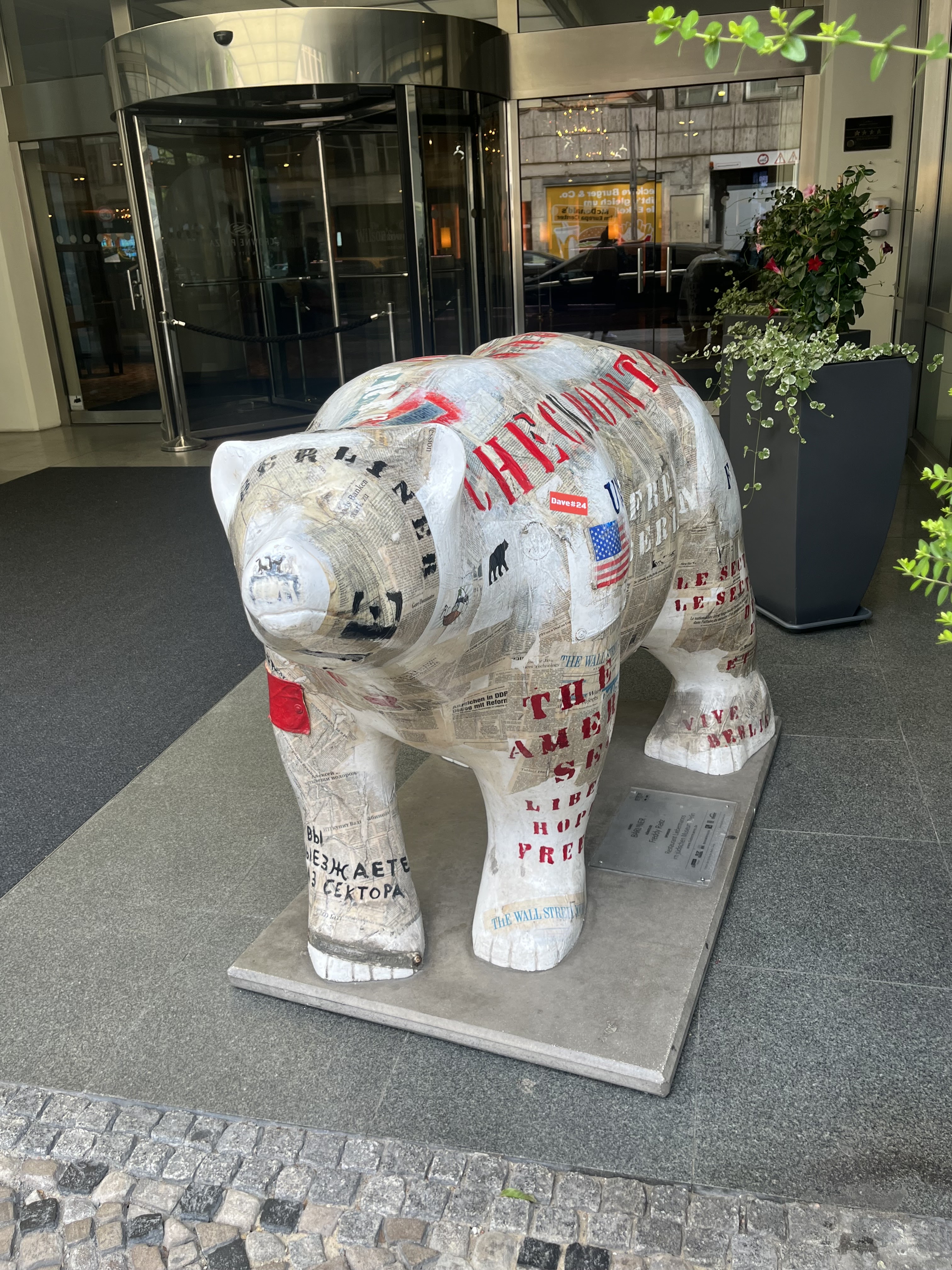
One of the many bears of Berlin--this guy guarded the entrance to our hotel.

Last stop on our spring Mother/Daughter trip was Berlin. The most surprising thing about Berlin was how clean it was for a big city--granted, we stayed in a really nice part of the city, but the streets were clean as was the air. The traffic was also pretty light for such a large metropolis. Germany has been going green for quite awhile now and biking to work or taking public transportation seems to be the norm. Anyway, the sun was shining, the air was fresh and clean, and the flowers were out in abundance.

I loved walking in the Tiergarten in central Berlin where little gardens like this just popped up.

To finish up our WWII historical theme for this trip, Emily and I visited the Topography of Terror, which is a documentation museum covering the Gestapo and the SS and SA during the Nazi regime. Outside of the museum we walked along a portion of the Berlin Wall that has been preserved as a monument. We also visited the Memorial to the Murdered Jews of Euope and Checkpoint Charlie.

Afterwards we agreed we needed to lighten the mood and do a few things just for fun. We visited the Museum of Natural History--we're big fans of the Denver Museum of Nature and Science as well as the Museum of Natural History in NYC, so it seemed like a good choice and it was a fun afternoon. Besides the requisite main hall being filled with dinosaur skeletons, this museum displayed animals differently from what I am used to--no dioramas but each stuffed animal in its own case. The weirdest exhibit by far was the huge room of jars filled with liquid and the remains of all sorts of creatures. 

The stuff that nightmares are made of!

For the final day of our trip, we walked across the street from our hotel and spent the day at the Berlin Zoo. It happened to be Father's Day in Germany (on a Thursday!), and so there were lots of families joining us. The zoo is absolutely beautiful, with interesting buildings/decor, large and natural-feeling enclosures for the animals, stunning gardens, and plentiful refreshment stands and cafes. And, they have pandas!!!!! I have never seen a panda other than pictures so that was pretty cool.

It was challenging to get a good photo as the pandas are behind glass and not getting me in the reflection was tricky.

Final image from Berlin is the Kaiser Wilhelm Memorial Church. It was bombed and almost completely destoryed in WWII. Instead of it being demolished, it was preserved and made structurally safe so that you can go inside and have a look around. Here's a bit more about it--I took tons of pictures of it and was fascinated by it.


Thursday, May 18, 2023

Travelogue: Berchtesgaden and the Eagle’s Nest


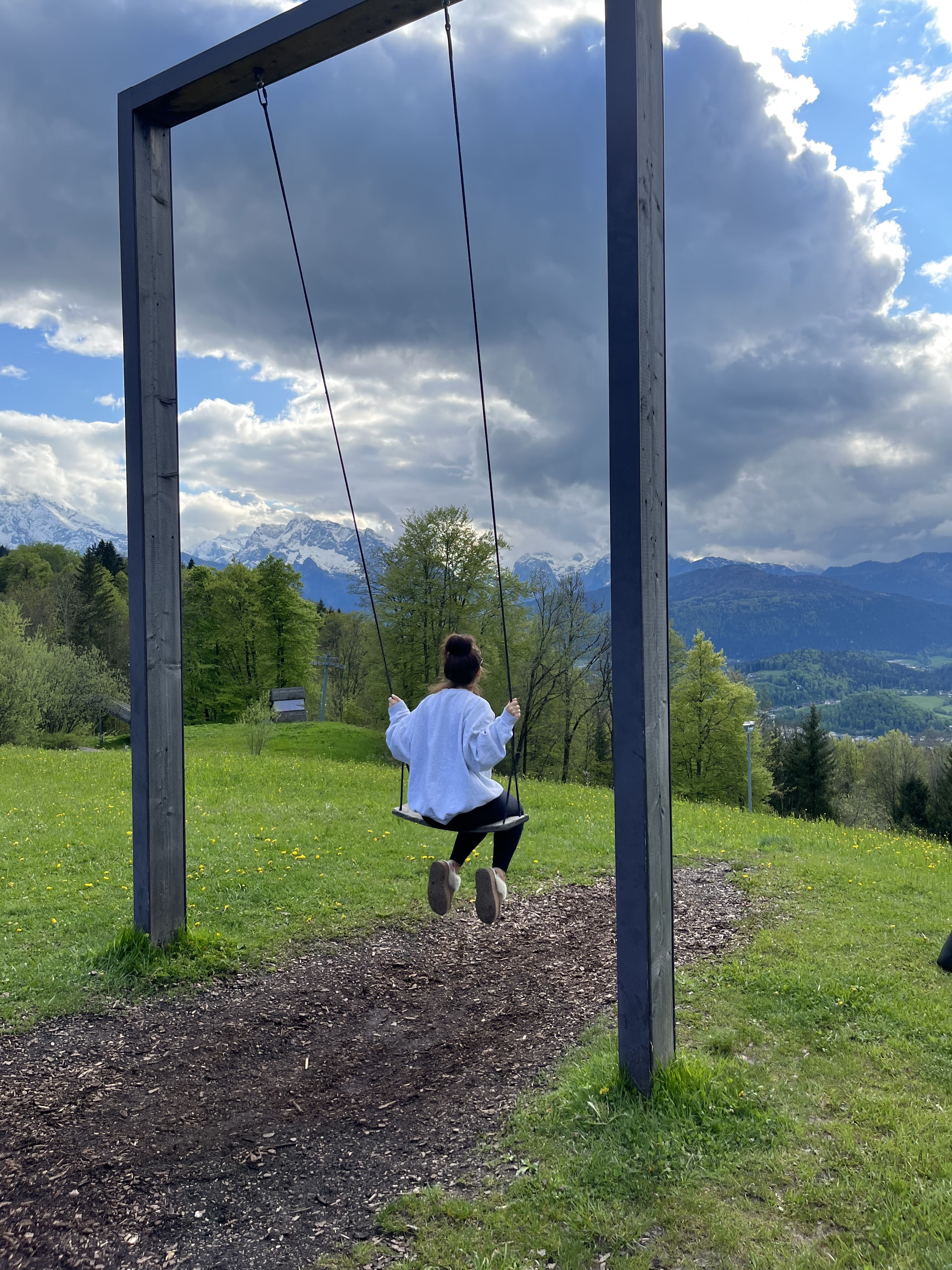
Emily enjoying the scenery when the rain finally stopped and the sun came out.

From Munich we rented a car (Europcar) and drove two hours south to Berchtesgaden in the German Alps. It is right on the Austrian border, 30 minutes from Salzburg. 

Tip: at the rental car place, the clerk asked if we were leaving Germany and I said no. I didn’t realize that the highway would take us into and then out of Austria (maybe 10-15 minutes total). When we exited the highway (still in Austria), we and a few other cars were flagged to pull over and we were slapped with a 120 Euro fine for driving in Austria without a sticker in the windshield. I asked where to get a sticker and was told any gas station for 10 Euros I could get a 10-day sticker. We got one for the return drive!

Berchtesgaden was a mixed bag—my daughter really wanted to visit Hilter’s mountaintop house and so I rearranged the trip and took out a visit to Heidelberg so we could go here. The house is one of the only remaining structures that was a personal possession of the Nazi high command, and it was called Kehlsteinhaus at the time. It is located at the top of the mountain, Obersalzberg. In the picture below, you can see it perched on top of the mountain. It basically has a cafe and a hall with about a dozen images with descriptions. So, I booked a tour that was highly recommended as providing more info than we would get just visiting on our own.

Sunday, just before we left Munich, I got an email saying that there was going to be a train/bus strike starting Sunday night that would impact tours on Monday (our day) and Tuesday because the only way to visit is to take a bus to the elevator that you then ride to the top. Since we had reservations in Berlin on Wednesday, we said we couldn’t rebook and decided to visit as soon as we arrived in Berchtesgaden on Sunday while the buses were still running. We did just that and visited the site in the cold rain and couldn’t see any of the views from the top because we were in a cloud.

A map of Obersalzburg showing the Eagle’s Nest perched at the top.

What it looks like not covered in clouds.

The cafe in the former dining hall.

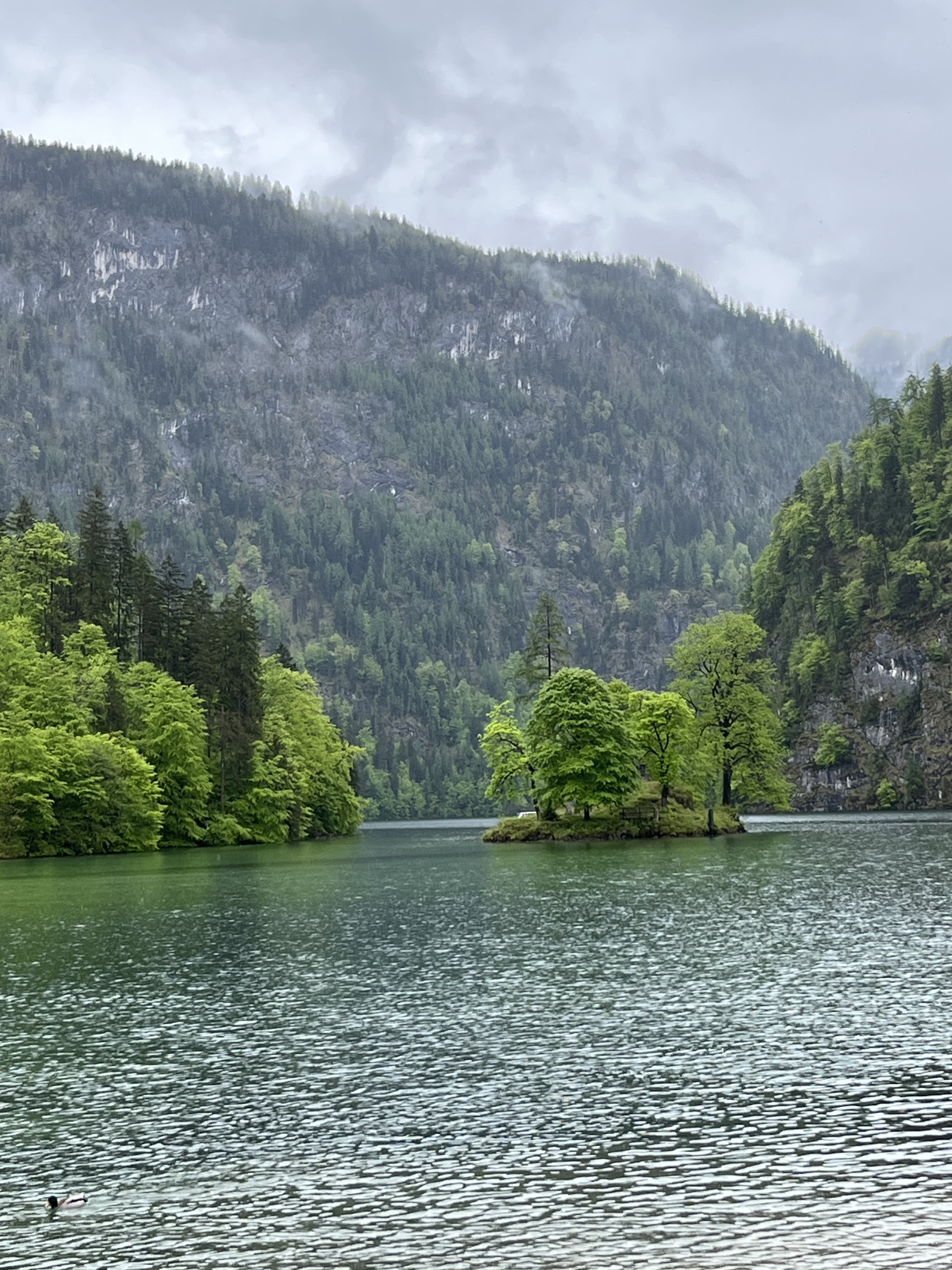
The following day we visited the Berchtesgaden National Park, including Konigsee (Kings Lake), which is like an inland fjord, and in the afternoon the sun finally came out and we enjoyed some wonderful mountain scenery. 

Konigsee

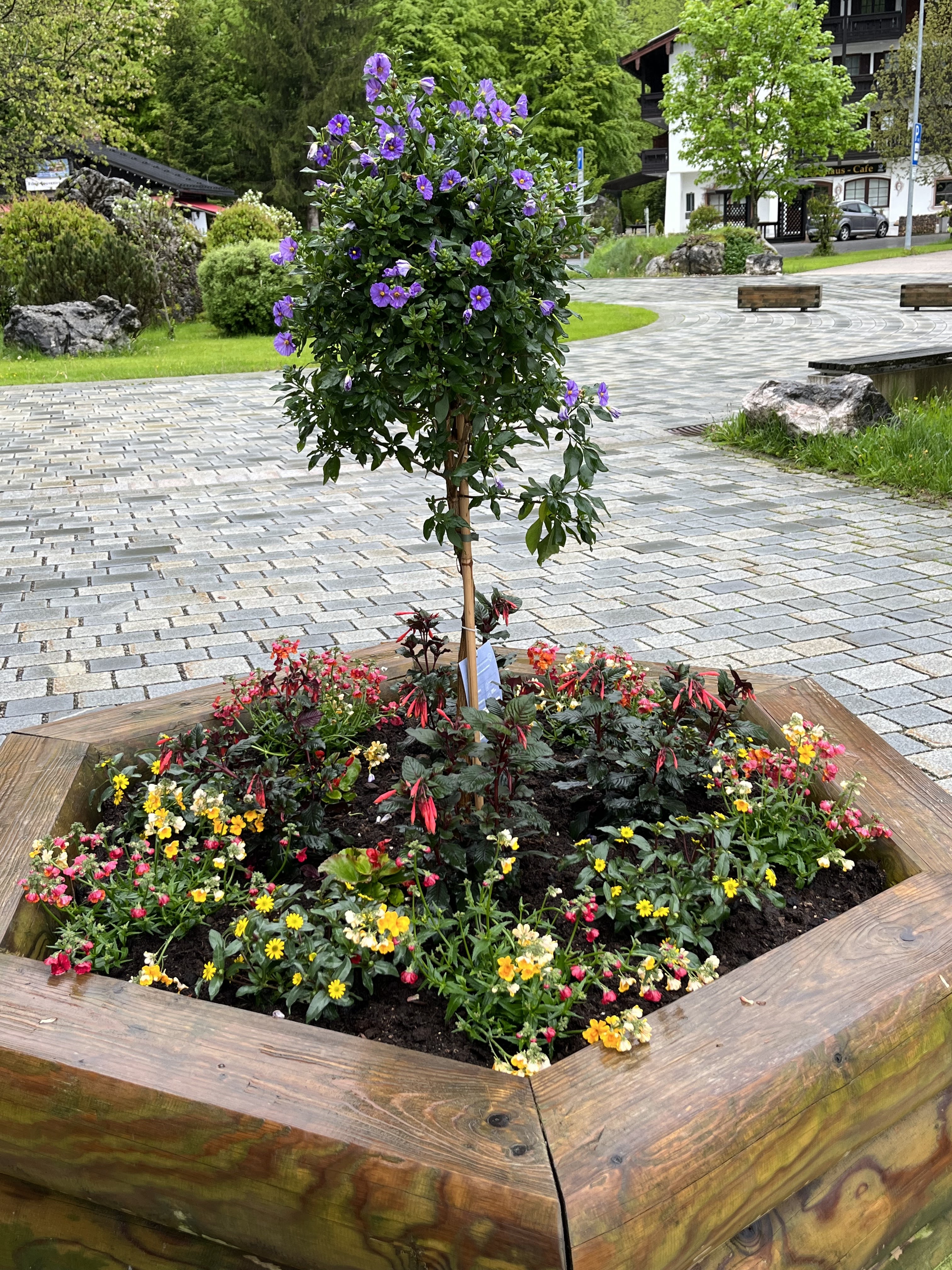
Requisite photo of flowers near the Berchtesgaden parking lot. 

We are glad we visited and saw the historical site and especially glad we got to enjoy some refreshing mountain air after all our time spent in cities.

Speaking of cities…next stop is Berlin.


Monday, May 15, 2023

Travelogue: Munich


We were hoping to leave the rain behind in Paris, but it followed us to Munich and made the first two days fairly soggy. It’s tough to learn a new city from under an umbrella and just about impossible to take pictures, but we made the best of it.  Despite the rain, I loved seeing the spring flowers and the fruit/veg stands loaded with delicious goodies. I bought two packets of strawberries that were so good!

I’m not a big fan of German food in general, but I fell in love with their chunky, white asparagus (spargel). This salmon with asparagus was out of this world!

We stayed near the train station and just a block from the old town area where most of what we wanted to do was within walking distance so both ended up getting 15-20k steps per day.

Yes, we did. We went to the Hard Rock Cafe in Berlin. It was definitely fun!

We started by visiting the Munich Documentation Centre for the History of National Socialism, which is a museum that documents the rise of the Nazi party in Munich. The museum was excellent, free, and again full of high school age kids.

Next we visited the Dachau concentration camp, which was incredibly moving. It’s one thing to read about these places, but visiting them enables you to get a deeper understanding and respect for what people endured and how they suffered. I ended up not feeling like taking any photos but just walked around, listened to the audio guide, and read the placards.

We also took a walking tour entitled Hitler and the Rise of the Nazi Party—again, excellent. The tour guide was terrific, and it was great to see the sites of events like Hitler’s first major speech, the route of the Beer Hall Putsch March and where it was crushed, the house where Hitler learned how to rub elbows properly with the upper crust who were crucial in his early fundraising years, and the various monuments that the German people have erected to commemorate the victims of the Nazi regime.

This is where some of the participants in the Beer Hall Putsch were killed. The Nazis made it sacred ground and required everyone who passed to give the Nazi salute.


The golden cobblestones mark the path that people who wanted to avoid giving the Nazi salute would take —it marks a detour around the “sacred ground.” Like any form of resistance during the Nazi control of Germany, taking this detour required courage.

Apart from the WWII excursions, we enjoyed shopping in Marienplatz, walking through the Englisher garden, watching the foolhardy surfing on the river rapids, and getting lost even with GPS on our phones. 


Now it’s time to leave the urban bustle for awhile and head for the hills. Next stop — Berchtesgaden in the German Alps near the Austrian border.


Wednesday, May 10, 2023

Our Excellent Adventure: Part the First - Paris


My daughter Emily and I have been planning her college graduation trip to Germany for a few years. With her graduation from CU Boulder last week, we are officially on tour. First stop was Paris—yes, it’s not in Germany but so close that we decided to get over jet lag with croissants, onion soup, and plenty of walks.

We stayed three nights at a lovely boutique hotel, Hotel Rose Bourbon, near the Eiffel Tower and had a great time. The trees are blooming, the umbrellas are getting a workout, and the air was fresh and clean.


The only museum we visited was Le Musee de la Liberation de Paris, which focused on Jean Moulet and General Leclerc, two key figures in the French resistance and liberation of Paris during WWII. It so happens that Monday was May 8, which is VE (Victory in Europe) Day, and it so happens that our walk to the Arc de Triomphe was cut short by police barricades in place because Macron was scheduled to speak. This was a happy coincidence because the theme of our trip is really WWII—both Emily and I are interested in the history of this time period and most of our plans for Germany are to visit sites and museums related to the war and its aftermath.


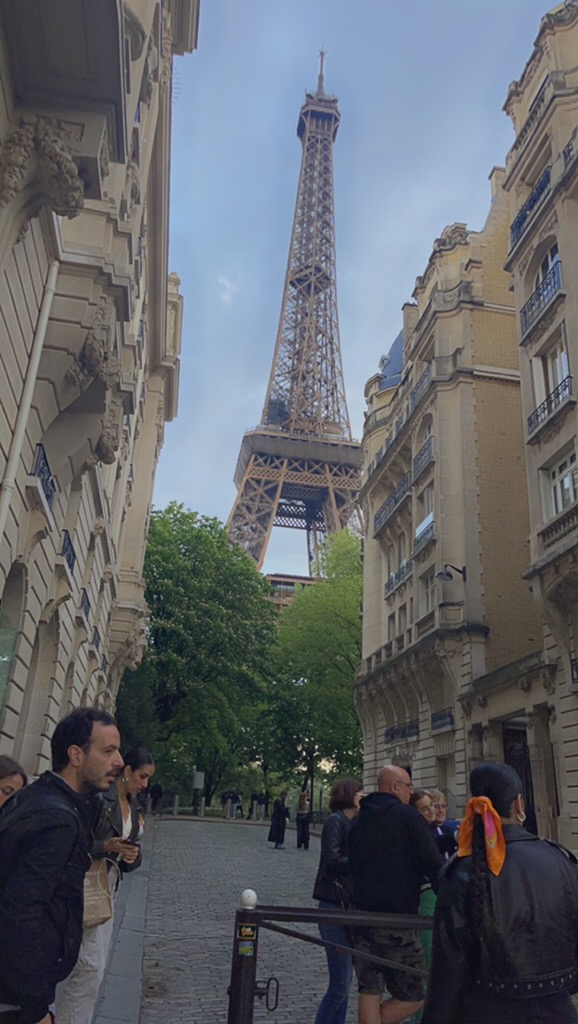
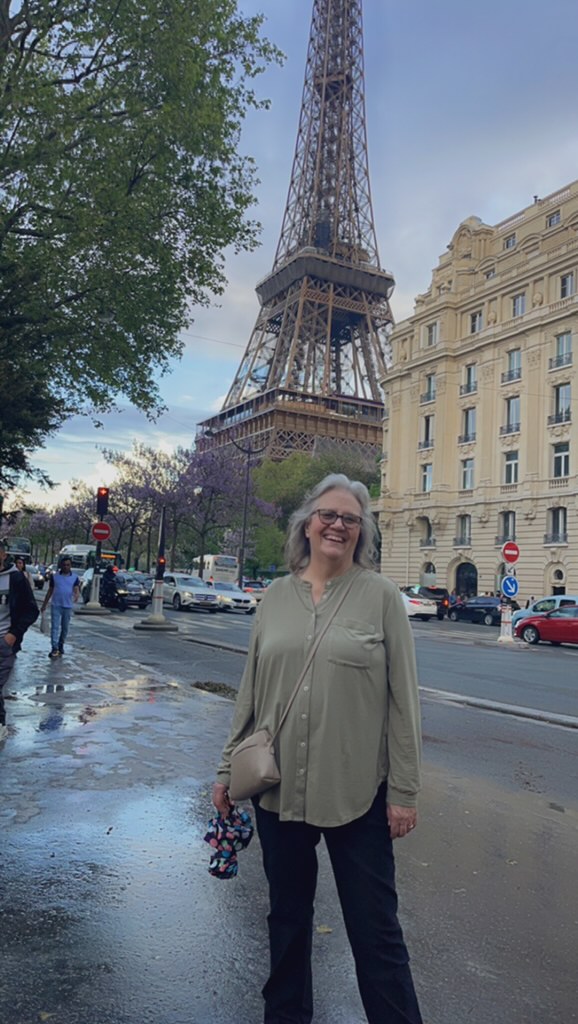
Here are some photos from our Paris walkabout.


Our time in Paris is over—jet lag is conquered—and Munich is next.

Sunday, November 27, 2022

Catching Up


Sorry for being AWOL, but I have been reading and listening and need to get back on track. The past couple of months have been characterized by WWII, opera, and LA lawyering. 


Let's start with the LA lawyer--I've been listening to Michael Connelly's Lincoln Lawyer series with my husband on our car trips. Listening to the first book in the series, The Lincoln Lawyer in Maine in September, then the second book, The Brass Verdict in Victoria, BC in October, and most recently, The Reversal on a trip across the mountains and back last week. I really love this series--Mickey Haller is a great character and I am fascinated by the details of the courtroom and defense and prosecution approaches. I know nothing about lawyering beyond The Good Wife, so this is really fun and interesting.


Now for opera. Opera? you ask. Yes, I grew up with opera and it never really left me. Colorado Opera in Denver started pinging me on social media with ads for their fall production of Verdi's Rigoletto. I decided to treat myself for my birthday--my husband had knee replacement surgery in October (so begged off with an ironclad excuse)--and decided I needed a refresher course. So, I ordered the libretto (Italian/English side by side), watched a YouTube video of Pavarotti's movie version, and listened to a 24-hour long, 32-lecture Great Course on the life and operas of Guiseppe Verdi, delivered by Professor Robert Greenberg of San Francisco. All of it was fantastic. The Pavarotti music with libretto in hand, the live production in Denver, and the detailed analysis of the opera with biographical context (there were 4 lectures on Rigoletto alone!). I finished the course yesterday, which culminated with 6 lectures on Verdi's last opera, Falstaff, based on Shakespeare's Merry Wives of Windsor. Greenberg has another Great Course on how to listen to opera, which I will probably do in 2023. 


On to WWII. Another Great Course, World War II: A Political and Social History, delivered by Professor Thomas Childers, followed by The Knight, Death, and the Devil, a fictionalized biography of Hermann Goring by Ella Leffland--this was a reread, but since I read it over 30 years ago, it was like reading for the first time. I also listened to two other related Great Courses: The Berlin Wall: A World Divided and Europe and Western Civilization in the Modern Age.

Hope everyone is enjoying the holiday season. Thanksgiving was fun and relaxing (we dined out!), and I started transforming the house to its Christmas wardrobe today. Next weekend, the tree.

Looking forward to visiting all my favorite blogs and catching up with what you all have been up to.

Friday, August 19, 2022

Mid-August Roundup - Reading, Walking, Learning

Dog days of summer--lots of rain in Colorado (hurrah!), a bit cooler weather, still no tomatoes. What's up with that? But don't you love my sunflower garden? The teddy bear sunflowers are finally coming out, and they are adorable!

Lots of walking. I've been closing my circles on my Apple Watch every day since Jan 1, and accomplished the July challenge (average 60 minutes of exercise per day), and I 'm track to do the August challenge (average burn 668 calories from exercise per day). Am I proud of this? You bet!

In addition to reading, I've been listening to Great Courses on Audible. Here's what I've listened to so far:

  • The Vikings, by Kenneth Harl - a 36-lecture course on the history and impact of the Vikings in medieval Europe. Absolutely, wonderful. The net-net is that Harl believes that the Viking raids, settlements, and assumption of power in certain areas was a major force in shaping Christian Europe. The Normans who invaded England in 1066 were essentially Vikings who had settled in Normandy and took control of the area. I did not realize that!
  • A History of Hilter's Empire, by Thomas Childers - a 12-lecture course that outlined the development of the Nazi party, its rise and fall. Again, incredibly interesting.
  • World War II: A Military and Social History, by Thomas Childers - I am just over half-way through this 30 lecture course. While I am getting more comfortable with the chronology and key points of the war in Europe, I am getting information that is largely new to me about the war in the Pacific and North Africa and the southern Mediterranean.
So why all this learning about WWII? My daughter and I are planning a trip to Germany in March/April. Because we are both interested in WWII, we want to visit a lot of the museums and historical sites from that time and the Cold War, so I wanted to do some pre-trip learning. I am also learning some German via Duolingo.

Now on to what I've been reading. 

The Midcoast, by Adam White - we're headed back to Maine for 10 days in September, so I wanted to read another novel set in Maine, and I saw this on a few blogs and thought I would give it a try. It was a solid 4-star novel, a debut novel, set in a very small town in Maine with an interesting story. Basically, the main character, Andrew, is a lot like Nick in The Great Gatsby in that he observes the rise and shattering fall of a family and how the facade of money and power can crumble when pushed even a little. The main character is an observer, not a player, without having much of a storyline himself. Not sure how this novel is doing overall in the market, but I think it could definitely use a better title, which I found dull and not enticing at all.


City of Vengeance, by D.V. Bishop - this is the first in a mystery series set in 16th century Florence and featuring Cesare Aldo, an officer working for the criminal courts in Florence, which bascially makes this a cop mystery. Absolutely loved the setting and Cesare is a great character with lots of potential for future stories. The writing was good and the mystery was interesting. Will definitely read the second in the series. Interestingly, I thought at the beginning of the book that it was going to be a take on The Merchant of Venice, as the first section deals with a gruff Jewish moneylender and his wayward daughter. The story didn't end up paralleling Merchant at all, but I was afraid we were straying into stereotypical grounds. Glad the author pulled back and told his own story without riding on Shakespeare's coattails. At 416 pages, this books squeaks under the wire to qualify for the Big Book Summer challenge.


The Diamond Eye, by Kate Quinn - WOW! I loved this book about a female, Russian sharpshooter during WWII. Not quite as good as The Rose Code, but wonderful nevertheless. I especially enjoyed the first part of the book, where Mila (aka Lady Death) is learning to be a soldier and developing her leadership skills (she eventually commands a platoon). The second part of the book deals with her visit to the US, Canada, and Great Britiain to drum up support for the US to aid the Allies and fight the Nazis. Mila Pavlichenko was a real person who wrote a memoir about her time in the Red Army and her trip to the US. The Author's Notes at the end is critical to enjoying/understanding the book, in my opinion, as she explains that 90% of the characters in the book are real people, and the only parts that she really fabricated were the larger story of Mila's estranged husband and the stalker who is trying to kill Roosevelt while she is visiting the White House. I particularly loved Mila's relationship with Eleanor Roosevelt, of whom I am a big fan! Reading this book while listening to the WWII Great Courses lectures was a perfect pairing.

Clocking in at 435 pages, this book also qualifies for the Big Book Summer challenge


Hope everyone has a good rest-of-August and happy reading, walking, and learning!

Tuesday, December 28, 2021

December Potpourri


Lots to catch up on--I haven't done a potpourri or roundup since RIP!

Anyway, apart from the Classics, here's what I've been reading:

Taste, by Stanley Tucci - I loved his CNN tour of Italy so much I watched it twice and then couldn't wait for Christmas to get his book. I listened to this foodie memoir, read by the author, and then asked for the book for Christmas for the recipes and to reread it. We're contemporaries, he is a few years younger than me, so it was so much fun to remember life in the 60s and 70s and 80s. A thoroughly enjoyable book.

Ribbons of Scarlet: A Novel of the French Revolution's Women, by Kate Quinn, et al - each chapter is authored by a different writer and features the story of a different woman, although the varioius women do show up in each other's stories. There is the wife of a philosopher, a sister of the King of France, a fruit seller who becomes a revolutionary, an artistocratic lady and they are all interesting and each story well written and compelling. It proves the notion that everyone has a story that deserves to be told, and I really enjoyed reading about the Revolution from the female perspective.

A Game of Birds and Wolves: The Ingenious Young Women Whose Secret Board Game Helped Win World War II, by Simon Parkin - this was a great follow-on to my reading about WWII code-breaking, and was an absolutely fascinating non-fiction. The Birds and Wolves were the German submarines that hunted down Allied ships using the strategy and techniques of a wolf pack (collaborative) and the fleets of submarines were given names of birds. The Wrens and their naval leader devised a game board on which they mapped the movements of the German subs and figured out the wolf-pack strategy and developed techniques for combating it. Riveting stuff! The pictures alone are fascinating. Now I am interested in the Battle of the Atlantic, and to that end have a copy of The Cruel Sea, by Nicholas Monsarrat, published in 1951, that I plan to read in 2022.

Farewell Mr Puffin: A small boat voyage to Iceland, by Paul Heiney - this was a gift from my brother Colin, who knows of my interest in birds, especially puffins, and sailing. Now I am eager to visit Iceland. It was a wonderful adventure, travel non-fiction book, filled with details of doing a passage (from just north of London), up the eastern coast of Britain and on northwest to Iceland. I particularly liked hearing about the various ports he laid up in, his various crews along the way, and the pubs and food eaten therein. Sadly, he only saw one puffin in an area abundant in puffins, but that was just bad luck. Really enjoyed this book and whetted my appetite for travel.

Jane and the Twelve Days of Christmas (#12 in Jane Austen Mysteries), by Stephanie Barron - I wanted to do a bit of Christmas reading this year and so dived into this wonderful novel after finishing #13 in the series, Jane and the Waterloo Map. It was great fun, despite the killjoys of Jane's brother James and his Mary Musgrove-esque wife, Mary. I particularly enjoyed Jane and Cassandra's gift of a doll with all the trimmings that they gave (over a period of days) to their niece, Caroline, one of James's daughters.

The Best Worst Christmas, by Kate Forster - this was an Audible freebie for members and I was looking for a light, bright Christmasy story that wasn't too treacly, and this was perfect. Loved all the characters, from the world-weary heroine back in England after living in Sydney for years, and her high-school boyfriend, now a doctor, and their parents. Very fun and festive.

The Stolen Lady, by Laura Morelli - this was a birthday gift from my daughter Sarah, who knows I love Morelli's books. As with The Night Portrait, by the same author, this combines the Italian Renaissance with WWII. This time, Anne, a typist working at the Louve, assists the curators in hiding the Mona Lisa and other art treasures from the musuem from the invading Nazis. The other half of the story chronicles the painting of the portrait of Lisa del Giocondo née Gheradini from the perspective of Leonardo da Vinci and Bellina, Lisa's lifelong maid. I absolutely loved visiting Milan and Florence in the early 1500s, as well as tracking the hiding places of the Louve artwork across France in the 1940s. I cannot wait to get back to both countries!

Winter Solstice, by Rosamunde Pilcher - according to GoodReads I read this book about 7 years ago, and I definitely had a copy in my stacks, but I honestly remember nothing about it except the tragedy that provided the catalyst for the bulk of the novel. I absolutely loved (re)reading it. Loved all the characters, the setting, north of Inverness in the winter, and the message of hope and rejuvenation in the bleak midwinter. An excellent Christmas story. I loved it so much I just started rereading The Shell Seekers, which I remember much better though I read it over 30 years ago when it first came out.

That's my roundup. Thankfully I am off work again this week, which means lots of reading and puzzle time. Happy Holidays to my blogging friends around the world. May your 2022 be filled with good health and good books.

Sunday, August 29, 2021

August Roundup

 Dog days of summer--garden harvest--shorter days--cooking, again, finally.

Over the past two weekends, I have made salsa, pickled beets, braised carrots and processed carrots for the freezer, zucchini bread, roasted tomato soup, and croutons for the soup--using tomatoes, peppers, onions, shallots, garlic, carrots, beets, and zucchini from the garden. All this while telling a neighbor that "I just don't cook anymore!" Go figure!

Oh, yes, and I've been reading. Here's my potpourri.


A Woman of No Importance: The Untold Story of the American Spy Who Helped Win World War II, by Sonia Purnell - this is one of the best books of 2021. Could not put it down. Virginia Hall was incredible--brave, passionate, capable. She persisted. Despite a prosthetic leg. Despite the old boys network. Despite the Gestapo, betrayals, and red tape, she really, truly helped liberate France and end WWII. This is non-fiction at its finest. I started out listening to an audio version but switched to print because there are a lot of names and locations and organizations to keep track of, but a truly marvelous read. A perfect companion book to Code Name Helene.

Virginia Hall - she persisted!


My Place at the Table: A Recipe for a Delicious Life in Paris, by Alexander Lobrano - another non-fiction, but this time a memoir. Really enjoyed this for the love of food, the love of Paris and France, and the insights into life as a journalist. Just a few years older than me, I recognized the world of Lobrano's childhood, the prejudices, the need to fit square pegs in round holes, the need to smooth over trauma and pretend everything was always all right. Poignant, interesting, and mouth-watering!

The Last Detective, by Peter Lovesey - attention Austen fans! This one's for you. Set in Bath in the 1990s, this is the first in the author's Peter Diamond mystery series. Peter Diamond is okay--not my favorite mystery solver, but the reason I read the book was for the Jane Austen connection. The mystery hinges on some letters that Austen wrote while living in Bath that surface and then disappear. Solving the mystery means finding those letters! Great fun. Not great literature, but fun nonetheless.


Sunday, May 03, 2020

April Roundup


April was a tough month on so many fronts, but at least I read some great books!


The Splendid and the Vile: A Saga of Churchill, Family, and Defiance During the Blitz, by Erik Larson - I like Larson's books and have read most of them and this is one of the best. Focus is on the Churchill family and the prime minister's staff. Larson's primary sources were the diaries of Churchill's youngest daughters, Mary, and one of his private secretaries, John Colville. While most of the narrative is on the British experience, it was interesting to read about the German perspective of the same events. Absolutely powerful book - one of the best of 2020 for me.


Case Histories, by Kate Atkinson - the first in Atkinson's Jackson Brodie mysteries, I absolutely loved this book. Atkinson is a very literary writer and this was a very literary mystery - she did a superb job of telling 4-5 different stories simultaneously, while also introducing her main character and giving us his back story. Eager to read the rest in this series.


Empire Falls, by Richard Russo - this is part of my Maine reading project for 2020, and was a very interesting story about a depressing little town in Maine. The mill has closed, no jobs or prospects of jobs, and the main character Miles is struggling with family, his past, his faith, and his job. Nevertheless, I thought it a compelling novel, and I plan to read more of Russo. Sadly, as expected, our trip to Maine this summer is cancelled, but I am enjoying digging into the fiction of the region.


Girl, Woman, Other, by Evaristo Bernardine - just finished this incredible book last night, and recommend it to anyone who wants to get a different view of Britain than the land served up by most of the novels I read. This is a collection of short stories about women of color in Britain whose lives intersect in the most interesting ways. This was one of the Tournament of Books contenders in 2020, making it to the quarter finals. I had read a few reviews that made it intriguing to me, and I thought it powerful, well-written and inventive, and broadened my horizons considerably.


The Atomic City Girls, by Janet Beard - I picked this up on impulse and wasn't disappointed. A novel about the women who worked at the Oak Ridge, TN factories that processed the plutonium used in the Manhattan Project (aka the atomic bomb). A fascinating story about race, naivete, patriotism, and ambition. I liked the main character, June, and thought her coming of age story was interesting and believable.

Hope you are all staying well and healthy, practicing social distancing, and finding comfort and strength or whatever you need from the reading you are able to do.


Sunday, September 30, 2018

Travelogue: Normandy Beaches

I just finished Stephen Ambrose's magnificent D-Day June 6, 1944: The Climactic Battle of World War II, and thought it appropriate that I incorporate it into my post on visiting the Normandy Beaches in August.

After Mont St Michel, we drove across the Cotentin peninsula to the Normandy beaches, where we would spend three nights in the lovely little fishing village of Port-en-Bessein, which will be getting its own post later on, and is between Omaha and Gold beaches.


We stopped enroute at Utah Beach, the westernmost part of the D-Day landings because our tour the next day didn't include it and we wanted to see it. We didn't have time to visit the museum, but instead opted to sit on the beach and eat the sandwiches we picked up in Mont St Michel and enjoy the beauty of the place.

A very striking monument at Utah beach, showing a replica of a Higgins boat.
The next day we did two tours with Bayeux Shuttle -- the morning focused on the British beaches and cemeteries, and the afternoon focused on the American beaches, ending with a visit to the American cemetery. I'm usually not one for tours, but I felt that this would really be the best way to get to the most interesting sites and get good info from an expert. 

The tours were both fantastic--definitely the right choice. In the morning, my husband and I were the only ones on the tour, so we had the very personable and knowledgeable guide all to ourselves. We got to ask loads of questions, and he gave us a first rate intro to D-Day. In the afternoon, the American tour had about a dozen people and so was less personal but still excellent.

We started at Longues Sur Mer and I got my first view of the German pillboxes, or batteries that shelled the beaches on D-Day.  The ground around was cratered by the aerial bombing that the Allies did leading up to D-Day, and it was eerie to walk inside and stand behind the guns.


We also visited the town of Arromanches (Gold Beach), and I was absolutely fascinated by the remains of "Port Winston," which was a Mulberry (or temporary) harbor that the Allies constructed  since there isn't a natural harbor in the immediate area.


Arromanches, Gold Beach - absolutely lovely, would love to return and spend some time here.

WWII remnants- full disclosure, my husband photoshopped the people out of this image. 
We ended our morning with a visit to one of many British cemeteries, which included casualties from Great Britain as well as Canada, Australia, New Zealand, and also German troops. Not a lot, but some. Unlike the American cemetery, the gravestones are not uniform, and family members were able to add a few words (usually scripture or poetry) to the vital information. 

Ryes British War Cemetery
In the afternoon, we visited Pointe du Hoc, a cliff overlooking the beach, and then Omaha Beach. Omaha is a spectacularly beautiful beach, and since we visited on a hot August day, it was crowded with people playing in the surf and sun. Our guide made a point of saying that while sometimes visitors are a bit shocked that people are playing where so many thousands died, it is a fitting tribute to the cause for which they died that the beach can today be enjoyed by everyone.

Memorial at Omaha Beach with people photoshopped out.
We ended the day at the exquisite American cemetery, where we observed the flag ceremony at the end of the day, which was very moving.


During our morning tour, I asked the guide for a book recommendation and his number 1 choice was D-Day by Stephen Ambrose. It was absolutely excellent, with most of the narrative being snippets of interviews the author conducted with veterans of the landing. The stories they told surpass anything that a novelist could create and reading their words was inspiring, chilling, and incredibly moving. Ambrose did an first-rate job of putting the invasion into context--from the massive preparation, including years of training and scouting right up to the last minute--as well as his own analysis of why it succeeded, what the Allies did right and what the Nazis did wrong. 

I was so glad that I was able to visit Normandy before reading the book as the place names and geography and feel of the land and sea helped me better understand the stories that the soldiers told of their experiences.