
First and foremost, Somerset Maugham is an exquisite writer. His prose has an elegant simplicity that is so moving and powerful.
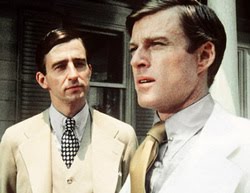
Written in 1925, the same year as The Great Gatsby, I found myself comparing the main character, Kitty, with Gatsby's Daisy. Cut from the same thin, wispy, pretty cloth, they share a shallowness and a weak will along with a loveliness that gets them into trouble. It is their ticket and their burden.
Along the same lines, Charlie Townsend, the cad of the story, reminds me so much of Tom Buchanan in Gatsby as well. Handsome, philandering, selfish--a person who smashes things up and then retreats back into his money or "vast carelessness."
Obviously, the parallels I saw between Kitty/Charlie and Daisy/Tom are my own retrospection and thinking about the world of the 1920s--post Great War, post Victorian, post Edwardian, imperialistic.
The Painted Veil takes place in Hong Kong and a cholera-stricken village in mainland China, with bits and pieces in London. Narrated in the third person, this is Kitty's story--her journey from a London debutante to the wife of a doctor first in Hong Kong and then in mainland China and then back to London for the reckoning.
It wasn't until Kitty and her husband Walter arrive in the village that I started marking passages. The scenes in Hong Kong are stifling, but scenes in the village are breathtaking.
The morning drew on and the sun touched the mist so that it shone whitely like the ghost of snow on a dying star. Though on the river it was light so that you discern palely the lines of the crowded junks and the thick forest of their masts, in front it was a shining wall the eye could not pierce. But suddenly from that white cloud a tall, grim, and massive bastion emerged. It seemed not merely to be made visible by the all-discovering sun but rather to rise out of nothing at the touch of a magic wand.
There were times that I felt so frustrated with Kitty, wanting her to be a heroine that I could admire, but that's not fair. Maugham gave me her story, shabby in parts and shameful in others, but one in which Kitty does grow in self awareness so that by the end she can declare to her father that she wants her unborn child, whom she believes to be a daughter, "to be fearless and frank. I want her to be a person , independent of others because she is possessed of herself, and I want her to take to life like a free man and make a better job of it than I have."
This is such a marked contrast to Daisy Buchanan who could only wish for her daughter to "be a fool- that's the best thing a girl can be in this world, a beautiful little fool," that I have to say that perhaps Kitty is a heroine I can admire after all.
The title is from the opening lines of a sonnet by Percy Bysshe Shelley, which is actually a pretty good synopsis of the story:
Lift not the painted veil which those who live
Call Life: though unreal shapes be pictured there,
And it but mimic all we would believe
With colours idly spread,—behind, lurk Fear
And Hope, twin Destinies; who ever weave
Their shadows, o'er the chasm, sightless and drear.
I knew one who had lifted it—he sought,
For his lost heart was tender, things to love,
But found them not, alas! nor was there aught
The world contains, the which he could approve.
Through the unheeding many he did move,
A splendour among shadows, a bright blot
Upon this gloomy scene, a Spirit that strove
For truth, and like the Preacher found it not.
There's another poetry reference that I particularly liked--it's from Oliver Goldsmith's An Elegy on the Death of a Mad Dog. Remember, "the dog it was that died."
The only other work by Maugham that I've read is Cakes and Ale, ten years ago. Now I'm inspired to read The Razor's Edge, which I've owned for years but never read, and Moon and Sixpence. Not sure I have it in me to read Of Human Bondage though. And the movie version? I always say I'm going to watch the film adaptation of books but rarely actually get around to it. But, maybe this time...
Yep, another book for the Back to the Classics Challenge - 2021, in the category twentieth century classic.