Showing posts with label Last Runaway. Show all posts

Wednesday, August 09, 2023

Dog Days of August Roundup - True Grit, et al


I used to think the perfect year would jump from spring to fall, but lately I am truly starting to appreciate summer. Maybe it's because this one has been relatively cool and much rainier than usual. Anyway, summer is winding down, and it's time for a reading roundup before pumpkin spice hits the shelves and frost hits the tomatoes.

True Grit, by Charles Portis - an absolutely fabulous 5-star read. I loved Mattie Ross, Rooster Cogburn, and LeBoeuf, and I loved the setting (the Old West circa 1870). I especially loved the writing--Mattie is the first-person narrator, and her voice is crisp and authentic with a dry wit. I listened to the audio version, as read by Donna Tartt, who also provided the afterword for the novel. Tartt raves eloquently about her entire family's multi-generational love for this novel, and she also wrote an excellent piece for the New York Times after Portis's death in 2020. I am sorry I didn't read this book as a teenager because I definitely feel I would have had a lifelong love for it, as does Tartt. Even if you're not sure you would like a Western, it's a short book and well worth a try. I actually think it should be on school reading lists. 

I've never seen the John Wayne movie and didn't really want to. However, I did just watch the 2010 movie with Jeff Bridges as Rooster, Matt Damon as LeBoeuf, and Hattie Steinfeld as Mattie. I thought it was fabulous. Very true to the book, snakes and all! I've just put a couple of other books by Portis on my GoodReads TBR list.


The Survivors, by Jane Harper - this Australian author is definitely becoming a favorite of mine. I like everything she writes. This standalone mystery is set in Tasmania, in a stiflingly small seaside village where most people are carrying a load of secrets under a weight of guilt. The perfect setting for a good then-and-now set of mysteries. I loved reading about the deadly caves--spooky and intriguing. Good, interesting characters, and, as always, well-written.


Station Eleven, by Emily St John Mandel - I never read sci-fi (except the occasional time travel yarn) and I loathe post-apocalyptic distopian stories, but my daughter said Station Eleven was really good and had lots of Shakespeare in it. She reads books that I recommend, so I thought I should do the same. It was really good--and it did have some Shakespeare in it. The post-apocalyptic cast of characters is a troupe of actors who put on Shakespeare's plays and travel with classical musicians who put on concerts in the upper Midwest after a virus destroys civilization and the survivors are attempting to survive. The novel was published in 2014, and anyone who read it before Covid hit was probably even more scared than the rest of us when Covid was in its earliest, scariest phase. I really enjoyed the jumping around in time (we get to know the characters before their world changed), and I especially enjoyed reading about how people viewed the lost world. I really had to swallow a lot to accept the idea that no one who survived could figure out how to turn the lights back on, but the author did a believable job in creating a fictional world I wanted to read about. It's not everyone's cup of tea, but I am glad I gave it a shot.

There's a mini-series that my daughter says is very good, and so I will be watching that sometime this Fall if I ever finish watching Castle.


The Last Runaway, by Tracy Chevalier - this was a reread of one of my favorite novels by one of my favorite contemporary authors. Set in 1850, it is the story of a young woman who immigrates to the US and makes her way in the new world, becoming a link in the underground railroad and quilting her way into a place for herself. Rereading this book has inspired me to find a place in my office to set up my sewing machine so that I can finish the quilt I started a few years ago so that I can start on my own underground railroad sampler quilt. Here a link to my original review, complete with references to Austen's Mansfield Park and Gaskell's North and South and the Thornton family, particularly the ladies. I'm happy to say that I saw the parallels on the second reading as well.

Happy Dog Days of Summer!

Tuesday, May 21, 2013

The Last Runaway


I haven't been disappointed by a Tracy Chevalier book yet.  I enjoyed Girl With a Pearl Earring and The Lady and the Unicorn, and loved Remarkable Creatures, but I think her latest, The Last Runaway is my favorite.

Maybe it's because it is set in pre-Civil War America and I've been reading a lot about slavery and the Civil War lately; maybe it's because its main character, Honor Bright, is a quilter and I've been feverishly working on three quilts this spring and so can appreciate Chevalier's riffs on sewing; maybe it's because Honor is such an atypical heroine but one I can relate to and understand.  Or, maybe it's because Chevalier is a gifted writer who continues to explore new stories and articulates so well internal dramas.

Quickie synopsis - Honor Bright is a young Quaker woman from England who accompanies her engaged sister in 1850 across the Atlantic to America to immigrate.  The sister dies enroute to Ohio, and Honor is stranded in America, unable to return home because of debilitating seasickness, friendless, shy, and dependent on the kindness of virtual strangers.  She settles in a tiny town near Oberlin, where the man who was to marry her sister lives.  Honor is befriended by Belle Mills, a local haberdasher, whose brother, Donovan, is a runaway slave hunter.  Donovan fall in love with Honor, who acknowledges a spark of attraction for him but abhors his occupation.  Honor marries a local dairy farmer, Jack Haymaker, and struggles to find her place within his family.  Her mother-in-law, Judith, is rigid, demanding and condescending.  Her sister-in-law, Dorcas, is jealous of Honor and not to be trusted.  And, with the recent passage of the Fugitive Slave Laws, the Haymakers have decided that they cannot risk losing their farm by helping slaves along the underground railroad as they pass through the Oberlin, OH area on their way to Canada.  Honor defies them by helping the runaways she encounters...and therein lies the heart of the story.

There's a lot of Fanny Price (Austen's Mansfield Park heroine) in Honor Bright--both are quiet, unassuming, and completely dependent on others and yet their moral compass is so strong that they muster the courage to defy the authority figures who rule them and will not be swayed from following the dictates of their conscience and heart.


There's also a lot of Elizabeth Gaskell's Thornton family (from North and South) in the Haymaker family.  Judith Haymaker and Mrs. Thornton are definitely cut from the same cloth--neither thinks the pretty foreigner who comes to town is good enough for her princely son, and neither is afraid to make her feel small, uncomfortable, and unwelcome.  Dorcas Haymaker has a sister in Fanny Thornton--both are awed by the new girl in their lives and both deal with it by flaunting their own more secure status and indulging in fits of jealousy and spite.


Despite the similarities between the Thornton women and the Haymaker women, I have to stress that Jack Haymaker is no John Thornton.  He was actually the hardest character for me to wrap my mind around.  Honor married him after a very brief courtship, primarily because she couldn't see any other choice given her lack of family in America to look out for her.  While he has his moments, he never achieves a heroic level--he lets life happen around him but doesn't really work to shape that life.  Both Thornton and Haymaker experience devastating losses early in their lives, and both assume the mantle of head-of-household at too young an age, but they handle this role very differently.

My favorite characters, however, after Honor, are Belle and Donovan.  Belle is a wonderful, energetic woman--free-speaking, blunt, independent, and big-hearted.  Despite their vast differences in temperament and demeanor, she and Honor become true friends.  This is one way in which Honor's story differs from Fanny Price's--in Mansfield Park, Fanny never has a true friend, to whom she can unburden her heart and who always has her back with no strings attached.

Donovan is a wonderfully interesting character because while he is definitely a villain, dangerous and mean-spirited, he loves a good woman and this makes you think that redemption might actually be a possibility for him.  Donovan loves Honor not just because she is pretty and compliant, but because he sees and appreciates the light of her spirit, something Judith Haymaker is never able to do.

I think the premise of an English Quaker girl encountering slavery and coming to terms with the otherness of the slaves and then their humanity and very personal connection to herself and her own story is a brilliant way to comment on America's "peculiar institution."  Honor experiences slavery first as an outsider who is horrified by what she sees, and then as an insider (once she marries into the system) who must resist the impulse to simply protect self-interest when crimes against humanity are being perpetrated.  I think the passage of the Fugitive Slave Law probably accelerated the timing of the Civil War by decades because it forced so many people to finally take a stand against slavery whereas before the Law they were willing to "live and let live" as along as they didn't have to help recapture slaves.

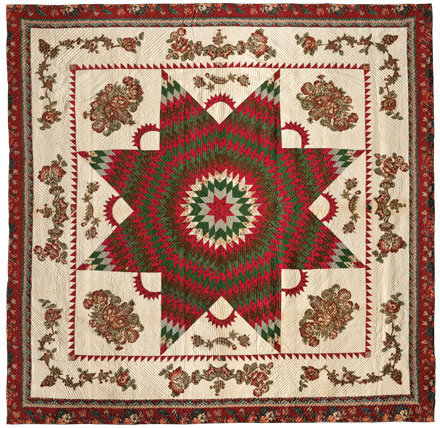
Finally, I really loved reading about Honor's sewing--her English patchwork as opposed to American applique, her technique of making rosettes, and her analysis of what makes a pleasing final product.  Here's a Star of Bethlehem quilt from the 1830s and now housed in the Brooklyn Museum.  This quilt pattern is mentioned many times in the novel.  I may have to make one myself.

Star of Bethlehem quilt, circa 1830,  Brooklyn Museum