Showing posts with label 1599: A Year in the Life of William Shakespeare. Show all posts

Sunday, October 18, 2009

Incommunicado and Coming Attractions


Sorry for the silent treatment this week, but I just returned from a whirlwind trip to the midwest with my 17-year-old daughter and husband. We visited three colleges that she is applying to--one in Minnesota and two in Iowa. I did have my laptop and a couple of books, but with all the driving, visiting, discussing, and absorbing, there was no time left to read/blog much less twitter and tweet.

I did manage to watch almost all of the next episode of Playing Shakespeare (planning to blog on it soon--topic is playing passion with coolness), finished 1599: A Year in the Life of William Shakespeare (can't wait to blog on final thoughts), finished Atonement (but will not blog on it until I watch the movie and do both together) and started The Secret Diaries of Charlotte Bronte (Blecchhh!).

I have thrown down The Secret Diaries in disgust twice now with a "Life's Too Short" speech to anyone who would care to listen, but I feel that if I'm going to blog about it I should actually finish it. Maybe it gets better.

Meanwhile, I'm trying to decide between starting Wilkie Collins's The Moonstone and Paul Collins's The Book of William: How Shakespeare's First Folio Conquered the World. I don't think I could go wrong with either.

I also want to let everyone know that I am on the Elizabeth Gaskell tour that The Classics Circuit has organized. I am the second stop--November 17--and will be blogging on Gaskell rather than one of her works. I am planning on doing the Collins tour as a blog reader rather than blog writer so that means I'll probably read The Moonstone. Okay, there you have it. Decision made. Gotta run and do laundry, unpack, and make chili for supper.

It's good to be back.

Thursday, August 27, 2009

The Passionate Pilgrim – Shakespeare’s Sonnets


I reread the portion of James Shapiro’s 1599: A Year in the Life of William Shakespeare that deals with the rogue publication of some of Shakespeare’s sonnets along with others not his and still others that might be his, but on an off day, in a collection entitled The Passionate Pilgrim. I was struck again by Shapiro’s contention that the plays were public and the sonnets were private. The latter evolved over time, were worked on and reworked for their own sake and as canvases for Shakespeare to play with themes he later incorporated into the plays. Shapiro says that Shakespeare only shared his sonnets with a select few. What he doesn't speculate on is which of those select few let William Jaggard get his hands on them and publish them without permission. That's a good mystery for someone to solve!

I also really enjoyed the notion Shapiro introduces in this section that Shakespeare would have haunted the bookstalls of London:

There’s no way that Shakespeare could have bought or borrowed even a fraction of the books that went into the making of his plays. Besides his main sources for his British histories and Roman tragedies, which he probably owned—Holinshed’s Chronicles and Plutarch’s Lives, he drew on hundreds of other works. From what we know of Shakespeare’s insatiable appetite for books, no patron’s collection—assuming that Shakespeare had access to one or more—could have accommodated his curiosity and range. London’s bookshops were by necessity Shakespeare’s working libraries, and he must have spent a good many hours browsing there, moving from one seller’s wares to the next (since, unlike today, each bookseller had a distinctive stock), either jotting down ideas in a commonplace book or storing them away in his prodigious actor’s memory. P. 191

I also enjoyed reading how Marlowe’s poem “Live with me and be my love” was included in The Passionate Pilgrim, and so initially ascribed to Shakespeare. The really interesting part was how it was alluded to and echoed and mocked by both Shakespeare and Marlowe, and according to Shapiro is “one of the finest expression of pastoral in English poetry.” I didn’t know that!

Shapiro’s discussion on the sonnets and their creation and abduction morphs into a discussion of As You Like It, the play Shakespeare wrote over the summer of 1599. The discussion is rich and complex, but one gem jumped out at me:
As You Like It is rooted in its place and time…its real topicality resides…in its attentiveness to evolving notions of Elizabethan comedy and pastoral. Comedy tends to have a briefer shelf life than other genres even as it’s more popular…What’s funny or delightful to one generation often feels pointless and strained to the next. When conventions and social expectations change, comedy must, too.

From my own somewhat limited play-going experience, it does seem that modern audiences laugh at the physical comedy that most directors ensure is present in most productions of the comedies/romances. The dramatic language still sways us mightily, but I don’t think we really would get most of the verbal jokes without help, Beatrice and Benedict, not withstanding. Maybe Shakespeare's genius lies in the fact that we think his comedies are funny at all. This notion certainly cements Austen's place in the Pantheon of literary geniuses...is there another writer who is as truly funny over time as Austen?

Monday, July 13, 2009

What I Learned About Shakespeare’s Julius Caesar in Shapiro’s 1599

I read James Shapiro's A Year in the Life of William Shakespeare: 1599 (P.S.) a few weeks ago, and am enjoying to no end going back and rereading it while I prepare blogs on each of the plays Shakespeare produced in that incredibly creative year. I learned a lot more than I'm able to reproduce here. Suffice it to say...if you have even a passing interest in Shakespeare, this is a terrific book.

On to Julius Caesar and the spring of 1599...


This is Ciarán Hinds in HBO's Rome, but I can't think of a better image for Caesar. If only he would play Shakespeare's Caesar for us.

1. There was a second Spanish Armada that threatened England in 1599, eleven years after the more famous invasion attempt in 1588.

2. Writing about Julius Caesar during the final years of Elizabeth I’s life and reign was risky—Elizabeth I was an aging, childless monarch, and with the still remembered examples of Richard II, who also had political trouble with Ireland and was overthrown by an ambitious aristocrat, Henry Bolingbroke (aka Henry IV, the father of the warrior king, Henry V, who had been the hero of the play Shakespeare completed before working on Julius Caesar) and Richard III, who was overthrown by Henry Tudor (i.e., Elizabeth I’s grandfather), the censors were sensitive to not letting anything into print that suggested that overthrowing an annointed monarch could be rationalized as a good thing. According to Shapiro, Elizabeth I actually said, “I am Richard II, know ye not that?

The authorities were concerned that Londoners might draw the same conclusions as their rebellious ancestors had two centuries earlier, when they supported a charismatic aristocrat’s overthrow of a childless monarch who had taxed them ruthlessly and mismanaged Ireland. P. 121

3. “Of all the major playwrights of the 1590s, he [Shakespeare] alone had managed to avoid a major confrontation with those in power. He had seen the innocent Thomas Kyd broken by torture on the rack, Christopher Marlowe possibly assassinated, and Ben Jonson imprisoned…His rivals were now either dead or impoverished. Genius also meant knowing what you could get away with writing.” P. 126

Shakespeare’s works are notorious for not revealing the author’s political and religious views, not to mention his sexual orientation—perhaps this atmosphere of severe censorship in which one had to get a license in order to have a manuscript printed required that genius be honed towards ambiguity, thereby ensuring a longevity and timelessness to the works.

Shakespeare wrote JC during a time of intense book burning by the government and all manner of works were censored—satire, histories, plays.

4. “No play by Shakespeare explores censorship and silencing so deeply as…Julius Caesar.” P.127 At yet, with regards the murder of Cinna the poet, who the Roman mob mistakes for Cinna the conspirator, Shapiro comments that it is surprising that Shakespeare shows so little sympathy for the fate of a fellow poet. Shapiro says that “The message seems to be that it’s a wise poet who knows his place and time, who doesn’t go looking for trouble in a dangerous political world.” P. 127

Earlier Shapiro had suggested that Shakespeare needed to write about topical issues in order to keep the attention of his audience, and so the challenge for Shakespeare was to write topically but neutrally…not an easy task.

5. The notion of the “popularity” of a political figure, a major theme in Julius Caesar, is one that is highly charged in the late 1590s as the meaning of the word itself in a political context was undergoing a significant change. In the mid-sixteenth century, the word popularity was used to describe “a radical form of democracy that was the opposite of tyranny. The new sense of the word, having to do with courting popular favor, emerged in the 1590s, and Shakespeare is one of the first to employ it in this sense. Shakespeare used the term first in HIV, pt 1 in 1596 and in HV in 1599, and then focuses on popularity as a concept throughout JC.

6. Shapiro makes the case that Shakespeare skillfully walks a narrow, wobbly fence in his portrayal of the two sides of the argument regarding whether Caesar was a tyrant and was justifiably “removed” from office or was savagely murdered, but it was one thing “to stage such a play, another to publish it. There would be no quarto editions of this popular play in Shakespeare’s lifetime: twenty-four years would pass before Englishmen and –women could buy and read Julius Caesar.” P.133

7. In JC, “the various strands of politics, character, inwardness, contemporary events, even Shakespeare’s own reflections on the act of writing, began to infuse each other.” P. 134

It contains 2500 lines, and is 800 lines shorter than HV, and it’s all in verse. It also contains fewer invented words than any other of his plays, and it has none of the inconsistencies that characterize HV.

Shapiro feels that Shakespeare was completely focused on creating a new type of work—compressed, tight, focused—and this enabled him to achieve a breakthrough. Shapiro says that Brutus’s pondering of the murder of Caesar is “one of Shakespeare’s first great soliloquies.” P. 135

In addition, in this play Shakespeare discovers that “brevity is the soul of wit”—that is, what characters don’t say can be as important as what they do say. Shapiro says that in JC the most memorable speeches are the shortest: Caesar’s “Et tu, Brute” and Brutus’s “Portia is dead.”

8. “Part of Shakespeare’s genius was discovering in Plutarch’s old story the fault lines of his own milieu.”

During this time of censorship, war with Ireland, concern over a charismatic aristocrat with bounding ambition, Shakespeare wrote a very topical play that explored “assassination, succession, tyrannicide, holidays” in a way that was allowable by the censors and is a masterpiece that foreshadows other masterpieces to come.

Monday, June 29, 2009

Back to 1599: Looking at Henry the Fifth in Context


Henry the Fifth was first performed in March 1599, immediately after the theaters reopened after being closed for Lent. Hence, it is the first of the plays that James Shapiro examines in its historical context in his book A Year in the Life of William Shakespeare: 1599 (P.S.). I’ve often read that HV is one of Shakespeare’s weakest plays. It’s been more popular with modern audiences than at any other time since it was first produced—most likely because of the film version with Laurence Olivier, made at the express request of the British government to instill patriotism in the breasts of the movie-going public, and the film version with Kenneth Branagh, made during the British Falklands War. It’s always been a favorite of mine since it was the first Shakespeare play I ever saw—my father took me to the Olivier film when I was about 11 or 12—and I was thoroughly swept away by Olivier as HV. I’ve always been a bit baffled by the critics’s dismissal of HV, but Shapiro does a masterful job of showing it to be not only a capstone of the history plays, but as a catalyst in redirecting Shakespeare’s career as playwright, poet, and shaper of English culture and consciousness.

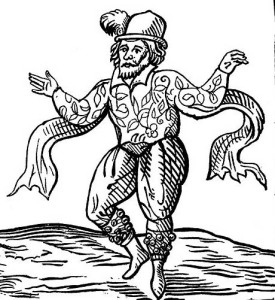
Kemp/Falstaff, the Globe, end of the War of the Roses Cycle

Shapiro says that as far back 1596, Shakespeare was trying to finish Henry the Fifth, which he had been thinking about for several years.
The scars of revision that Henry the Fifth bear—inconsistencies, locales that are specified then altered, characters that are introduced and then mysteriously disappear, repetitions that seem to be ghostly remnants of earlier drafts—testify to the extent to which Shakespeare’s conception of the play kept changing…As Shakespeare’s melancholy epilogue to Henry the Fifth acknowledges—with its backward glance at a decade’s worth of history plays with which he had entertained Shoreditch audiences—Henry the Fifth marked the end of one stage of his career and the unchartered beginning of another. (p. 20)


When the Chamberlain’s Men performed HIV, p2 at the Curtain, the play closes with an epilogue spoken by Will Kemp, that transitioned neatly into and referenced the bawdy jig that typically closed all Elizabethean plays, comedies as well as tragedies. In the original epilogue, “our humble author” promises to “continue the story.” According to Shapiro, this is the only time that Shakespeare ever shares with his audience what he planned to write next. However, when the Chamberlain’s Men were invited to perform that play at court, Shakespeare revised the epilogue because plays at court could not end with ribald jigs. In the revised epilogue, Shakepeare delivered his own words and in them makes no mention of what his next play will be about and no promise that Kemp will return as Falstaff. Most importantly, he suggests that “playwright and playgoers are bound in a partnership, sharers in a venture.” At this point, Shakespeare and most of the Chamberlain’s Men were building a new theatre of their own, the Globe, and his next play, the one he was currently working on when he wrote and delivered the revised epilogue, was Henry the Fifth, which does not include Falstaff directly (i.e., his death scene is described), Will Kemp in another role, or the typical closing bawdy jig. Shapiro suggests that Shakespeare in this revised epilogue to HIV,p2 prepares his audience for the new course that Henry the Fifth will set him and them (i.e., the playgoing public) on.


As an aside, HIV,p2 was published in 1601, two years after it was first performed, and this publication contains both epilogues. However, the printer left a bit of space between the court (aka Whitehall revised version) and the original Curtain version, indicating that he was aware that there were two separate epilogues. The 1623 folio also includes both versions but without the space between, melding them into a single epilogue. According to Shapiro, “modern-day editors, who ought to know better, have followed suit, leaving the confusion intact and obscuring why and how Shakespeare redirects his art at this time.” (p.36)

“Since at least the eighteenth century, critics have struggled to make sense of Shakespeare’s change of heart about Falstaff. Why would he abandon one of his great creations—especially after promising that we’d see Falstaff again?” Shapiro answers this by saying that
Shakespeare’s decision had nothing to do with character or plot but rather with Kemp and clowning. The parting of the ways between Shakespeare and Kemp—ironically if unintentionally mirrored in Hal’s icy repudiation of Falstaff—was a rejection not only of a certain kind of comedy but also a declaration that from here on in, it was going to be a playwright’s and not an actor’s theater, no matter how popular the actor. (p.37)


Given Shakespeare’s finely tuned poetic and ironic sensibilities, I can’t imagine that Hal’s rejection of Falstaff mirroring his own rejection of Kemp was lost on him. In fact, his rejection of Kemp might have inspired him to develop the rejection theme in HV, though in HIV,p2 (2.1.208-17), Prince Hal does tell the audience of his masterplan to come out and shine…does this mean that Shakespeare planned this breaking with Kemp as long ago as the writing of HIV,p2?

Ireland, the Death of Edmund Spenser, and the Earl of Essex

In 1598, Elizabeth sent a force to Ireland to subdue the latest uprising. B ecause she was tight with money and relied on conscripted forces instead of a regular (aka paid) army or mercenaries. The English were soundly beaten at the Battle of Blackwater, and the Earl of Essex (a young, brash, handsome, arrogant favorite/lover of the queen) was raising troops to return for vengeance. Shakespeare’s Henry the Fifth reflects many of the issues surrounding this proposed Irish expedition, including the morality of invading another country, the injustices and corruption associated with conscripting an army (also shown in HIV, p2), and the dangers of a military man being so successful that his ambitions are fueled to the point of insurrection, a theme that Shakespeare would fully explore in his next play, Julius Caesar.

Edmund Spenser was a marked contrast to Shakespeare—he totally embraced the role of poet to a patron, and was rewarded with lands in Ireland, which he lost during the 1598 uprising by the Irish against their English overlords. Shakespeare, while he allowed some patronage, pursued his own path as playwright within a group of players, rising to an ownership position of the troupe as well as the theater itself (i.e., the Globe that was currently under construction)—with his proceeds, he bought lands and a house in his hometown in the very English Stratford-upon-Avon. Spenser died unexpectedly in January, 1599 at the age of 46, and was interred at Westminster Abbey. Poets carried his hearse, and poems, instead of flowers, were tossed into his grave. According to Shapiro, “It’s unlikely that many of London’s writers would have missed the occasion…” to pen a poem in praise of Spenser but he asserts that Shakespeare probably did as he “had a strong aversion to heaping praise on the work of the living or the dead.” P. 70 Shapiro imagines that Shakespeare, who probably would have attended the funeral, might have wandered into the Chantry Chapel where HV and the remains of his wife, Queen Katherine, are buried, which is near where Spenser was being interred. Given that he is currently completing his play on HV, this seems more than likely. “Like Spenser, Henry V, who died at age thirty-five—Shakespeare’s current age—had not lived to fulfill his great promise.” In HVI, p1, written about ten years earlier, Shakespeare had staged HV’s funeral, in which mourners compare him to Julius Caesar. Now that Shakespeare was finally finishing HV itself, it seems more than coincidence that he produced JC next and that the two became even more an artistic extension of each other.

On February 20, Shakespeare and the rest of the Chamberlain’s Men performed in Richmond, and Shapiro speculates that Shakespeare most likely would have stayed in Richmond to hear a sermon ushering in Lent that was delivered by Lancelot Andrewes, “arguably England’s greatest preacher in an age notable for its oratory. For Shakespeare that morning in court would offer a chance to hear and study a remarkable performer.” (p.77) The title of Andrewes’s sermon was Preached before Queen Elizabeth at Richmond, On the 21st of February, A.D. 1599, being Ash Wednesday, at What Time the Earl of Essex was Going Forth, upon the Expedition for Ireland.

When scholars talk about the sources of Shakespeare’s plays, they almost always mean printed books like Raphael Holinshed’s Chronicles…But Shakespeare’s was an aural culture…Lost to us are the unrecorded sounds reverberating around him—street cries of vendors, church bells, regional and foreign accents, scraps of overheard conversations, and countless bits of speech and noise…Some of these made their way into Shakespeare’s writing…Only a tiny percentage of Elizabethan sermons were committed to print, so it’s a stroke of luck that Andrewes’s war sermon was one of them, for the evidence suggests that elements of it inspired (or uncannily paralleled) the play that Shakespeare was now completing. (p. 81)


It’s worth reading Shapiro’s analysis of the speech alongside HV’s St. Crispian’s Day speech in both style—the “thumping reiteration of ‘this time’ and ‘this day’”—and in the arguments that justify an “aggressive offensive war.” According to Shapiro, Ireland “haunts Shakespeare’s play….” and “seeps into the play at the most unexpected and even unintended moments.” (p. 88)

In fact, in the final act, Shakespeare speaks overtly and not in illusion to the imminent Irish campaign. Interestingly, this speech (Chorus, 5.0.22-35) also includes a reference to Caesar. “As we shift perspective from Henry’s triumphant return to Julius Caesar’s to Essex’s, then back to Henry’s, much gets blurred…” and is disquieting. (p. 89)

Back to the critics’ dismissal of HV as an important play. According to Shapiro, “Those seeking to pinpoint Shakespeare’s political views in Henry the Fifth will always be disappointed…” (p. 91) because “what they overlook is that all the debate about the war is the real story.” (p. 92) “Conquest, national identity, and mixed origins—the obsessive concerns of Elizabethan Irish policy—run deep through Henry the Fifth and sharply distinguish it from previous English accounts of Henry’s reign.” (p. 98)

Perhaps this is what I personally love about HV, now that I’ve read about it in context, it demonstrates in microcosm the genius of Shakespeare in taking a schoolboy’s story and adding depth and breadth and relevance to it both for his own contemporary audience and for those that followed. For that, I can forgive lapses in continuity.

Friday, May 22, 2009

1599: A Year in the Life of William Shakespeare


I finally got started on A Year in the Life of William Shakespeare: 1599 (P.S.), which I learned about from Nick Hornby. It is as terrific as I had hoped. I love the premise--instead of doing a traditional birth-to-death bio, author James Shapiro, examines Shakespeare's life and works indepth during the course of one critical year, 1599. He explores not only what Shakespeare himself was up to (and this was arguably the most important year in his career), but also the weather, what people were eating, discusssing, the current political situation, what preachers were preaching about, etc. Shapiro puts Shakespeare in context, which is probably the most important task in analyzing a life and works.

So what was Shakespeare up to in 1599? Well, he wrote Henry V, Julius Caesar, and As You Like It, and drafted Hamlet. And that was in his spare time at night, when he wasn't acting, directing, and generally managing the business affairs of his acting troupe. For all of those people who worry about what Shakespeare was doing in London away from his wife, it looks like he was working. There's an old saw that success is 10% talent and 90% hard work. I won't discount the genius that was Shakespeare, but he did work hard.

Now on to the really interesting notion that Shapiro leads with:
...cradle to grave biographers of Shakespeare tend to assume that what makes people who they are now, made people who they were then. Historians of sixteenth century England are not so sure. Because almost no one thought to write a memoir or keep a diary in Shakespeare's day...we don't know whether their emotional lives were like ours.

Their formative years certainly weren't. Strangers breast-fed infants, and babies were often swaddled for their first year. Childhood was brief, and most adolescents, rich and poor, were sent from home to live and serve in other households. Plague, death in childbirth, harvest failures, and high infant mortality rates may have diminished the intensity of family bonds...

Even constants such as love and marriage weren't the same...the meaning of key concepts, like what constitutes an "individual," was different....Given that this was an age of faith, or at the least, one in which church attendance was mandatory, religion, too, played a greater role in shaping how life, death, and the afterlife were imagined.

All this suggests that as much as we might want Shakespeare to have been like us, he wasn't. Conventional biographies of Shakespeare are necessary fictions that will always be with us--less for what they tell us about Shakespeare's life than for what they reveal about our fantasies of who we want Shakespeare to be.


This got me to thinking about other biographies--certainly most writers are not as illusive as Shakespeare, but how far back can we go before we can say that we really cannot understand an author because the worlds that we inhabit are just too different?

I would go so far as to say that, to paraphrase Shapiro, conventional biographies are necessary fictions--less for what they tell us about another's life than for what they reveal about our fantasies of who we want to be. Maybe this is why we read in general--reading for self-knowledge transcends reading bios.

Friday, April 10, 2009

Shakespeare Wrote for Money...according to Nick Hornby

Trolling my favorite blogs for airplane reading a few weeks ago, I pounced on a title that appealed to me on every level, Nick Hornby's Shakespeare Wrote for Money. I added it to my Amazon wish list and without really checking it out, I blithely spent my hard-earned Borders Bucks on it just before leaving for the airport last weekend.

Imagine my disappointment when I discovered that it was a collection of Hornby's columns in the Believer on what he read each month between August 06 and September 08. Not that the columns aren't interesting in and of themselves, and since this is my first taste of Hornby, though I did like the movie version of About a Boy (Full Screen Edition), it's not a complete loss. But, I wanted to read about Shakespeare!

Hornby got the book's title from his April 07 column in which he included notes about James Shapiro's A Year in the Life of William Shakespeare: 1599 (P.S.)
so I did get about a page of some Shakespeare discussion, mostly comparing it to Claire Tomalin's bio of Thomas Hardy.


Here's what Hornby had to say about Shapiro's book:
It's a brilliant book, riveting, illuminating, and original...full of stuff with which you want to amaze, enlighten, and educate your friends. 1599 was the year Shakespeare polished off Henry V, wrote As You Like It and Julius Caesar, and drafted Hamlet....Both Julius Caesar and Henry V are shown to be more about England's conflict with Ireland than we had any hope of understanding without Shapiro's expert illumination...The only thing you have to care about to love this book is how and why things get written. The "why" is relatively straightforward: Shakespeare wrote for money. He had a wife, a new theater, and a large theater company to support...the "how is more illusive...


I don't mean to 'dis Hornby, but the 1599 book is the one I really want to read. It's on my Amazon list and I may have to buy it before I've accumulated any more Borders Bucks.

An aside, having read a lot of Bill Bryson and none (up to now) of Nick Hornby, in his column on reading anyway, Hornby's voice sounds remarkably similar to Bryson's.