Showing posts with label Wives and Daughters. Show all posts

Sunday, May 10, 2009

Wives and Daughters - fairy tales, gossip, and other stories


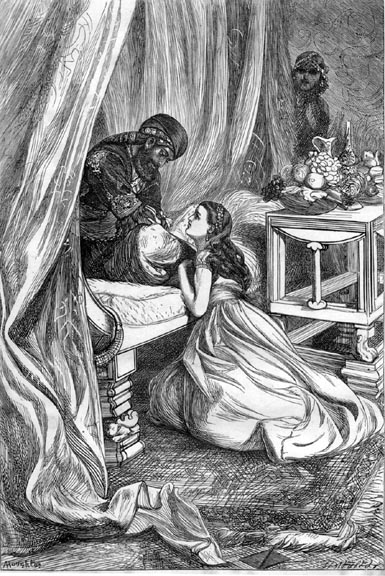
The Sultan Pardons Scheherazade, Arthur Boyd Houghton (1836-1875)


I finished W&D this evening, having two plane rides over the past three days in which to focus on reading it. I cried during the last chapter, not just for the story but knowing these were the last words of her work that Gaskell wrote.

During the last several chapters I found several more references to fairy tales that I earmarked.

* Chapter 51 "Troubles Never Come Alone" - after Mr and Mrs Gibson have discovered that Cynthia was behind Molly's secret meetings with Mr Preston, and Mrs G, Cynthia, and Molly are all sitting silently..."Molly grew to fancy it was some old enchantment that weighed upon their tongues and kept them still."

* "Out With the Old Love and On with The New" - Cynthia refers to a story when she is telling Molly that what she feels for Mr Henderson really must be love
'...sometimes I really was so unhappy, I thought I must put an iron-band round my heart to keep it from breaking, like the Faithful John of the German story,--do you remember Molly?--how when his master came to his crown and his fortune, and his lady-love, after innumerable trials and disgraces, and was driving away from the church where he'd been married in a coach and six, with Faithful John behind, the happy couple heard three great cracks in succession, and on inquiring, they were the iron-bands round his heart, that Faithful John had worn all during the time of his master's tribulation, to keep it from breaking.'


I have to say that I like Cynthia so much better on this reading than the first time I read it. Then, I kept on expecting her to be a hardened rival to Molly, sort of in the Caroline Bingley way, and she isn't. She is honest regarding her shallowness, which is why I can like her and still despise her mother. Of course, the jealousy of the mother for the daughter makes Mrs G completely beyond the pale, even if her pretentions weren't so annoying.

* When Lady Harriet is talking with her brother, Lord Hollingford in chapter 58, "Reviving Hopes and Brightening Prospects," about the possibility of her favorite, Molly Gibson, being loved by his favorite, Roger Hamley, she reminds him of
'...the Charity Ball; you called her 'unusually intelligent" after you had danced with her there. But after all we are like the genie and the fairy in the Arabian Nights' Entertainment, who each cried up the merits of the Prince Caramalzaman and the Princess Badoura.'


Lady Harriet is one of my absolute favorite characters in the book, and I wonder if she would have inspired Gaskell to tell her story in another novel...had she lived. I can't help but feel that she does have an interesting story of her own--her relationship with her mother and brother is fascinating and her affection for and ability to be influenced by Molly is remarkable. I can't think of another character who shares what I consider to be her very modern qualities--she wouldn't be at all out of place in a Roaring Twenties novel. There's a bit of Flora Poste (Cold Comfort Farm) in Lady Harriet.

With regards to the fairy tale references, I don't have a thesis around Gaskell's frequent references apart from just stating that they add a layer of richness to the main storytelling. And Gaskell was a lover of stories--her plots often turn on gossip and its affects. Interestingly, Dickens once called Gaskell his Scheherazade.


* Finally, in chapter 59, "Molly Gibson at Hamley Hall," when Molly is agonizing over Mrs. Goodenough's speculation that Mrs G is sending Molly over to Hamley Hall in order to catch a husband,
...The more she bade these fancies begone the more they answered her (as Daniel O'Rourke did the man in the moon, when he bade Dan get off his seat on the sickle, and go into empty space), 'The more ye ask us the more we won't stir.'


Gaskell did have so much to say, in her stories and through her characters and in her letters. She was a keen observer of the human condition and the human psyche and the frailties and strengths that are born out of love, ambition, opportunity, and grace.

I think my favorite line, and what I think might be the definitive Gaskell line, is from Chapter 47, "Scandal and Its Victims," in which Miss Browning, another absolutely wonderful character, says
'...don't repeat evil on any authority unless you can do some good by speaking about it...I'm not a good woman, but I know what is good, and that advice is.'


Thinking back to her earliest works, Elizabeth Gaskell used her ability to tell stories and to write well as a way of doing good in the world. Along with Dickens, she wrote 'social problem' novels that were intended to educate her peers about the plight of the working poor, the disenfranchised, the lost.

As she progressed as a novelist, her stories became more complex, deeper, and richer. No longer merely parables, at the end of her life, in her final work, she was still practicing what she had Miss Browning preach--telling her stories, some aspects of which were painful (Mrs Gibson's shallow, jealous, narrow life, the sorrow that Squire Hamley and Osborne inflicted on each other, etc.), was her wonderful, admirable way of doing good in the world.

Wednesday, May 06, 2009

Wives and Daughters: Mr. Preston


I love this description of Robert Preston that Cynthia gives in chapter 43, "Cynthia's Confession":
...for he is cruel in his very soul--tigerish, with his beautiful striped skin and relentless heart.


This captures perfectly his power over Cynthia.

I can't help but wonder about his relationship with Mrs. G--he clearly disappointed her greatly by moving his attentions from her to her daughter while they were still at Ashcombe. Her response to him whenever she sees him, though, has an air of guilt about it that makes me think she allowed him more liberties, to put it delicately, than would have been proper. Just as Cynthia carries the secret of her engagement to him through most of the book, Hyacinth carries the guilt of her prior, perhaps intimate, relationship with him into Hollingford and into her marriage with Mr Gibson.

I noticed that both Miss Browning and Lady Harriet, when facing the fact that Molly was seen meeting privately with Mr. Preston, declare that they will personally go to church and "forbid the banns" to prevent Molly from marrying Mr. P. The mark of a true friend, indeed!


Wednesday, April 29, 2009

Wives and Daughters: thoughts on earmarked pages


Another George du Maurier illustration for the Wives and Daughters, The Cornhill, 1864.


From Chapter 34, "A Lover's Mistake"
Molly chose a walk that had been a favourite with her ever since she was a child. Something or other had happened just before she left home that made her begin wondering how far it was right for the sake of domestic peace to pass over without comment the little deviations from right that people perceive in those whom they live with. Or, whether, as they are placed in families for distinct purposes, not by chance merely, there are not duties involved in this aspect of their lot in life, - whether by continually passing over failings, their own standard is not lowered, - the practical application of these thoughts being a dismal sort of perplexity on Molly's part as to whether her father was quite aware of her stepmother's perpetual lapses from truth; and whether his blindness was wilful or not.


From reading Uglow's bio of Gaskell, it seems that she herself sometimes fictionalized her own view of circumstances. I truly wonder how much of Mrs. Gibson is self-portrait. That's a bit harsh to say, because I dislike Mrs Gibson very much and I like Elizabeth Gaskell very much as an author and as a person, though she was tempermental, flighty, and sometimes absolutely insensitive to the needs and feelings of her daughters.

If there's a bit of Mrs. Gaskell in Mrs. Gibson, I wonder whether there's also a bit of her daughter Flossie in Cynthia.

Also from "A Lover's Mistake"...
Mrs Gibson was pouring out, unheard and unheeded, words of farewell; Cynthia was rearranging some flowers in a vase on the table, the defects in which had caught her artistic eye, without the consciousness penetrating to her mind. Molly stood, numb to the heart; neither glad nor sorry, nor anything but stunned. She felt the slackened touch of the warm grasping hand; she looked up - for till now her eyes had been downcast, as if there were heavy weights to their lids - and the place was empty where he had been ; his quick step was heard on the stair, the front door was opened and shut; and then as quick as lightning Molly ran up to the front attic - the lumber-room, whose window commanded the street down which he must pass. The window-clasp was unused and stiff, Molly tugged at it - unless it was open, and her head put out, that last chance would be gone.


I love this passage and consider it one of the best Elizabeth Gaskell ever wrote--it is very Persuasion-like in its depiction of the heat and chaos within Molly, as contrasted to the superficiality of Mrs Gibson and the cold passivity of Cynthia--it reminds me of Anne Eliot seeing Captain Wentworth again while all those around her are unaware of the turmoil within.

Saturday, April 25, 2009

Gaskell and Mr. Gibson: Feet of Clay

I can't tell you how disappointed I was to read this passage (Chapter 35, "The Mother's Manoeuvre,") in which Mr. Gibson has just told Squire Hamley of Roger and Cynthia's engagement. Mr. Gibson is encouraging the squire to stop by his house to meet Cynthia, whom he refers to as "your son's future wife":

'Roger's "future wife!" - He'll be wiser by the time he comes home. Two years among the black folk will have put more sense in him.'

'Possible, but not probable, I should say,' replied Mr Gibson. 'Black folk are not remarkable for their powers of reasoning, I believe, so that they have not much chance of altering his opinion by argument, even if they understood each other's language; and certainly if he shares my taste, their peculiarity of complexion will only make him appreciate white skins the more.'


In no other works of Gaskells is there any hint, that I recall, of prejudice, racial or otherwise on her part. But this passage is there, and Mr. Gibson, although he has his failings, is portrayed as a thoroughly upright, honorable man. If Gaskell puts these words in his mouth, is he speaking for her?

With her deep Unitarian ties and her desire to affect social change through her writing, I can't help but wonder why she had Mr. Gibson, an overall sympathetic character, say such a thing.

The chapter closes with another psychological portrait of Mrs. Gibson in which the narrator labels her as "amiably callous." I think it is a wonderful description of Mrs. G (aka Hyacinth, Clare, Mrs. Kirkpatrick). I hope it is not also an accurate description of Gaskell.

Wednesday, April 22, 2009

Wives and Daughters - Remembrance of things past


A George du Maurier illustration for Wives and Daughters
when it was published in "The Cornhill" in 1865. From Project Gutenberg

Chapter 23 - "Osborne Hamley Reviews His Position"
I earmarked the two pages containing Osborne musing over the vagaries of life...
'...If -- how I hate "ifs." "If me no ifs." My life has been based on "whens;" and first they have turned to "ifs," and then they have vanished away. It was "when Osborne gets honours," and then "if Osborne," and then a failure altogether. I said to Aimée, "When my mother sees you," and now it is "If my father saw her," with a very faint prospect of its ever coming to pass'

I can't forget that this is Gaskell's final work--she died when she was almost finished writing it. These words are poignant coming from Osborne, and heartbreaking coming from Gaskell. I disputed awhile ago the assertion that she had a premonition of her own death based on a letter that recently came to light in which she declared she wouldn't live out the year. I'm not changing my mind, but there are many passages within W&D that are imbued with the sense that time is slipping away before dreams are realized.

Later in the same chapter, I earmarked this passage for the same reason as that above. Squire Hamley is talking with Roger after his wife has died...
'...I used to be reckoned a good master, but that is past now! Osborne was once a little boy, and she was once alive -- and I was once a good master -- a good master -- yes! It is all past now.'


I've also been struck by the richness of Gaskell's prose. Much as I loved North and South, some passages are downright clunky. W&D is truly Gaskell's masterpiece. I often lament and wonder at the obscurity into which she has, until recently, fallen. Had she lived and continued to write at the caliber of W&D...but now I'm starting to sound like Osborne. Here's a passage I marked as characteristic of her prose in W&D, from Chapter 31, "A Passive Coquette" in which Mr. Gibson is thinking about his step-daughter Cynthia.
'She is in a mental fever of some kind,' thought he to himself. 'She is very fascinating, but I don't quite understand her.' If Molly had not been so entirely loyal to her friend, she might have thought this constant brilliancy a little tiresome when brought into every-day life; it was not the sunshiny rest of a placid lake, it was rather the glitter of the pieces of a broken mirror, which confuses and bewilders, Cynthia would not talk quietly about anything now; subjects of thought or conversation seemed to have lost their relative value. There were exceptions to this mood of hers, when she sank into deep fits of silence, that would have been gloomy had it not been for the never varying sweetness of her temper. If there was a little kindness to be done to either Mr Gibson or Molly, Cynthia was just as ready as ever to do it; nor did she refuse to do anything her mother wished, however, fidgety might be the humour that prompted the wish. But in this latter case Cynthia's eyes were not quickened by her heart.

The psychological insight and instinct of this passage--both the words of Mr Gibson's and that of the narrator--regarding Cynthia just blow me away. The fever, the mood swings, the eyes (mirroring the soul, remember)--this passage shows Gaskell to be a keen observer (she had four daughters of her own, plus many close female friends) and a compassionate portrait painter. Much as Cynthia frustrates me, I feel for the girl.

Thursday, April 16, 2009

Wives and Daughters: P&P - The Gibsons and the Bennets

I meant to make this posting on W&D about the passive aggressiveness of both Mr. and Mrs. Gibson (don't you just "love" how Mr. Gibson guilts Molly into doing/saying/feeling what he wants her to by withdrawing his affections and presence...see conversation about Molly calling Clare/Hyacinth "Mamma" in chapter 15) and also about the lack of expression the narrator notes in both Mrs. Gibson's and Cynthia's eyes, whilst cleverly observing that this was the era during which the eyes were universally recognized as being the windows to the soul...but no matter.

I read chapter 24 tonight and since I know P&P chapter/verse I couldn't help but being struck by this passage:
and to those whom he liked Mr Gibson could be remarkably agreeable.


And who does that sound like if not Mr. Bennet?

Cynthia and Molly looked their best, which was all the duty Mrs Gibson absolutely required of them, as she was willing enough to take her full share in the conversation.


And who does not insist on her share of the conversation if not Lady Catherine de Bourgh?

'Cynthia is not a dunce either,' said Mrs Gibson, afraid lest her daughter's opinion of herself might be taken seriously. 'But I have always observed that some people have a talent for one thing and some for another. Now Cynthia's talents are not for science and the severer studies. Do you remember, love, what trouble I had to teach you the use of the globes?'

'Yes; and I don't know longitude from latitude now; and I'm always puzzled as to which is perpendicular and which is horizontal.'

'Yet, I do assure you,' her mother continued, rather addressing herself to Osborne 'that her memory for poetry is prodigious. I have heard her repeat the "Prisoner of Chillon" from beginning to end.'

'It would be rather a bore to have to hear her, I think,' said Mr Gibson, smiling at Cynthia, who gave him back one of her bright looks of mutual understanding.


And this whole passage reminded me strongly of Elizabeth deflecting Mrs. Bennet while they were visiting Netherfield when Jane was sick--not so much in content but in tone and even cadence.

I imagine that I am making too much of this, and that as a Janeite, I see Austen's influence everywhere, but I have to wonder whether consciously or unconsciously, Mr. and Mrs. Bennet were in Gaskell's mind when she was forming Mr. and Mrs. Gibson. Mrs G. certainly has the same matchmaking tendencies as Mrs. B., and her husband is forced to retreat into his shell to escape from her silliness.

Final note today - I noticed a discrepancy in the conversation cited above.

In my Penguin Classics edition, Cynthia says "I don't know longitude from altitude," whereas the online source that I cut and pasted from says "I don't know longitude from latitude..."

I prefer 'altitude' to 'latitude' because it's funnier (and Cynthia playing at Mrs. Malaprop is funny!). I do think Cynthia has a better sense of humor than I originally gave her credit for, but I wonder which is what Gaskell actually wrote. Perhaps Jenny Uglow will mention this in the bio--I'm not reading her analysis of W&D until I finish the book. Of course, regardless of what Gaskell wrote, critics will debate what she meant because she regularly made mistakes with chronology and geography and had a hard time keeping straight what she called various characters. All part of her charm, in my opinion.

Friday, April 03, 2009

Fate is a cunning hussy...more W&D

Ever since I read Gaskell's bizarre story, Curious if True, I have been noticing her very frequent references to fairy tales and folk lore in her stories.

In chapter 5 of Wives and Daughters, "Calf Love," Mr. Gibson decides to send Molly to Hamley Hall and he explains his intentions to her by saying that
'There are three old ladies sitting somewhere, and thinking about you just at this very minute; one has a distaff in her hands, and is spinning a thread; she has come to a knot in it, and is puzzled what to do with it. Her sister has a great pair of scissors in her hands, and wants--as she always does, when any difficulty arises in the smoothness of the thread--to cut it off short; but the third, who has the most head of the three, plans how to undo the knot; and she it is who has decided that you are to go to Hamley...as the Fates have decreed that this visit is to be paid, there is nothing left for you and me but to submit.'


Molly correctly labels this nonsense, though, of course, she acquiesces. However, Gaskell has picked the right metaphor for showing the blindness and willful folly of Mr. Gibson. A difficulty has arisen in Mr. Gibson's smooth life--his daughter is becoming that most dangerous of all beings, an attractive woman--he thinks he is being clever and solving the problem of her sexuality by locking her in a tower (i.e., Hamley Hall), but with this action he is simply seizing the scissors and attempting to cut the knot instead of acknowledging that maybe the knot isn't an obstacle but an affirmation of life.

Chapter 7's opening paragraph picks up this theme again, with the lovely observation that "fate is a cunning hussy." Mr. Gibson recklessly tempted fate by attributing his desperate response to the fear of Molly's maturity to the Fates, but he had no idea what that 'cunning hussy' had in store for him. So much for hubris.

Tuesday, March 31, 2009

Wives and Daughters...the beginning of the end


I just got back from a spring break trip to NYC and Cooperstown (for the Baseball Hall of Fame), which is why I haven't posted in awhile. Both were wonderful--we got to see Lauren Graham as Miss Adelaide in Guys and Dolls, and we got to see all the baseball greats from the ages immortalized in what comes down to a shrine to a great game. I especially enjoyed visiting the exhibit on the All-American Girls Professional Baseball League and seeing the photos of the women we learned about in A League of Their Own
.

On the reading front, I finally started rereading WIVES AND DAUGHTERS: An Everyday Story
to close out my end-to-end reading of Elizabeth Gaskell. I won't claim to have read every word she has written, but I have now read all the novels and novellas and most of the short stories and a few of the non-fiction pieces.

Wives and Daughters is undoubtedly her masterpiece. While I love North and South, Gaskell is a much more accomplished writer at the end of her life. It's been fascinating reading her end-to-end and to watch her grow in her use of language and her control of her characters. I'm only up to chapter 6 where Molly first visits Hamley Hall, but I'm already mesmerized by the gently rocking motion of the text. I can't help but feel sad at the huge change that Dr. Gibson is going to inflict on his life and that of his daughter by his misguided attempt to keep his bird in her cage.

I was reading W&D on the plane home sitting next to my own 16-year old daughter, fresh from the sights and sounds (not to mention the smells and sensations) of Manhattan and I thought about the huge difference that 150 years has made in the lives of young women. Much as I love studying history and reading Victorian literature, I am so glad to have the opportunity to live my life now and not then.

Wednesday, February 18, 2009

Ironic reversal....comedy, tragedy and Austen

I'm just about to start rereading Gaskell's last, unfinished novel, Wives and Daughters (Penguin Classics), and so last night started the Introduction in my Penguin Classics version by Pam Norris. In this Introduction, Norris presents a completely wonderful idea that delineates W&D from Middlemarch, another one of my favorite novels.

Both novels turn on what Norris terms "ironic reversals." For example, in W&D "Osborne Hamley's plan to reconcile his father to his secret marriage is, in the event, effected by his untimely death, not by literary immortaility as he had dreamed. This ironic reversal is deeply sad, but on the whole the persistent upsetting of human scheming imbues the novel with an optimistic spirit of comic regeneration...This makes a striking contrast to George Eliot's Middlemarch, in which the determining minutiae of social mischances imperceptibly bear down with tragic force upon human hopes and aspirations. In Wives and Daughters many seemingly arbitrary circumstances form the chain of cause and effect that lead Mr Gibson into his ill-judged proposal, but the resulting marriage is represented by Gaskell in a predominantly comic light of human fraility, compromise and self-deceptions. The result is survival not destruction."

Many lovers of Austen's novels have found another author to love in Gaskell, particularly W&D, which many say is closest to Austen. And in this aspect of ironic reversals leading to a comedic world view rather than a tragic one, I have to wonder whether this might be the nugget in Gaskell that grabs Janeites and holds them fast.

Sunday, January 18, 2009

Cousin Phillis - Tragedy Averted


If you haven't read Gaskell's Cousin Phillis yet, be forewarned that this post contains spoilers. However, if you're like me, you might enjoy the book more knowing that none of the major characters dies. In fact, offhand, I can't think of a single death in the novella, which must make this unique among Gaskell's works!

Not that there isn't a life-threatening illness and plenty of opportunities for Gaskell to wrench hearts again, but this time she merely settled for merely putting the reader through the wringer waiting for the axe to fall.

I'm being flip, but I think that Cousin Phillis does mark a maturing style on Gaskell's part that culminates in Wives and Daughters. Speaking of Wives and Daughters, Ebenezer Holman, Phillis's father, foreshadows Dr. Gibson in his relationship with his daughter. They are close, they are alike in interests and temperament, and he panics when he realizes that his daughter is no longer a little girl but a marriageable woman.

I also enjoyed contrasting Cousin Phillis with Sylvia's Lovers. As I mentioned in the previous post on this work, she's telling the same basic story twice but exploring different ways in which the relationships and the character of the young woman can change and grow and evolve.
Unlike Sylvia's Lovers, I love the way this story closes. Betty, the family's kitchen servant, tells Paul, the narrator, about the speech she delivered to Phillis, who was taking too long to recover from the fever that set in after her heart was broken by the faithlessness of her erstwhile lover:

'Now, Phillis!' said she, coming up to the sofa; 'we ha' done a'we can for you, and th' doctors has done a' they can for you, and I think the Lord has done a' He can for you, and more than you deserve, too, if you don't do something for yourself. If I were you, I'd rise up and snuff the moon, sooner than break your father's and your mother's hearts wi' watching and waiting till it pleases you to fight your Own way back to cheerfulness. There, I never favoured long preachings, and I've said my say.'


We all should have a Betty in our lives to tell us to fight our own way back to cheerfulness and not to break the hearts of those who love us with our melancholy. It's worth saying that Phillis takes Betty's words to heart and takes charge of her own fight and rallies. You go, girl!

In a nutshell, here is what Gaskell is saying in Cousin Phillis: we can't control what others do--if a lover leaves before he even proposes, if he marries someone else instead of returning home to us--but we can control how we respond to it.

Monday, December 29, 2008

Elizabeth Gaskell's Resurrection


Last week I read a marvelous paper in the latest Gaskell Society Journal entitled "Elizabeth Gaskell's Legacy from Romanticism," by John Beers. It provided yet more detailed examples on how Gaskell was a writer of the first order when it came to layering meaning upon meaning by showing her use of and illusion to the Romantic poets, especially Wordsworth and Coleridge.

But, that's not what I want to write about today. What I want to write about today is a 2006 article in The Times OnLine that Beers refers to frequently in his paper--it is Heather Glen's article, Elizabeth Gaskell's resurrection.

Glen addresses head-on the issue that has been troubling me for some time now. Why did I never encounter Gaskell before a few years ago? Glen answers that Gaskell "was the victim of various kinds of condenscension" and was denigrated to secondary status by critics who never were able to see beyond her surface "sympathy."

The article is actually a review of a 10-volume complete works, edited by Joanne Shattock, et al. In the article, Glen shows the books as divided into two parts (five volumes in each part, and each part costing £450). I found a five-volume set on Amazon for $671--this looks to be one of the two parts, but the listing doesn't specify which parts are included.

This is all rather academic as I can't afford the set, partial though it is, and enticing as it is. This edition, according to Glen, provides the "first comprehensive critical and textual edition" of all Gaskell's known works and records "variants scrupulously" and contextualizes "the works it presents by providing explanatory footnotes and a clear account of the production and reception of each text." While I have been enjoying Uglow's bio of Gaskell immensely whilst reading Gaskell's works in order, it provides just a bit on the production and reception of the works, an area that I would love to explore further.

Glen then goes on to analyze the opening scene in Mary Barton in terms of her use of Wordworth's Lucy poem, the politics of 1847 and the implications buried in her use of specific words and phrases such as "republican" and "holiday." This is fascinating stuff!

Glen talks about Gaskell's "intelligent disinterestedness...that attentiveness and responsiveness to the multifacetedness of reality that Michael Wood has called 'the kindess of novels' and that Gaskell's contemporaries described, in a term too easily confused with sentimentalism, as 'sympathy.'"

This is one of the aspects that I love about Gaskell--her ability to see all sides of an argument, and respect the different points of view and the different paths that brought individuals to where they are in the story.

I especially appreciated Glen's discussion of Ruskin's Modern Painters III. Ever since I read in Uglow's bio that this was one of Gaskell's favorite books, I have wondered why she loved it so much. What did it say to her that resonated? According to Glen, Ruskin's theory on the "'mighty pictorial fusion' to be made out of the multifariousness of a faithfully registered reality" fascinated Gaskell, who strived to "write truthfully."

Finally, I cannot wait to reread Wives and Daughters, and enjoy for myself the "rhythmic repetition" and invocation of nursery rhyme in the novel's opening. This, according to Glen, demonstrates Gaskell's "artfulness of her seemingly artless method." In the end, I think that is why Gaskell was considered second rate for so long--she made it look too easy.

Wednesday, December 03, 2008

Reading Gaskell for the First Time?

Mary-Laure left a comment on the previous blog entry asking for a recommendation on which Gaskell to read first.

Here are my thoughts on the subject. Caveat - I haven't yet read Cousin Phillis, nor have I read ALL the short stories, but I think I've read enough to venture an opinion.

1) North and South - some people have a problem liking Margaret, but I think she is a marvelous Victorian heroine. Not as "on a pedestal" as many of Dickens' heroines, but definitely of the angel variety who stumbles from time to time. N&S is a love story, it's a social problem story, and it has a good cross section of characters, showing Gaskell's range and sympathies.

2) Cranford - her most popular novel, and her personal favorite. Based on reminiscences of her girlhood in Knutsford, it is episodic in nature, gentle in tone and humor, and sweet. Dickens loved Gaskell's Cranford stories, which he published as individual pieces before she collected them into a novel.

3) Wives and Daughters - I think of this as Gaskell's masterpiece, but, tragically, she died just before completing it. It is rich in characters that defy type, rich in detail, rural, and a thumping good read. It lacks the social problem aspect that characterized most of Gaskell's writing, especially her early writing, and drove her to sacrifice so much of her time to writing so I can't say that it is the one Gaskell to read, but it is marvelous.

4) The Grey Woman - a novella that is a wonderful Blackbead type story. If all you know about Gaskell is Cranford, the GW is something completely different.

5) My Lady Ludlow - a fascinating novella that shows Gaskell's ability to weave various stories and themes into a cohesive whole, with variations in narrative technique.

6) Sylvia's Lovers - while I never warmed to the heroine, this is a purely historical novel with all the dialogue delivered in accurate dialect. A monumental feat of historical research, inspired during Gaskell's visit to Whitby with her daughters. Based on true events.

7) The Old Nurse's Story - my favorite of Gaskell's short stories. A classic Victorian ghost story.

8) Ruth - a fascinating moral tale in which Gaskell takes the road not often taken by Victorian authors and champions the unwed mother.

Sunday, November 30, 2008

Moorland Cottage

I finished Gaskell's Moorland Cottage yesterday. The parallels to Wives and Daughters didn't totally play out with regards to the plot, but I did find more characters that seemed early sketches of the W&D crew. Mr. Buxton had some shades of Squire Hamley, and Frank Buxton really seemed a composite of Osbourne and Roger Hamley. Frank had the promise of university prizes ala Osbourne and ended up disappointing his father in his choice of wife, but with regards to character, Frank had Roger's sweetness and earnestness in full. I kept on expecting Erminia to turn out like Cynthia, but thankfully she didn't and was a loyal friend to Maggie throughout.

Gaskell took another run at the brother who is lost at sea motif--this time, though, Maggie ultimately learns the truth about Edward's disappearance. Her own brother's disappearance at sea, naturally enough, haunted so many of her stories.

The ending is Victorian melodrama at its best. I was a bit confused with how Frank came to be on the same ship as Maggie and Edward, but then Gaskell explained it after the fact. I think the story would have been much stronger if she had told us some of what Frank was up to instead of having him appear like a ghost in the burning ship to save Maggie. Confession time...I couldn't help thinking of the ending of the Titanic movie when Kate Winslet and Leonardo DiCaprio are in the water.

It's worth reading if you are studying Gaskell, want a good, sweet, typical Victorian story, or love Wives and Daughters so much that you want to see it in the prototype stage.

Tuesday, November 25, 2008

The Moorland Cottage: precursor to Wives & Daughters

I just started The Moorland Cottage, one of Gaskell's novellas, last night. She wrote it fairly early in her career, about the same time as Mary Barton. The little girl in the story, Maggie Browne, reminds me of Molly Gibson, her mother reminds me of Hyacinth Gibson in her self-centered jealousy of her daughter, Mrs. Buxton reminds me of Mrs. Hamley in her response to Maggie and her fragility, and Frank Buxton reminds me of Roger Hamley in his championing of Maggie. It will be interesting to see if Moorland Cottage really is a precursor to W&D, or if the characters early on simply remind of others that she develops later.

Monday, November 17, 2008

Mr. Harrison's Confessions - Paper on General Practioners in Victorian England

Mr. Harrison's Confessions is a sweet, funny, charming novella whose basic characters and plot line were incorporated into the BBC Cranford mini-series. Scanning the online version of The Gaskell Society Journal, I found this paper, "Mr Harrison's Confessions": A Study of the General Practitioner's Social and Professional Dis-ease in Mid-Nineteenth Century England by Marie Fitzwilliam.

The paper goes into the social and professional standing of doctors during the 19th century, and shows how Gaskell reflects a personal understanding of the profession in not only Mr. Harrison's Confessions, but also Cranford and Wives and Daughters. Her uncle, Peter Holland, was a country doctor of the kind depicted in these works.

While Fitzwilliam summarizes by saying that in the story, Gaskell shows her belief that the "science and technology of medicine must take primacy over the superficial trappings of the profession," which is an interesting way of looking at Mr. Harrison's Confessions and one that didn't occur to me whilst reading it. Certainly, I got that old Mr. Morgan's ways were ineffective as compared to young Mr. Harrison's, but I missed that part of the old ways was the slavish emphasis on form and manners...it's there, of course, but I missed it.

A good paper worth reading.