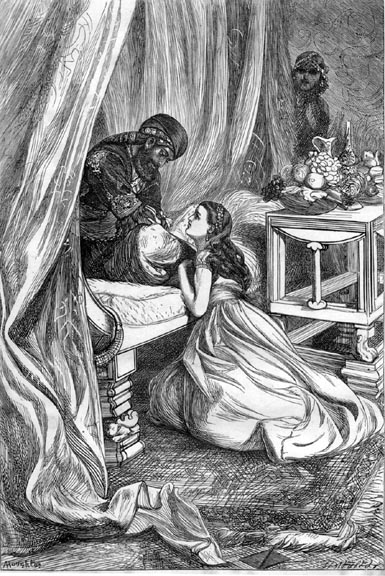
 The Sultan Pardons Scheherazade, Arthur Boyd Houghton (1836-1875)
I finished W&D this evening, having two plane rides over the past three days in which to focus on reading it. I cried during the last chapter, not just for the story but knowing these were the last words of her work that Gaskell wrote.
During the last several chapters I found several more references to fairy tales that I earmarked.
* Chapter 51 "Troubles Never Come Alone" - after Mr and Mrs Gibson have discovered that Cynthia was behind Molly's secret meetings with Mr Preston, and Mrs G, Cynthia, and Molly are all sitting silently..."Molly grew to fancy it was some old enchantment that weighed upon their tongues and kept them still."
* "Out With the Old Love and On with The New" - Cynthia refers to a story when she is telling Molly that what she feels for Mr Henderson really must be love
'...sometimes I really was so unhappy, I thought I must put an iron-band round my heart to keep it from breaking, like the Faithful John of the German story,--do you remember Molly?--how when his master came to his crown and his fortune, and his lady-love, after innumerable trials and disgraces, and was driving away from the church where he'd been married in a coach and six, with Faithful John behind, the happy couple heard three great cracks in succession, and on inquiring, they were the iron-bands round his heart, that Faithful John had worn all during the time of his master's tribulation, to keep it from breaking.'
I have to say that I like Cynthia so much better on this reading than the first time I read it. Then, I kept on expecting her to be a hardened rival to Molly, sort of in the Caroline Bingley way, and she isn't. She is honest regarding her shallowness, which is why I can like her and still despise her mother. Of course, the jealousy of the mother for the daughter makes Mrs G completely beyond the pale, even if her pretentions weren't so annoying.
* When Lady Harriet is talking with her brother, Lord Hollingford in chapter 58, "Reviving Hopes and Brightening Prospects," about the possibility of her favorite, Molly Gibson, being loved by his favorite, Roger Hamley, she reminds him of
'...the Charity Ball; you called her 'unusually intelligent" after you had danced with her there. But after all we are like the genie and the fairy in the Arabian Nights' Entertainment, who each cried up the merits of the Prince Caramalzaman and the Princess Badoura.'

Lady Harriet is one of my absolute favorite characters in the book, and I wonder if she would have inspired Gaskell to tell her story in another novel...had she lived. I can't help but feel that she does have an interesting story of her own--her relationship with her mother and brother is fascinating and her affection for and ability to be influenced by Molly is remarkable. I can't think of another character who shares what I consider to be her very modern qualities--she wouldn't be at all out of place in a Roaring Twenties novel. There's a bit of Flora Poste (
Cold Comfort Farm) in Lady Harriet.
With regards to the fairy tale references, I don't have a thesis around Gaskell's frequent references apart from just stating that they add a layer of richness to the main storytelling. And Gaskell was a lover of stories--her plots often turn on gossip and its affects. Interestingly, Dickens once called Gaskell his Scheherazade.
* Finally, in chapter 59, "Molly Gibson at Hamley Hall," when Molly is agonizing over Mrs. Goodenough's speculation that Mrs G is sending Molly over to Hamley Hall in order to catch a husband,
...The more she bade these fancies begone the more they answered her (as Daniel O'Rourke did the man in the moon, when he bade Dan get off his seat on the sickle, and go into empty space), 'The more ye ask us the more we won't stir.'
Gaskell did have so much to say, in her stories and through her characters and in her letters. She was a keen observer of the human condition and the human psyche and the frailties and strengths that are born out of love, ambition, opportunity, and grace.
I think my favorite line, and what I think might be the definitive Gaskell line, is from Chapter 47, "Scandal and Its Victims," in which Miss Browning, another absolutely wonderful character, says
'...don't repeat evil on any authority unless you can do some good by speaking about it...I'm not a good woman, but I know what is good, and that advice is.'
Thinking back to her earliest works, Elizabeth Gaskell used her ability to tell stories and to write well as a way of doing good in the world. Along with Dickens, she wrote 'social problem' novels that were intended to educate her peers about the plight of the working poor, the disenfranchised, the lost.
As she progressed as a novelist, her stories became more complex, deeper, and richer. No longer merely parables, at the end of her life, in her final work, she was still practicing what she had Miss Browning preach--telling her stories, some aspects of which were painful (Mrs Gibson's shallow, jealous, narrow life, the sorrow that Squire Hamley and Osborne inflicted on each other, etc.), was her wonderful, admirable way of doing good in the world.




 . Not only is the setting Rural and the tone Romantic, but the heroine, Hazel, is somewhat a stock character in that she is a complete Innocent, beautiful and wild. She is Marianne Dashwood's ideal in that she speaks what she feels and she feels from the heart. I'm only about a third of the way through, and Hazel has already eluded a fall from grace (i.e., the kind that Tess Durbyfield and Ruth Hilton, from Gaskell's Ruth, couldn't escape) but I fear that this will turn into a tragedy along the lines of a Hardy story rather than a triumph, like that I loved in
  also by Mary Webb.