Showing posts with label Tracy Chevalier. Show all posts

Monday, July 21, 2025

The Glassmaker - Tracy Chevalier


Author Tracy Chevalier not only never repeats herself when it comes to her historical novels, diving into drastically different time periods, locations, and characters with each novel, all that require extensive research, but with her latest, The Glassmaker, she shows a courageous, creative willingness to play with the time/space continuum.

Overwhelmingly, I prefer realism over fantasy in fiction, with just a few magical realism exceptions, so at first I struggled with what Chevalier was doing in The Glassmaker, but the end result was a triumph.

So, what does she do? The Glassmaker tells the story of Orsola Rosso, daughter of a maestro glassmaker in Murano (one of the Venetian islands) in the 1480s. Her family have been glassmakers for generations, with the craft being passed from father to son in a tightly controlled industry. We learn about Orsola's family--her brothers, her savvy mother, her baby sister, and how the family handles the untimely death of her father, who dies during a glassmaking accident. 

We learn how the glass works produced by the Rosso family are sold throughout Europe, through a German middleman, Klingenberg, who resides in Venice. Orsola becomes a glass bead maker herself, one of just a few females who learn to work with glass. We learn that a handsome stranger is hired on to the Rosso workshop and Orsola cannot stop looking at him. 

And then the timeframe of the story shifts from the late 15th century to roughly 100 years later, to the 1570s. Orsola is now a young woman, in love with Antonio, still handsome but no longer a stranger, but not appropriate for the daughter of a glass maestro to marry. 

Plague descends upon Venice and Murano. Orsola and most of her family survive not only the disease but the quarantines enforced on them when members of their household fall ill. Life is difficult, but the family survives and Orsola becomes a skilled bead maker and entrepreneur.

Throughout the rest of the novel, as Orsola ages from a young woman to a wife and mother, then on to middle age and beyond, the time period in which the story is set shifts as well, sometimes by a 100 or so years, sometimes more, taking us from the time when Venice was a trading capital of the world through the time of Casanova and the growth of casinos and Carnival, then the French invasion of Venice and the dissolution of the Republic, then into the wars of the 20th century, and finally to 2020 and Covid.

The Rosso family and Orsola evolve as families do, with births and deaths, marriages and intrigues, jealousies and reconciliations. Their basic family history remains intact--they are a glass-making family, their father died in an accident, they live and work on Murano and visit Venice for business more than pleasure. I found it fascinating that Chevalier was able to tell the story of this family intact as she skipped from timeframe to timeframe, which gets to the heart of why I love stories. The setting is the window dressing, it adds flavor and interest, but the stories of people and how they love, grow, and dream are timeless.

I also think this was a super cool way to tell the history of Venice and glass-making as an industry. I loved hearing about how glass works are made, distributed, sold, and treasured. And, I loved seeing how she handled social changes over time (e.g., a character who was a slave in the 15th century is not a slave in the 20th, but he is still restricted by how others perceive him).

I do think Chevalier was both creative and courageous in how she chose to tell the story of Orsola and her family against the backdrop of the history of Venice, Murano, and the glass-making industry. It took tremendous skill as an author to present both stories in a realistic way. Bravo!

Now I am ready to return to Venice, and this time, I will go to Murano!


Thursday, August 08, 2024

Dog Days and Summer Reads


At the Edge of the Orchard, by Tracy Chevalier - I like everything Chevalier writes, and this was no exception, except it takes a lot of faith to make it through the first part, which has some of the most disagreeable characters you can imagine. Actually, I started this book five or so years ago and stopped reading after about 30 pages because I couldn't stand the company. But, my husband read it and said that the awful people are really only in the first part and the overall story is good. Then, the GoodReads True Book Talk group voted to read it in July, so I plunged back in. 

The story starts with a homesteading family in the Black Swamp in Ohio in the 1830s and their struggle to survive and grow apples, courtesy of John Chapman, aka Johnny Appleseed. The father loves grafting trees to produce his favorite variety to eat, and the mother loves hard cider...to a fault. 

Robert is the eldest son, and the novel really gets good when he heads west to make his fortune and after trying his hand at cowboying and gold mining, he ends up working for a botanist from England who makes his living by providing English gardens and landowners with seeds and seedlings from redwoods and sequoias. Who knew this was a thing back in the 1850s? Loved reading about California in the early days.


How to Read a Book, by Monica Wood - this was a recommendation from JoAnn at Gulfside Musing, and it was a thoroughly enjoyable novel. Shades of Orange is the New Black as a women's correctional facility figures prominently--Violet is incarcerated for manslaughter, Harriet is a retired teacher who leads a weekly bookclub at the prison, and Frank is the husband of the woman Violet accidently killed. It is truly a lovely story about second chances and the power of forgiveness as a life-giving force.

Fun Fact: did you know that African Grey Parrots are super smart and can differentiate colors and objects and show feelings and affection? I didn't, but I learned a lot about them while reading this book!


Jane Austen: Writing, Society, Politics, by Tom Keymer - this was the JASNA Denver/Boulder bookclub's selection for our July read. Chosen because the author is delivering a keynote at the JASNA AGM in October in Cleveland (no, I am not going this year), it turned out to be quite interesting. 

A sampling of the tidbits I learned:

  • Blaise Castle, where John Thorpe takes Catherine Morland at breakneck speed in Northanger Abbey, was actually a tourist trap and folly and not a real gothic castle.
  • Virginia Woolf wrote something called "Jane Austen at 60," which I think I would like to read sometime.
  • Vladimir Nabakov lectured on Austen and did a drawing of Sotherton Court from Mansfield Park.

It was a fun, interesting book, and I'm sure his keynote will be excellent.

Once Persuaded, Twice Shy, by Melodie Edwards - for our September book, JASNA Denver/Boulder decided to read some fun modern riffs on Persuasion. I am traveling in September, so I got a jumpstart and read this one, which takes place in Canada (Niagra-on-the-Lake). It was enormous fun--well-written with mostly believable characters, sufficient angst, and a lovely resolution. Perfect summer escapism, but everyone agreed...the title is atrocious.

The author has also written a modern Jane Eyre story, Jane & Edward, that I might read. Has anyone read it? Worth reading?


The Scarecrow, by Michael Connelly - I've been listening to Connelly's Harry Bosch, Mickey Haller (Lincoln Lawyer), and Renee Ballard LA crime novels, but I didn't know that he had a 3-part series that featured a newspaper reporter until I was looking for something to listen to and stumbled across the middle book in the series. I generally don't read series out of order, but rules are made to be broken. 

Jack McEvoy is a LA Times crime reporter who has just been given his pink slip. He sees an opportunity to write a final, Pulitzer-Prize winning story with a tip that comes during his last week, and we're off to the races. This was classic Connelly in that I felt like I really had an insider's view of a newsroom and the relationships between law enforcement, lawyers, and the media. The set up was high-tech featuring data centers and hacking, the bad guys were smart and horrible, and the characters were terrific. I'm just sorry that McEvoy only has three books.


The Plot, by Jean Hanff Korelitz - I was super excited to read this one, but only ended up giving it three stars because I really hated the ending, which felt so contrived and non-satisfying. I also had a hard time buying into the premise, which is that a struggling novelist uses a surefire plot that one of his students told him before that student passed away. Apparently, using this plot was somehow considered heinous, which really didn't resonate with me, and the revenge angle also stretched my ability to suspend disbelief. 

-----------------

I think that's a wrap on the reading front.

In other news, it is finally raining in Colorado, helping to dampen down the wildfires and smoky haze, which means I need to get outside a do some weeding while we have a break from the heat.

I am loving the Olympics. Women's rugby!!! Who knew it was so much fun to watch? And track and field, and swimming, and diviing, and volleyball, and tennis, and something called Cross Canoe Slalom. Wow!

I am also loving Bridgerton. I finally bit the bullet and started watching. Finished season 2 last night, now on to season 3. I used to think Downton Abbey had the best costumes, but Bridgerton is just eye-candy galore. 

The tomatoes are starting to ripen so I'll be making tomato sauce to freeze for the winter. The chili peppers are fantastic, so I've been roasting and peeling and dicing and freezing for green chili. I actually grew bell peppers this year, and they are growing and just starting to ripen. The onions are awesome.

Life is good. Hope you are well and enjoying the dog days.

Wednesday, August 09, 2023

Dog Days of August Roundup - True Grit, et al


I used to think the perfect year would jump from spring to fall, but lately I am truly starting to appreciate summer. Maybe it's because this one has been relatively cool and much rainier than usual. Anyway, summer is winding down, and it's time for a reading roundup before pumpkin spice hits the shelves and frost hits the tomatoes.

True Grit, by Charles Portis - an absolutely fabulous 5-star read. I loved Mattie Ross, Rooster Cogburn, and LeBoeuf, and I loved the setting (the Old West circa 1870). I especially loved the writing--Mattie is the first-person narrator, and her voice is crisp and authentic with a dry wit. I listened to the audio version, as read by Donna Tartt, who also provided the afterword for the novel. Tartt raves eloquently about her entire family's multi-generational love for this novel, and she also wrote an excellent piece for the New York Times after Portis's death in 2020. I am sorry I didn't read this book as a teenager because I definitely feel I would have had a lifelong love for it, as does Tartt. Even if you're not sure you would like a Western, it's a short book and well worth a try. I actually think it should be on school reading lists. 

I've never seen the John Wayne movie and didn't really want to. However, I did just watch the 2010 movie with Jeff Bridges as Rooster, Matt Damon as LeBoeuf, and Hattie Steinfeld as Mattie. I thought it was fabulous. Very true to the book, snakes and all! I've just put a couple of other books by Portis on my GoodReads TBR list.


The Survivors, by Jane Harper - this Australian author is definitely becoming a favorite of mine. I like everything she writes. This standalone mystery is set in Tasmania, in a stiflingly small seaside village where most people are carrying a load of secrets under a weight of guilt. The perfect setting for a good then-and-now set of mysteries. I loved reading about the deadly caves--spooky and intriguing. Good, interesting characters, and, as always, well-written.


Station Eleven, by Emily St John Mandel - I never read sci-fi (except the occasional time travel yarn) and I loathe post-apocalyptic distopian stories, but my daughter said Station Eleven was really good and had lots of Shakespeare in it. She reads books that I recommend, so I thought I should do the same. It was really good--and it did have some Shakespeare in it. The post-apocalyptic cast of characters is a troupe of actors who put on Shakespeare's plays and travel with classical musicians who put on concerts in the upper Midwest after a virus destroys civilization and the survivors are attempting to survive. The novel was published in 2014, and anyone who read it before Covid hit was probably even more scared than the rest of us when Covid was in its earliest, scariest phase. I really enjoyed the jumping around in time (we get to know the characters before their world changed), and I especially enjoyed reading about how people viewed the lost world. I really had to swallow a lot to accept the idea that no one who survived could figure out how to turn the lights back on, but the author did a believable job in creating a fictional world I wanted to read about. It's not everyone's cup of tea, but I am glad I gave it a shot.

There's a mini-series that my daughter says is very good, and so I will be watching that sometime this Fall if I ever finish watching Castle.


The Last Runaway, by Tracy Chevalier - this was a reread of one of my favorite novels by one of my favorite contemporary authors. Set in 1850, it is the story of a young woman who immigrates to the US and makes her way in the new world, becoming a link in the underground railroad and quilting her way into a place for herself. Rereading this book has inspired me to find a place in my office to set up my sewing machine so that I can finish the quilt I started a few years ago so that I can start on my own underground railroad sampler quilt. Here a link to my original review, complete with references to Austen's Mansfield Park and Gaskell's North and South and the Thornton family, particularly the ladies. I'm happy to say that I saw the parallels on the second reading as well.

Happy Dog Days of Summer!

Saturday, October 12, 2019

A Single Thread


I'm a long time fan of Tracy Chevalier, and have read about half of her books, beginning with Girl With a Pearl Earring, and I just finished A Single Thread. One of the things I like about Chevalier is that the subjects (settings, premise) of her novels vary widely. She really can never be accused of repeating herself.

A Single Thread is about Violet Speedwell, a thirty-something spinster who lost her fiance in the Great War and has just moved out of her mother's house in Southampton and is trying to build a life for herself in the cathedral town of Winchester.

The novel explored and examined a number of activities that I am absolutely fascinated by. Violet joins the cathedral embroidery society whose mission is to make kneelers and cushions for the cathedral, and she learns to embroider. It's been years since I did any embroidery or cross-stitch because I want to save my eyesight for reading, but hearing Violet's meditations on the relaxed focus that embroidery can impart made me want to pull out my floss and start a new project!

Violet meets a very nice older man with whom she develops a deep friendship, and he happens to be a bell-ringer, not only at Winchester Cathedral but also in his own village's parish church. Again, I loved hearing about the intricacies of bell ringing--from the mathematical construction of the patterns, to what a peal of bells actually involves, to the physical strength it takes to ring and well, to  the community and social structure of the bell-ringers themselves.

And then there's the cathedral itself. I love medieval architecture and reading about someone who is able to spend hours in the cathedral was wonderful. She finds Tudor era graffiti, goes up to the bell tower, and learns some of its secret passageways. Seriously good stuff!

In many ways, A Single Thread is a coming of age story. Despite Violet being 38, WWI essentially froze her in time and stunted her development as an adult. By breaking away from her domineering mother, supporting herself, finding friends, and building a life for herself that has meaning and purpose, she is finally able to shuffle out from under the oppressive weight of WWI and live fully.

Sadly, WWII is looming on the horizon--the story takes place in the early thirties, when Hitler was coming to power, and many people couldn't really believe he would survive long politically.

I really enjoyed A Single Thread and watching Violet grow into herself. There were suspenseful sections--Chevalier does a great job of introducing a physical threat to Violet that provides an undercurrent of unease that undercuts the seemingly mild life that Violet leads. I also really enjoyed the extended family that Violet creates for herself out of a medley of friends that are themselves on the fringes of society.

Oh, and yes, Violet does visit Jane Austen's grave at one point :)

Sunday, June 23, 2019

Springing to Summer - hodge podge of books read


My blogging has gotten very sporadic, so I thought I should catch up on all the wonderful, and so-so, books I've read recently that somehow didn't get their own post.

Tangerine by Christine Mangan - I listened to the audio version and had very mixed feelings. On the one hand, I thought the premise was creative and appealing - a young woman is stalked by her best friend, circa 1950s, after she has married and moved to Morocco. It is a psychological thriller with alternating narratives--the young wife, Alice Shipley, and her college roommate and best friend, Lucy Mason. In the end, I gave it 3 stars and I absolutely hated the ending and found the characters fairly unbelievable.

Remarkable Creatures, by Tracy Chevalier - another audio and a reread for me. Listened to this on a road trip in May and fell in love with this book all over again. About female fossil hunters in Dorset in early 1800s--Mary Anning and her friend, rival, mentor Elizabeth Philpot. Absolutely fascinating, well-written, and compelling.

Romantic Outlaws: The Extraordinary Lives of Mary Wollstonecraft and Her Daughter Mary Shelley, by Charlotte Gordon - 5 stars all the way. Loved this book and learned so much about both of the Marys and their really extraordinary lives and the impact they had on philosophy, art, and feminism.

Me Before You, by Jojo Moyes - I have been wanting to read this for awhile and finally just got the audio from the library and was so caught up in the story that I grabbed an ebook version to read when I couldn't listen. I'm currently listening to the sequel, After You, and loving it just as much.

In the Footsteps of Alexander the Great: A Journey from Greece to Asia, by Michael Wood - a really good history/travel/adventure book about not only Alexander but also Michael Wood as he and his camera crew traced Alexander's campaign from Greece to India. I had read a bio of Alexander decades ago so this was a good refresher as to the man and the world that he conquered. I started watching the TV series that this book was a companion to but didn't care for it as I felt it skimmed the facts and details that I found so interesting in the book.

The American Agent (Maisie Dobbs #15), by Jacqueline Winspear - oh, how I love this series. We are now in 1940 during the London Blitz and Maisie is juggling family issues while trying to solve a murder mystery and stay alive during the bombing. I am so glad that Winspear has slowed down her timeline and we get to see Maisie during various stages of the war.

Kitchens of the Great Midwest, by J. Ryan Stradal - another book that I've been meaning to read for ages. I read mixed reviews of this book, but ended up really liking what others didn't, namely the structure, which takes us through the life of ultra-foodie Eva Thorvald from Minnesota in chapters that are really stand-alone short stories from various points in her life, sometimes told from her pov and sometimes in which she is not much more than a bit player. I was hungry through most of the book, eager to try the recipes, and swept away by Eva's story from babyhood to entrepreneur chef.

Kingbird Highway: The Biggest Year in the Life of an Extreme Birder, by Kenn Kaufman - totally loved this book, spent most of it looking up birds and locations on my ipad while I read, and felt totally nostalgic for the 1970s, when Kenn hitchhiked around the country as a teenager, racking up birds, meeting the birding community royalty, and living life with passion.

I think after reading War and Peace pretty much straight through in the early part of the year, I was eager for shorter books with lots of variation. Now, I am engulfed in another chunkster, Can You Forgive Her?, so I expect my number of books read, versus pages read, to take another nosedive this summer.

Hope you all have a wonderful reading summer!


Sunday, May 08, 2016

Striking Out


I usually have pretty good luck with books, especially since I started blogging and reading other's blogs and scanning GoodReads for books I would like, but just this past week I had two disappointments.  Maybe I wasn't in the mood, but I read the obligatory 50 pages, and found I was completely uninterested in continuing.  And what were these duds?

At the Edge of the Orchard, by Tracy Chevalier - I've just loved all her other books I've read: Girl with the Pearl Earring, Remarkable Creatures, The Lady and the Unicorn, The Last Runaway.  But this one just fell flat--I found the couple distasteful and uninteresting and the tone just seemed grim.  I was so looking forward to this book, but the magic just wasn't there.

The Buried Giant, by Kazuo Ishiguro - I liked this one slightly better, probably because it seemed like reading a Grimm's fairy tale or Germanic folk story, but again it just didn't seem to be the way I wanted to spend my time right now.  As with the other book, I've really enjoyed Ishiguro's other novels that I've read, The Remains of the Day and Never Let Me Go, but this one just didn't work for me.

I might revisit both at some time in the future.  Maybe I'm suffering from a surfeit of books underway (see Juggling) and just wasn't hungry for a new story.

Happy Mother's Day to all of us--those with children, those who don't, those with mothers still living, and those whose mothers have passed on.  We're all in this together!


Wednesday, April 02, 2014

Top Ten Tuesday: Gateway Books/Authors

This week's Top Ten Tuesday (hosted by The Broke and the Bookish) is about those Gateway Books or Authors in Our Reading Journey who got you into reading, or into reading a genre you never thought you'd read, or brought you BACK into reading.

Definitely this was a fun Top Ten list to consider--I focused on authors because when I find an author who works for, I tend to try to read everything they come out with.  I also had a blast coming up with the right illustrations for my authors.

Donna Leon - Leon's series of books featuring Guido Brunetti sparked an interest in Venice that has taken hold of me and just won't let go.  Now I seek out books--histories, novels, memoirs--about Venice.  Hoping to make it there this fall.


Nevada Barr - I've always liked mysteries, but Barr's Anna Pigeon series which features a lot of National Parks and a lot of hiking got me interested in both.  Now I walk daily and hike weekly, and make a point of planning vacations around visiting National Parks...truly one of America's best ideas! 


Mary Stewart - I'm not much of a Romance reader but my mom used to get British women's magazines from our town's newspaper/tobacco shop in the 1960's and I learned to read by reading the serialized Mary Stewart stories, complete with stirring illustrations!


Bill Bryson - My love of travel and travel memoirs can be traced to reading Bryson's oh-so-snarky travel books.


Jane Austen - Classics don't have to be big, scary, or filled with political ramblings that are incomprehensible to the modern reader.


Daphne du Maurier - I love psychological thrillers and DDM is the mistress of the genre.


James Michener - I love historical fiction and Michener hooked me early.


Margaret Forster - I didn't really start reading literary bios until my dad gave me Forster's bio of Elizabeth Barrett Browning and I fell in love with the genre.


Erik Larson - I love his histories that read like novels; Larsen's books made me go back and read In Cold Blood, the prototype of the genre in which Larsen shines.


Tracy Chevalier - Artifact-based fictionalized backstory. Love it!


Tuesday, May 21, 2013

The Last Runaway


I haven't been disappointed by a Tracy Chevalier book yet.  I enjoyed Girl With a Pearl Earring and The Lady and the Unicorn, and loved Remarkable Creatures, but I think her latest, The Last Runaway is my favorite.

Maybe it's because it is set in pre-Civil War America and I've been reading a lot about slavery and the Civil War lately; maybe it's because its main character, Honor Bright, is a quilter and I've been feverishly working on three quilts this spring and so can appreciate Chevalier's riffs on sewing; maybe it's because Honor is such an atypical heroine but one I can relate to and understand.  Or, maybe it's because Chevalier is a gifted writer who continues to explore new stories and articulates so well internal dramas.

Quickie synopsis - Honor Bright is a young Quaker woman from England who accompanies her engaged sister in 1850 across the Atlantic to America to immigrate.  The sister dies enroute to Ohio, and Honor is stranded in America, unable to return home because of debilitating seasickness, friendless, shy, and dependent on the kindness of virtual strangers.  She settles in a tiny town near Oberlin, where the man who was to marry her sister lives.  Honor is befriended by Belle Mills, a local haberdasher, whose brother, Donovan, is a runaway slave hunter.  Donovan fall in love with Honor, who acknowledges a spark of attraction for him but abhors his occupation.  Honor marries a local dairy farmer, Jack Haymaker, and struggles to find her place within his family.  Her mother-in-law, Judith, is rigid, demanding and condescending.  Her sister-in-law, Dorcas, is jealous of Honor and not to be trusted.  And, with the recent passage of the Fugitive Slave Laws, the Haymakers have decided that they cannot risk losing their farm by helping slaves along the underground railroad as they pass through the Oberlin, OH area on their way to Canada.  Honor defies them by helping the runaways she encounters...and therein lies the heart of the story.

There's a lot of Fanny Price (Austen's Mansfield Park heroine) in Honor Bright--both are quiet, unassuming, and completely dependent on others and yet their moral compass is so strong that they muster the courage to defy the authority figures who rule them and will not be swayed from following the dictates of their conscience and heart.


There's also a lot of Elizabeth Gaskell's Thornton family (from North and South) in the Haymaker family.  Judith Haymaker and Mrs. Thornton are definitely cut from the same cloth--neither thinks the pretty foreigner who comes to town is good enough for her princely son, and neither is afraid to make her feel small, uncomfortable, and unwelcome.  Dorcas Haymaker has a sister in Fanny Thornton--both are awed by the new girl in their lives and both deal with it by flaunting their own more secure status and indulging in fits of jealousy and spite.


Despite the similarities between the Thornton women and the Haymaker women, I have to stress that Jack Haymaker is no John Thornton.  He was actually the hardest character for me to wrap my mind around.  Honor married him after a very brief courtship, primarily because she couldn't see any other choice given her lack of family in America to look out for her.  While he has his moments, he never achieves a heroic level--he lets life happen around him but doesn't really work to shape that life.  Both Thornton and Haymaker experience devastating losses early in their lives, and both assume the mantle of head-of-household at too young an age, but they handle this role very differently.

My favorite characters, however, after Honor, are Belle and Donovan.  Belle is a wonderful, energetic woman--free-speaking, blunt, independent, and big-hearted.  Despite their vast differences in temperament and demeanor, she and Honor become true friends.  This is one way in which Honor's story differs from Fanny Price's--in Mansfield Park, Fanny never has a true friend, to whom she can unburden her heart and who always has her back with no strings attached.

Donovan is a wonderfully interesting character because while he is definitely a villain, dangerous and mean-spirited, he loves a good woman and this makes you think that redemption might actually be a possibility for him.  Donovan loves Honor not just because she is pretty and compliant, but because he sees and appreciates the light of her spirit, something Judith Haymaker is never able to do.

I think the premise of an English Quaker girl encountering slavery and coming to terms with the otherness of the slaves and then their humanity and very personal connection to herself and her own story is a brilliant way to comment on America's "peculiar institution."  Honor experiences slavery first as an outsider who is horrified by what she sees, and then as an insider (once she marries into the system) who must resist the impulse to simply protect self-interest when crimes against humanity are being perpetrated.  I think the passage of the Fugitive Slave Law probably accelerated the timing of the Civil War by decades because it forced so many people to finally take a stand against slavery whereas before the Law they were willing to "live and let live" as along as they didn't have to help recapture slaves.

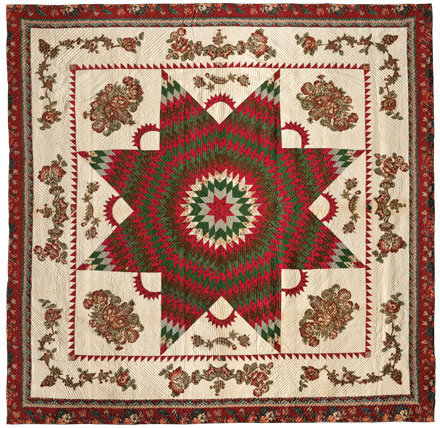
Finally, I really loved reading about Honor's sewing--her English patchwork as opposed to American applique, her technique of making rosettes, and her analysis of what makes a pleasing final product.  Here's a Star of Bethlehem quilt from the 1830s and now housed in the Brooklyn Museum.  This quilt pattern is mentioned many times in the novel.  I may have to make one myself.

Star of Bethlehem quilt, circa 1830,  Brooklyn Museum


Saturday, May 08, 2010

Remarkable Creatures


I'm on a Tracy Chevalier roll lately. I listened to The Lady and the Unicorn and blogged on it recently, and just finished listening to her latest, Remarkable Creatures, which is a fictionalized account of the lives, work, and relationship of Mary Anning and Elizabeth Philpot. These two women were truly as remarkable as the remains of the creatures they found, and I loved reading their stories as told by themselves.

Mary was a poor working girl who lived a stone's throw from the beach at Lyme Regis in the early 1800s. Elizabeth was a London-bred spinster, about ten to fifteen years her senior, who retired with her sisters to Lyme Regis when their parents died and their brother married. Mary grew up finding "curies"--that is, fossils of ancient, extinct creatures--on the beach and in the cliffs rising out of the beach near her home. She sold them mostly to the scientific "gentlemen" who were actively formulating the theories related to geology, evolution, the age of the earth, and God and his handiwork that would shake, rattle, and roll society, education, and theology.

Elizabeth was Mary's friend--a single lady, living with her sisters, in a style comparable to the Austen sisters, though they weren't quite as dependent on the kindness of brothers as Jane and Cassandra were. They shared a passion for fossils, and Elizabeth helped Mary's family figure out how to sell her incredible finds (e.g., the first complete ichthyosaurus and the first plesiosaurus).

I'm planning on reading The Fossil Hunter, by Shelley Emling, which is a non-fictional approach to the same subject. I'm glad I learned about Mary and Elizabeth in novel form first, however, because Chevalier did such a terrific job of shaping the themes and balancing the struggles the women faced (i.e., with each other, society, and the men who patronized them) in the context of each's own voice. It was well-written, cohesive, and, above all, terribly interesting.


The entire novel is in first person, though sometimes Mary is speaking and sometimes Elizabeth is. I'm not sure if the distinction between the two voices comes through as strongly in print as it does in audio form, but the two readers were so distinct--Elizabeth with her gentrified voice and Mary with her working class speech that I came away feeling that I knew each woman very well and could empathize with them completely. I loved how Elizabeth, the observer, always introduced the people with what they "led with"--their eyes, their feet, their mouth, their hands--it was an effective thread that gave me insight into both Elizabeth and the people she encountered. I loved how Mary's defining characteristic was that she was struck by lightening--literally and figuratively. Chevalier was really in top form with this book.

As a long-time reader of Austen, I have found that over the years my interest in her life and times has extended in particular to the scientific progress that was happening during the Regency and beyond. Remarkable Creatures provided a wonderful slice of life during the time period immediately following her death. In addition, I felt that I had a realistic view into various strata of society and how they interacted with each and how they didn't.

I must say, though, that the only clumsy part was when Chevalier felt the need to insert Austen into the story--Elizabeth, who has a keen scientific mind, denigrates her younger sister Margaret, who, she feels, wastes her time reading romantic novels such as those by Miss Austen who Margaret sort of remembers meeting at an assembly shortly after the Philpot sisters moved to Lyme. I found this pandering to the common infatuation with Austen a bit grating, but it really was the only less than fabulous part of the novel.

Definitely one of the best books I've read in 2010 thus far.

Saturday, April 03, 2010

The Lady and the Unicorn


I really enjoyed Tracy Chevalier's Girl With a Pearl Earring a few years ago, so when I spied her The Lady and the Unicorn in the audio book section of the library a few weeks ago, I grabbed it. I've had the novel languishing on the TBR shelf for years now, but this seemed like a perfect book for the car...and gym. Now that I've started treading the mill twice a week, my book consumption should skyrocket!

Back to The Lady and the Unicorn. It was great. I particularly enjoyed the different voices of the various characters, starting with Nicolas des Innocents, the Lothario portrait painter who designed the tapestries which now hang in Musée de Cluny, the various women who inspired him both artistically and sensually, from the spoiled daughter of his patron, her mother, and the mother/daughter of the weaver who creates the final product.

Not much is really known about Jean Le Viste, the French nobleman who commissioned the tapestries, and so I felt perfectly comfortable with the story that Chevalier created for their incarnation. In addition to providing an interesting story with interesting people that I came to care about, Chevalier skillfully imparts a lot of details about the daily life of the characters, be they noble, artisan, servant, or shopkeeper. I also learned about the mechanics of tapestry creation, a subject I happen to be very interested in, as well as a smattering regarding how guilds worked in medieval Europe. All fascinating stuff.

My absolute favorite character was Christine, the weaver's wife, who is a strong individual and a talented weaver in her own right. In the story, she finally gets the chance to weave--the guild won't let women weave but her husband was so pressed for time, that he let her. She is also a true partner and soulmate to her husband, a practical but loving and tender mother, and a plain-spoken but devout woman. Strong but not headstrong. I've often said that, much as I love to read history, I would have gone crazy had I lived in a time other than now, but Christine is an intriguing portrait of a woman who can adapt and bend and still stay true to who she is.

My second favorite character is Christine's daugher, Alienor. She is blind, she is dependent, and yet she saves herself from a horrible fate. She is strong and knows who she is and what she believes in. In contrast, the noblewomen, Jean La Viste's wife and daughter, are trapped, resentful, and bitter in their velvet cages.

All of the women in their turn, including the servant girls and ladies in waiting, are seduced by the unicorn, Nicolas des Innocents, but then they seduce/entrap him as well.

The Lady and the Unicorn is a well-crafted, interesting, imaginative novel that works on multiple levels and was a thoroughly enjoyable read.

Good thing I'm on the wait list for Chevalier's latest, Remarkable Creatures.