Showing posts with label Colorado. Show all posts

Thursday, May 23, 2024

Travelogue: Ute Mt Birding Festival and southern Colorado


Arkansas River, Salida, Colorado

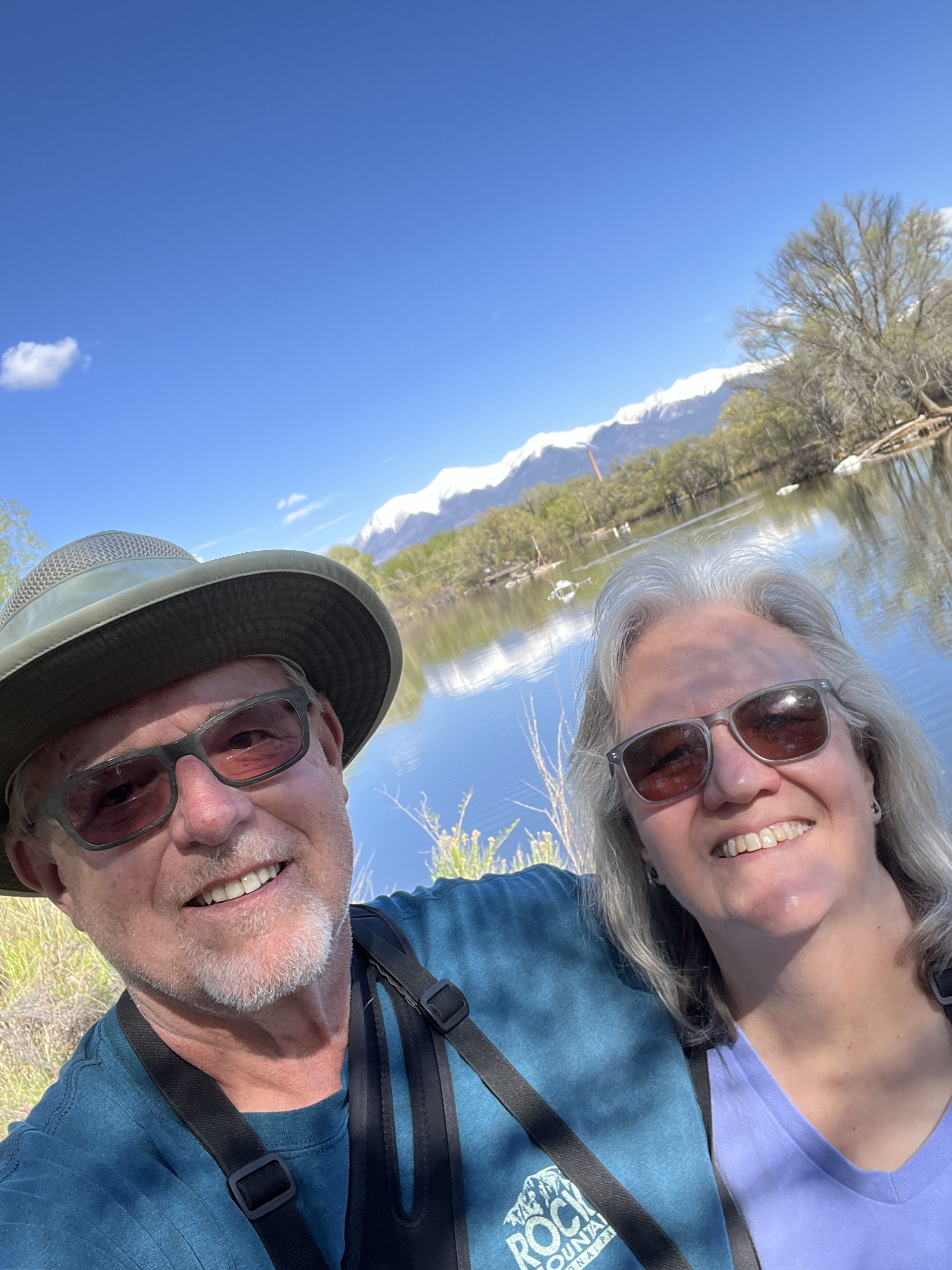
Last week we went to the Ute Mt Birding Festival in Cortez, Colorado to celebrate our 40th wedding anniversary, which was on May 12. It was our 4th time going to this bird fest, but the last time was 2019, so we were overdue for this favorite road trip.

Cortez is basically due west of Mesa Verde National Park and provides a good alternative to Durango for visitors who want a really small-town experience. We drove down on a Wednesday, and it was a full day as Cortez is seven hours of drive time from our house, which means stopping for lunch, gas, and leg stretching meant nine+ hours of traveling.


We had two full days of birding, saw and heard well over 100 different species, and logged four life birds. We ate twice at The Farm Bistro--locally sourced and absolutely wonderful. If you ever pass through Cortez, definitely put this place on your list.


On Saturday we headed for Salida, a little over halfway home, stopping at Chimney Rock National Monument.

Chimney Rock (right) and Companion Rock (left)

Fun Fact #1: All national parks are run by the National Park Service, but some national monuments are run by the Forest Service. These two organizations have different goals. The NPS tries to preserve sites and areas, while the Forest Service manages usage. It struck me as weird that Chimney Rock, sacred to Native Americans, would be under the jurisdiction of the Forest Service--if any place should be guaranteed as a preservation site, this is it. I am sure there is a political reason at the root of this weirdness.

Fun Fact #2: Just as the position of sun rise changes over time, seasonally, the position of moon rise also changes over time, oscillating south to north, but over a much longer period time--18.6 years, actually. Every 18.6 years, the full moon rises between Chimney Rock and adjacent Companion Rock, and archeologists believe that the Chaco people built a lunar observatory and the villages surrounding Chimney Rock supported the ancient observers. It turns out the full moons between July 2023 and December 2025 rise between the twin towers. The ranger on duty said that they may do live streaming this September and October. Here's more info on the Lunar Standstill and Chimney Rock.


View from Chimney Rock

After Chimney Rock, we landed in Salida for the night. Another restaurant recommendation: The Fritz is wonderful. We ate there five years ago, and it was as great as we remembered. I love Colorado mountain towns, and Salida has always been a favorite. A walk after dinner over the Arkansas gave me the chance to take the photo at the top of this post, which kind of says everything about how great this trip was.
40 years!

Now I'm working like crazy in the garden to make up for the five days I was away from my babies! Update on progress there soon!

Thursday, September 21, 2023

Travelogue: Glenwood Springs

Our family likes to visit one of Colorado’s many wonderful mountain towns in August, and this year we settled on Glenwood Springs, mainly so that we could hike up to Hanging Lake, an iconic Colorado destination that none of us had actually been to.

Hanging Lake is a lovely little lake, a pond really, fed by mountain springs that cascade into a rock cavity nestled in Glenwood Canyon, 20 minutes east of Glenwood Springs, just off I-70.  The hike to the pond is short (1.3 miles), steep (a gain of 1200 feet in elevation), rocky, narrow, and gorgeous, following Dead Horse Creek, which occasionally shows off with a waterfall here and there. I walk daily, weather permitting or not, and feel like my legs are relatively strong. After only 10 minutes, my face was so red my daughter thought I might be having a stroke, so I slowed down to a crawl and at that pace did make it to the top, stopping first at Spouting Rock, a wonderful waterfall that drops in front of a cave so that you can walk behind it and enjoy it from all angles. We rested for about 20 minutes, scarfing down granola bars and water, before heading back down the trail.


If you decide to visit Hanging Lake, be forewarned that reservations are required. The ticket taker at the gate said he turns away roughly 100 cars a day that arrive without planning ahead. Also be aware that the forest service that protects Hanging Lake has spent a lot of time and resources cleaning it up—apparently it used to be pretty trashed even a few years ago—and fines for even touching the water, much less swimming in it, are steep enough to dissuade even the most hardened idiots. Hanging Lake was named a National Natural Landmark in 2011.

One of Glenwood Springs’s claims to fame are its many hot springs that soothe aching muscles after hiking, cycling, skiing, or just living. We had fully intended to partake of one of the many pools after our hike and then the requisite lunch (we had an 8 am reservation so that we could hike in the cool of the mountain summer morning) but discovered that even the big public pool in town was charging $50/person. I’m not cheap as a rule, but $50 for a soak in a hot pool for 30 minutes (which is all I can really take) was just not worth it. I would rather spend that $50 on books!

Both Doc Holliday and Theodore Roosevelt famously loved Glenwood. Doc lived and gambled and drank there for a few years before he eventually died of tuberculosis and is buried somewhere in the town—apparently the headstone in one of the graveyards does not in fact mark his grave. Roosevelt visited so often that the Hotel Colorado (where we stayed!) was dubbed the Western White House.

If you go, here are some travel tips:

  • Visit Bullock Western Wear on Grand Avenue and try on the $900 turquoise lambskin jacket. You will look fabulous and will get your fix of western clothing until your next trip.
  • Avoid the underpass where I-70 crosses Grand Avenue on Friday evenings when there are tables set out and the music is blaring from the bars—the acoustics are such that you will lose your hearing. Every other time of day or week, this is actually a really nice place to congregate, meet friends, find some shade in the summer, but watch out on Friday night!
  • Bring walking shoes—the trails along the Colorado River, especially through Two Rivers Park, are relaxing and enjoyable. You can watch rafters coming down both the Colorado from the east and the Roaring Fork from the south. Also, make sure you find the monument to the 12 firefighters who lost their lives battling the Storm King fire in 1994.

  • If you are heading down to Denver after your trip to Glenwood, plan on heavy traffic from the Eisenhower tunnel all the way to highway 6. We decided to use the toll lane and pay the $9 or I think we would still be sitting in traffic.
  • Don’t stay at the Hotel Colorado over the weekend if you don’t want to be inconvenienced by the many weddings that are held there year-round. I completely get why couples want to get married there—the setting is really beautiful, and the courtyard is charming, but we wanted to enjoy a drink in the courtyard before heading out to dinner, but it was closed for a wedding. Call me a curmudgeon, but it was a bit annoying. The bride was beautiful, but the bridesmaids were in gray, which I thought was a bit of a weird color for a summer afternoon wedding. See, there was a silver lining. My daughter and I got to critique wedding party attire!
  • Don't stay at the Hotel Colorado if you are afraid of ghosts. We didn't see or hear any, but it is on the list of most haunted hotels in Colorado.

Glenwood is a charming western Colorado town, near to the Colorado wine, peach, and corn country. The Colorado and Roaring Fork rivers offer fun for fisherfolk, rafters, canoeists, photographers, and walkers. There are lots of restaurants featuring ranch food like smoky BBQ, beans, steaks, and Tex-Mex. Family friendly and with a certifiably good history pedigree, it is downstream from Aspen and is a much more enjoyable town to visit, according to this Colorado native.

Monday, July 25, 2016

Centennial


I just returned from a wonderful road trip from Colorado to the Olympic Peninsula in Washington state, traveling through WY, UT, ID, and OR along the way.  Enroute we listened to most of Centennial, by James Michener, having started it on a road trip in May.  It did take two road trips because it's a long book, over a 1000 pages in the mass market paperback version I have on my shelf.

It was first published in 1974, anticipating the 100th anniversary of Colorado's statehood and the 200th anniversary of the USA's nationhood in 1976.  It is dated, with some quaint bits explaining how cassette players work in cars and the use of the term Chicano, which I haven't really heard much in about 20 years.

Centennial is a framed story, which I wasn't expecting.  The idea is that the first-person narrator is a historian, hired by a magazine to vet the research done by its staff on an article series on the Platte River, and its role in the shaping of Colorado.  The historian visits the fictional town of Centennial, which was located north of Greeley and east of Fort Collins, on the Colorado prairie, and sends back chapters that tell the story of Centennial, in his own words and based on his own research. It's a cute premise, and one that reflects what I know about how Michener set about writing his own massive novels--a team of researchers who put together the material that he drew from to create his own narrative.

As with most Michener works, Centennial begins with the formation of the earth and we get stories about the dinosaurs, prehistoric horses, bison, beavers, snakes, and eagles, all before Michener gets around to the human inhabitants of the land we know as Colorado.  Then, he describes the various tribes of Native Americans, focusing in on "Our People," the Arapaho, who lived in the part of Colorado where I live.  I loved hearing about Lame Beaver and his wife Blue Leaf and their daughter, Clay Basket, who married the two trappers who ventured into Arapaho lands to hunt and trade.  As a native Coloradan, I know the geography well that Michener describes, even though he changed many place names.

The rest of the story, from the trapper days to the present, was structured around real events and real people that Michener renamed and reformed to suit his story arcs.  For example, he moved the Sand Creek Massacre from southern Colorado to the northeastern plains.  Once I stopped protesting and accepted the fact that Centennial was pure fiction inspired by history, I enjoyed it.  My favorite character was Ellie Zendt, Levi's first wife, followed closely by Charlotte Lloyd, the British heiress who fell in love with the Colorado prairie and found Bristol boring by comparison!

Believe it or not, I've never actually watched all of the TV series (one of the first mini-series to come out), so I will be embarking on that project tonight.  But taking it slowly.  I know that the production values are as dated as Michener's narrative, but it is a veritable cast of 1970's stars, which should be loads of fun to see again).


Monday, February 29, 2016

Breaking Wild


I really like to read about far away places and stories set in the distant past, but sometimes it's fun to read about the here and now.  I heard about Breaking Wild, Diane Les Becquet's debut novel earlier this year, and immediately wanted to read it because it is set in Colorado and is a thriller of sorts.

I enjoyed it and read it on both legs of a trip to New York over the weekend.  I ended up seeing it as a cross between The Girl on the Train and 127 Hours.  It is another one of those alternating protagonists novels--this time we get the third-person narration of Amy Rae's story, a reckless young mother who gets lost on a hunting trip in northwest Colorado, and first-person narration of Pru's story, the single mom who is part of the search and rescue team that tries to find Amy Rae.  I'm not entirely sure why one was first person and the other was third, but it worked and helped keep the two stories straight in my head.

While it has a high tension quotient--will Amy Rae survive the bear, the cougar, the freezing temperatures, the injuries, the isolation, and her own recklessness?  I also really liked how the author told the back stories of both Amy Rae and Pru--they have a lot of similarities. Both are comfortable roughing it in the Colorado mountains, both are committed to their children, but they come at life and its responsibilities completely differently.  Both have to decide to live and how.

With regards to 127 Hours, much as I disliked the author of that book--his recklessness also took a heavy toll on the people he said he loved--I found Breaking Wild to be as fascinating as 127 Hours just to read about how people can survive in absolutely horrible situations.  The will to live is a powerful force and we can endure more than is conceivable given some knowledge, some tools, and sheer grit.

I really enjoyed the book--the pacing was good, the writing was pretty good (although I confess that early on I struggled with the author's love of similes--it's usually sufficient to say that the sky is blue, it doesn't need to be compared to something else, although Colorado blue skies are breathtaking!), the story was good, and the characters were interesting, flawed, and worth rooting for although Amy Rae is hard to like for the most part.  But, she was a good counterpoint to Pru and her saintliness.

This was a nice break from the classics that I've been reading lately and it was fun to read about places I know very well...Boulder, Golden, the Western Slope, and the Colorado Rockies.


Wednesday, May 30, 2012

Wordless Wednesday: Walden Ponds, Boulder County, Colorado


Photos courtesy of my husband, Jeff, whose photos can be found here.  He took them during a recent hike at Walden Ponds Wildlife Habitat.
 Singest of summer in full-throated ease... John Keats

The Light Brigade

The world is mud-luscious and puddle-wonderful. ee cummings

A thing of beauty is a joy forever... John Keats

The poetry of the earth is never dead. John Keats

One touch of nature makes the whole world kin. Shakespeare


To sit in the shade on a fine day and look upon verdure is the most perfect refreshment. Austen