Showing posts with label #ReadingItaly. Show all posts

Monday, September 18, 2023

The Marriage Portrait by Maggie O’Farrell


Maggie O’Farrell’s latest novel, The Marriage Portrait, is even better than Hamnet and The Vanishing Act of Esme Lennox, both of which I thought were terrific. Unlike other novels that purport to be the backstory of a famous work of art (e.g., The Girl with the Pearl Earring, The Lady and the Unicorn), this is the backstory of a portrait that probably existed but that hasn’t survived, which makes it even more intriguing.

This is the story of Lucrezia di Medici, a middle child and third daughter of Cosimo I, Grand Duke of Florence, and teenage bride of Alfonso, Duke of Ferrara. She died early in the marriage, perhaps from disease, perhaps murdered by her husband who was desperate for an heir and unwilling to wait long for Lucrezia to conceive.

I absolutely loved the character that O’Farrell bestowed on this unsung female who for centuries has been little more than a footnote of Florentine history. She was an artist, fascinated and attuned to the natural world, particularly animals. She was strong, energetic, and intelligent—had the Florentine world not been enslaved by a patriarchal society, she would have been an ideal successor to her father, much more so than any of her brothers. She was definitely a spiritual sister of the caged tiger she charmed into letting her pet her, and their stories tracked each other until near the end when Lucrezia's veered in a different direction.

************SPOILERS BELOW*****************

I absolutely adored the ending and was fervently hoping that the story would resolve as it did, with Lucrezia escaping from the fate history allotted her and finding a place and role for herself as an anonymous artist of exquisite tiny paintings of animals, presumably finding love and passion, purpose and fulfillment outside the trappings and dangers of court and politics and power.

Usually, I am a stickler for historical accuracy, but in the case of Lucrezia, about whom so little is known, I have no problem with this author creating an alternate reality for her.

I also think that O'Farrell did a great job in her portrait of Alfonso. Our view of him was entirely governed by Lucrezia's, evolving as she matured from the little girl she was when she first met him to the innocent bride whose only role is to bear children to the scared teenager who has learned what he is capable of doing when thwarted. 

******************************************

Definitely a 5-star novel that I look forward to rereading someday.

Sunday, September 04, 2022

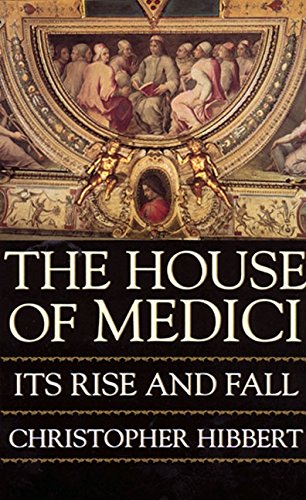
The House of Medici: Its Rise and Fall


I love to visit Italy, and I love to learn about its history. Since I am on a mission to read all of the books I received as gifts last year, I eagerly turned The House of Medici: Its Rise and Fall, by Christopher Hibbert. Published in 1974, it's not the latest scholarship, but I did enjoy it for the most part and read it fairly carefully until Part IV, 1537 - 1743. Like most people I am most interested in the rise of the family during the Renaissance, but I found my mind wandering while reading about the last of the Medici. I sort of felt like author did too, and the narrative became far less compelling in the last section. 

I also loved learning more about Florence, especially on the heels of reading City of Vengeance earlier this summer. I visited Florence in 2015 and although I loved seeing David in particular, I really expressed then and since that I had no desire to revisit the city because of the hordes of tourists. After reading so much about Florence, I'm reconsidering but would definitely go in the off season. I can deal with wind and rain better than I can crowds.

I was disappointed in the illustrations, which were just black and white images and some of them pretty grainy. Now, I am on the lookout for a more modern book, with color illustrations, on the same topic. Any suggestions?

I also want to watch, for the 3rd time, the marvelous TV series, Medici. I know it is not all historically accurate, but the production is great and fun to watch.


Sunday, October 24, 2021

Christ Stopped at Eboli


Every year I try to read at least one book by an Italian author to help me better understand the country and its history. I love to visit Italy, and I think this enriches those visits.

This year I chose Christ Stopped at Eboli, by Carlo Levi, on the recommendation of my friend, Maxene. The good news is that it was written in 1947 and so qualifies for the 2021 Back to the Classics challenge, and I'm putting it in the Classic by a New-to-You Author.

This is a non-fiction account of the year that the author spent in exile in the southern most region of Italy. Levi was a painter from Turin whose political activities in the 1930s earned him the wrath of the fascists who were coming to power in Italy during that time, and the punishment for these activities was banishment to a remote and rural village in mountaneous Lucania, now known as Basilicata. I think this is equivalent to the Soviets sending Alexander Solzhenitsyn to Siberia.

The title of the book comes from a saying that means that the civilizing affects of Christianity didn't make it to the southern most region of Italy--in other words, Christ and Christianity didn't affect the region of Italy south of the town of Eboli. The world in which Levi lived for a year was one of abject poverty, where the people were not only treated as feudal serfs but they saw themselves as almost less than human. Despite no money, no jobs, no industry, and farming that failed year after year because the crops were inappropriate for the landscape, the tax burden was never lifted and the people had to slaughter their precious goats, depriving their families of much needed milk, to pay their taxes. 

Levi was not only a painter but had some medical training and the village adopted him as their doctor. But, of course, Kavkaesque bureacracy got in the way and he was forced to stop treating the villagers. At one point, Levi created a plan to combat the ever-present malaria, but this too was quashed. Punishing Levi by further restricting his activities was more important than promoting the health and well-being of the residents of this region.

While many parts of the book and Levi's experiences were tough to read about, the writing as translated by Frances Frenaye was exquisite, and I really did enjoy reading about the various villagers and how Levi became a part of their lives and he became a part of theirs. At the end, when Levi is granted amnesty along with other political exiles, the villagers beg him not to leave but to stay and marry the village beauty because if he leaves he will never return.

This was an exceptioinally good book. It not only gave me perspective on the conditions in Italy between the world wars, but it also demonstrates in very real terms why so many people from this region immigrated to the US and Canada.

There is a film version from 1979 that received a BAFTA in 1983. I always say that I am going to watch the film version of books I enjoy, but maybe this time I really will!


Saturday, August 07, 2021

Pictures from Italy - Charles Dickens


For the Back to the Classics 2021 category, Adventure or Travel, I had a couple of possibilities but landed on Pictures from Italy, by Charles Dickens.

In 1844, after the disappointing reception of Martin Chuzzlewit and more expenses than income, Dickens and his already large family (wife and 5 children and sister-in-law) went to live in Italy for 18 months.

Pictures from Italy recounts his journey from London to Paris and then through France to Genoa, where the family lived while Dickens traveled around Italy with and without other family members. It was in Genoa that he wrote one of his Christmas stories, The Chimes. Other than that, the travelogue that became Pictures from Italy was the only writing, apart from letters, that he did during this time.

Much as I love Italy and reading about traveling in Italy, I found this mostly a somewhat tedious book that could have benefitted from editing. Some of the chapters are quite short (just a handful of pages) while others are very long (Rome clocks in at 46 pages and covers a variety of topics that could have been broken into more digestible parts). I got the feeling that Dickens simply handed over his travel notes to his publisher and moved on to his next long fictional project, Dombey and Son.

What I found most interesting were the parts where I could glimpse future works, particularly Little Dorrit, when the Dorrit family travels to Venice, traversing the Alps. Dickens also witnessed and slavishly recounts the beheading of a criminal, which I am sure informed such scenes in A Tale of Two Cities.

I found his disdain of the Catholicism of the Italians off-putting--respecting the faith of the locals is the least one can do when visiting their country--and he observed with what I thought was an arrogant eye. 

I did love and appreciate the feelings of awe he had when visiting the Colosseum and the Forum in Rome, and like him, I couldn't get enough of them either. Same when he visited Pompeii, although his trip up Vesuvius and back down was harrowing to the point of disbelief.

His writing on Naples was the most Dickenesque of the entire book. He does paint a vivid, if chaotic, picture full of color and motion and drama. In fact, the writing did get better as the book progressed, with the last sections far superior to the beginning. It just needed editing and structure--I really felt like I was reading his notes.

Map of Charles Dickens' Travels throughout 1844-1845

The other interesting thing about reading this particular book is that Italy was undergoing tremendous change at this time, having experienced revolutions in the 1820s and 1830s, and moments away from plunging into the Risorgimento, or Italian unification, that really got underway in 1848 and was a reality by 1871. 

This is another one of those books that I'm glad I read, but may not feel the urge to reread. That said, Dickens' descriptions of Genoa and Verona have made me definitely add them to my next trip to Italy, so I may dip into this book again to refresh my memory with what he visited so that I can retrace his steps to some degree.


Wednesday, August 19, 2015

The Uncle from Rome


I found out about The Uncle from Rome, by Joseph Caldwell, in the anthology Italy in Mind, which included the first chapter.  I read it a few months ago, and was hooked.  I needed to read the rest of the story!  So I did.

Here's the premise: Michael Ruane is an opera singer from New York who has spent his career as a comprimario--that is, one who is part of the supporting cast but never is the star of the show.  He is visiting Naples in order to sing in a production of Tosca and to produce and sing in a one-night performance of Curlew River by Benjamin Britten as a tribute to one of his former singing teachers.  This is his one opportunity to sing the lead role.

Michael is asked, make that begged, by the diva starring in Tosca to assume the role of the "uncle from Rome" at the wedding of the son of her former music teacher.  Michael agrees to do so, being fluent in Italian, and is swept away by the role.  He assumes that the role is for the wedding only, but the family embraces him, respects him, and pulls him into their crazy, soap-opera, pizza-fueled world.  And he lets them because he discovers how much he loves being a respected uncle.  

The family that he pretends to be now part of is classically dysfunctional and Michael relishes trying to solve their horrific problems--one son is threatening to kill the other son, the newlyweds are reeling from their own shotgun wedding, and the matriarch is blind to reality.

In addition to all of this, Michael's former lover recently died of AIDS and he is feeling empty and angry with himself for being unable to grieve as he wants and expects himself to do.  In the cast of Curlew River, Michael finds a young man, Piero, with a gorgeous voice who challenges him to let himself mourn, heal, and try on new, scary roles.  There is one incredible scene where Michael and Piero climb a hill and look out over Naples below them--Piero echoes Satan from the King James version of the Bible and says to Michael "I will give you all this if you bow down and worship me."

What makes The Uncle from Rome so interesting and satisfying as a novel is the way that Caldwell explores the idea of how the roles a person assumes can frame or even dictate the parameters of that person's life--whether as a lover, a diva, a bit player, a rejected lover, a mourner, a matriarch, a son, or an uncle...from Rome.

Once again, I enjoyed reading about Italian culture and place.  I learned more about the food, the customs, and especially enjoyed the opera world depicted, a world in which the relative merits of divas are hotly, passionately debated.   I doubt I would have discovered this book if I hadn't been looking for books to read that are set in Italy, but I am so glad I did find it.

The final scene is one of the best endings to a book that I've read in a long time.  All I will say is that Michael somehow manages to pull all the roles he is playing both on and off the stage into one shining moment that made my jaw drop and then made me laugh with relief.