Showing posts with label Northanger Abbey. Show all posts

Monday, May 30, 2011

Mailbox Monday...on Tuesday


Mailbox Monday is the gathering place for readers to share the exciting books that came into their house last week via post. Warning: Mailbox Monday can lead to envy, toppling TBR piles and humongous wish lists!

Mailbox Monday was created by Marcia at A Girl and her Books, and is currently being hosted by Mari from Mari Reads for the month of May.


A few new books arrived recently, including The Remains of the Day, by Kazuo Ishiguo. I have wanted to read this for years, and would love to watch the movie as well, but never owned a copy so now I swear I will carve out time for this book this year.

After I posted about Wallace Stegner's excellent Angle of Repose, many commented that Crossing to Safety was actually their favorite of Stegner's novels, so I had to get a copy. I also pulled his Beyond the Hundredth Meridian off the shelf and added it to the reading pile--I picked it up last time I visited the Grand Canyon, and would really like to read about John Wesley Powell.

Finally, I got my copy of the latest issue of Persuasions, the journal of the Jane Austen Society of North America. It is chock full of fascinating papers (here's the Table of Contents, many about Northanger Abbey, which was the focus of last year's Annual General Meeting. I've already read the first three papers, and plan to read it between major books, sort of like the way I read short stories. Some of the papers are available online here.

Let the summer commence...

Sunday, January 30, 2011

There Must Be Murder...a Northanger Abbey Sequel


I had planned on reading Margaret Sullivan's new Northanger Abbey sequel, There Must Be Murder, sometime this year, but when I won a copy of the book on Austenblog.com I treated myself to reading it almost as soon as it arrived.

A perfect tonic for the mid-winter blahs, There Must Be Murder includes all of my favorite parts of Jane Austen's Northanger Abbey--namely, the wit and charm of Henry Tilney, the interesting and picturesque setting of Bath, the innocence of Catherine as she continues to learn life's lessons, and the joys of immersing oneself in a good novel.

The novel picks up the NA story three months after Henry and Catherine are married and the premise is that they return to Bath to celebrate the first anniversary of their meeting there. I am happy to report that the couple is blissfully satisfied with married life--Henry reads The Mysteries of Udolpho to Catherine, continues to make her laugh with his arch commentary, and is more than happy to let her adore him.

Despite the ominous title, the plot is gently satirical, soft-boiled, and entirely enjoyable. Catherine discovers a rival for Henry's affections, Catherine is pursued by a rake, General Tilney is courting a likely murderess (aka The Merry Widow), and Catherine and Henry are revealed to be potty about dogs and indifferent, if not hostile to cats. Who knew?!

Finally, the illustrations by Cassandra Chouinard are absolutely charming. Here's a wonderful example, featuring MacGuffin, the Tilney's Newfoundland.


A quick read, There Must Be Murder, is a treat for Janeites and a must for those of us who are consider themselves players on Team Tilney.

Tuesday, April 20, 2010

Mysteries of Udolpho--the Twilight of Its Day


These days, most people who know about Ann Radcliffe’s The Mysteries of Udolpho know about it because Catherine Morland read it and Jane Austen parodied it in Northanger Abbey. However, back when it hit the streets for the first time in May of 1794, it was a blockbuster…I like to think of it as the Twilight of its day.

If you are only going to read one Gothic novel, to see what all the fuss was about, read Udolpho. Unlike most of the others in the genre, it is truly suspenseful (you only find out what’s behind all the mysteries in the story in the last couple of chapters and the romantic dilemma is only resolved in the final few pages). Though not really terrifying, it is remarkably readable and I found it extremely fun.

I was warned of the lengthy descriptions of exotic locales, but I enjoyed visiting Venice, Tuscany, Provence, and the Apennines and Alps circa 1581 circa Radcliffe’s mind. She actually never visited most of the places she wrote about, and only visited France once. Her descriptions are the stuff that dreams and legends are made of and seem so familiar and right and romantic and thrilling to those of use who are experienced armchair travelers.


I was also warned of the melodramatic plot lines, and these are there in spades, but are a great deal of fun of you let your imagination get the better of you. Emily St. Aubert, the heroine who seems more like a Rousseau-educated English lass than a late Renaissance French mademoiselle, is a plucky, perfect specimen who cries buckets, faints at crucial moments (e.g., just after lifting the black veil, which means we don’t learn what is behind it for another 300 pages), and could give Marianne Dashwood instruction in sensibility and Elinor Dashwood pointers on rationality. The hero of the story, Valancourt, is a bit one-dimensional—we only hear about his depraved behavior in Paris but don’t get to witness it—and the villain, Monsieur Montoni, is wonderfully wicked and amoral but no match for our girl.

In thinking about the story, I think Radcliffe did a much better job with her female characters than the male ones. Madome Montoni, Emily’s foolish aunt who plays a reasonably good wicked stepmother for much of the time, has a somewhat interesting character, as does Signora Laurentini. The men are more static—either good or evil, with the exception of Valancourt, whose fortunes exemplify the moral lesson of the story, as expressed in the second-to-last paragraph of the novel:

…though the vicious can sometimes pour affliction upon the good, their power is transient and their punishment certain; and that innocence, though oppressed by injustice, shall, supported by patience, finally triumph over misfortune!


One unexpected aspect of the book is the poetry that Radcliffe inserts throughout the story. It shouldn’t have surprised me because the full title of the novel is The Mysteries of Udolpho, A Romance; Interspersed with some Pieces of Poetry. Emily is quite good at composing quite lengthy poems, usually when she stumbles upon a particularly gorgeous vista or after a particularly wrenching experience. I confess that I read very few of these, but I imagine Radcliffe’s original readers soaked them up before plunging ahead with the story, which does move at a pretty brisk clip.


I am not going to review the plot here as it would take a short novel to simply recap all of Emily’s adventures, but suffice it to say that there are castles, banditti, pirates, dungeons, secret passages, convents, nuns, ghosts, skeletons, poisonings, sword fights, abductions, storms, inheritances, deaths, confessions, and true love. What more could you ask for?

Finally, if you do take the plunge and decide to read this definitive Gothic novel, make sure you read the Penguin edition. The Introduction by Jacqueline Howard, which I scanned before and read after reading the novel, is absolutely first rate.

Wednesday, April 14, 2010

The Gothic Novel


It's not even summer yet in the U.S. and already I'm anticipating October reading by diving into Gothic novels. I have only Northanger Abbey to blame. After rereading it earlier this year, my regional JASNA group decided to explore the reading list that Isabella Thorpe gives to Catherine Morland.

Here's the list:

The Mysteries of Udolpho by Ann Radcliffe, 1794
The Italian, or the Confessional of the Black Penitents by Ann Radcliffe, 1797
Clermont, a Tale by Regina Maia Roche, 1798
The Mysterious Warning, a German Tale by Eliza Parsons, 1796
The Necromancer; or, the Tale of the Black Forest, by "Ludwig Flammernberg" (aka Carl Friedrich Kahlert, 1794
The Midnight Bell by Francis Lathom, 1798
Orphan of the Rhine by Eleanor Sleath, 1798
Horrid Mysteries by the Marquis de Gross, 1796
The Monk by Matthew Gregory Lewis, 1796
Castle of Otranto by Horace Walpole, 1794

I chose the most popular of them all, The Mysteries of Udolpho, and the one that Catherine actually reads in NA, and I'm happy to say that I am closing in on the ending and will be posting on it soon.

In the meantime, I asked my JASNA friend, Maxene, if she would allow me to post the wonderful paper she developed a few years ago on the Gothic novel. She agreed, and here it is. In the words of my beloved Jane Austen, "run mad as often as you choose, but do not faint!" There is a lot of fainting in Gothic novels, but they are not for the faint of heart.
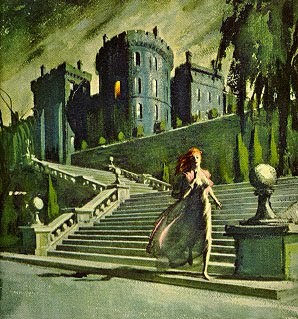


------------------------------------
THE GOTHIC NOVEL - courtesy of Maxene

By the late 18th century, literacy in England had spread from the upper to the lower classes, and even servants, in their leisure time, joined the reading public, along with many women. Thus, literature reached a far wider audience than ever before. This new readership could now take advantage of the many circulating libraries available. There was also more of a tendency for people to seek out reading for simple pleasure and relaxation rather than for educational or religious purposes. During this period, especially in the years between 1790 and 1820, the most popular type of fiction read in England was the Gothic novel.

Horace Walpole’s Castle of Otranto (1764) is considered the first Gothic novel. A slight book, it is significant for its influence on those Gothic writers yet to come. This book introduced the elements of Gothic fiction, among which feeling is the distinctive attribute. Coral Howells, in her Love, Mystery and Misery: Feelings in Gothic Fiction, states: “Gothic fiction with its castles and abbeys, persecuted heroines, ghosts and nightmares, projects a peculiarly fraught fantasy world of necroses and morbidity—it is a shadowy world of ruins and twilit scenery, lit up from time to time by lurid flashes of passion and violence.” Gothic fiction contained descriptions of imaginary landscapes set in forests and mountains, had a large cast of characters, and, above all, was full of exaggerations.

There was no real successor to Walpole until 1777 when Clara Reeves’s Old English Baron was published. However, it wasn’t until 1789, with the publication of her Castles of Athlin and Dunbayne that the most important and most popular Gothic novelist, and the writer considered the founder of Gothic fiction, came on the literary scene: Ann Radcliffe. Of her five Gothic romances, written between 1789 and 1797, the most famous are The Mysteries of Udolpho and The Italian. Mrs. Radcliffe was a master of landscape description and specialized in terror by suggestion underlaid, however, by a basic rationality. Behind the terror of the Black Veil in Udolpho is something that can be explained.

After Mrs. Radcliffe, Gothic fiction evolved from terror to horror. One explanation for this evolution is the abundance of Gothic architecture which was available for first-hand inspection during the last decades of the 18th century. Earlier Gothic fiction relied for its effects on the damp, tortuous corridors of crumbling castles and abbeys. In reality, people were now able to see that these built Gothic buildings were light and airy. As one critic explains: “The effects of Mrs. Radcliffe and her heirs were dependent on obscurity and between 1790 and 1810 that obscurity was to be undermined.” Real, built Gothic was no longer a matter of mystery and irrationality, so written Gothic began to employ more stereotyped and extreme Gothic settings and shifted away from the suspense of Mrs. Radcliffe’s books to the described horrors of, for example, Matthew G. Lewis’s The Monk (1796).

The Monk plunges us into a world of horror with semi-pornographic elements in it. It is “a nightmare of fiendish wickedness, ghastly supernaturalism and sadistic sensuality.” Sounds delightfully repellent! And we remember that John Thorpe thought it a “tolerably decent” novel and had “read that t’other day….” C. Robert Maturin’s Melmuth the Wanderer (1820), published near the end of Gothic fiction’s popularity, is the greatest novel of the school of horror but includes within it some more complex psychology. There were hundreds of stories written in imitation of Radcliffe, Lewis and Maturin. Public demand for morbidly sensational fiction was also satisfied by a host of minor writers: for example, those published by the Minerva Press, most of whose work was repetitive and sensational in the extreme.

By 1816, the first great popular passion for Gothic romances had passed its peak. By the 1820’s, ‘Gothic’ had become a derogatory if not an abusive word. But Gothic conventions were assimilated into the imaginative literature of Romanticism. Mary Shelley’s Frankenstein (1818), more psychological but with Gothic elements, is the most lasting example.

Gothic fiction, however, is significant for its attempt to write a new kind of fiction dealing primarily with feelings and with emotional and imaginative awareness, elements more typical of poetry and drama than of the novel. “These explorations were expressed through exaggerated imagery in which contemporary readers found excitement, suspense and beneath it all an interplay of the passions they covertly recognized in themselves” (Howells).

And this brings us to Jane Austen, who, with her family, read widely in Gothic fiction and enjoyed what she read. In a letter to Cassandra, dated October 24, 1798, Austen writes: “My father is now reading the Midnight Bell, which he has got from the library….” This book had just been published earlier that very year.

Almost every element of Mrs. Radcliffe’s novels is exactly the sort of thing Jane Austen went out of her way to avoid, the exact opposite of her “little bit of ivory.” Austen wrote Northanger Abbey when Gothic fiction’s popularity was at its peak and after Mrs. Radcliffe’s Udolpho had enthralled the reading public. But she acknowledged in her Advertisement to Northanger Abbey, in 1816, that she was aware popular taste had changed and that Northanger Abbey contained obsolete elements--nowhere so obsolete as in Isabella’s list of horrid fiction that she imparted to Catherine. None of these books was written after 1798. To some, though, this list does suggest the beginning, peak, and decline of the Gothic novel, just as Catherine’s questions about Blaize Castle’s age, keep, ramparts and towers suggest the phases of England’s long history of castle building from the keep of the 12th century through the ramparts of the 13th and then to the towers, a feature of late medieval castles. If Northanger Abbey is a parody of the Gothic novel, it also has elements which show Jane Austen’s affinity to it. She doesn’t so much reject the Gothic because it is different from life, but because it can so easily distort someone’s real life responses. As we all know from reading Northanger Abbey, real life and Gothic fiction aren’t so very completely different as Henry Tilney believed them to be.


Thursday, February 11, 2010

Northanger Abbey and its Petulant Patriarch


Catherine Morland and Northanger Abbey are usually struggling with Fanny Price and Mansfield Park for the dubious honor for least favorite heroine and novel amongst the Austen Six. This is a pity because whenever I reread NA I'm reminded of how much I enjoy it and how much I like and admire silly, impressionable but wiser-than-she-gives-herself-credit-for Catherine ("Rounders") Morland.

Yes, she is duped by Isabella Thorpe into thinking that they are truly friends, and yes, she fawns on Henry Tilney something fierce, but the little voices that tell her from the start that all is not right with Isabella and General Tilney, in particular, prove that she does have sense should she chose to use it.

I find Catherine fresh, funny, sympathetic, and endearing, and I find Austen in Northanger Abbey the same.

I reread one Austen novel a year, and this year I read Northanger Abbey. Whenever I read Northanger Abbey, I also read a marvelous paper that was published in Persuasions, The Jane Austen Journal, No. 20 (1998), a publication of the Jane Austen Society of North America. It's titled "The Case of the Petulant Patriarch" and its author is Kenneth W. Graham, a professor at the University of Guelph. Several years ago, I asked Dr. Graham if I could have his permission to scan and post his article, since JASNA didn't include it in their online collection. He granted that permission, provided that JASNA approved. After obtaining approval from JASNA, I moved on to other projects and never got around to posting the paper.

After reading it again last night, I decided that my Austen friends would enjoy Dr. Graham's article, so I scanned it and here it is.

"The Case of the Petulant Patriarch" is a speculative look at General Tilney's military career and how it shaped him. In his paper, Graham sets out to "shadow General Tilney, the petulant patriarch."
He is a puzzling figure, not only in what he is but in what he represents: we meet a man, overconfident, stubborn, selfish, petulant, who in his accomplishments and influence represents the upper levels of British authority. Shadowing General Tilney through his army career and his life as a husband, father, and landowner will bring us into contact with the tensions of his times and with what may well be the real mystery to be solved, the mystery of Jane Austen's position in the ideologically uneasy epoch of the 1790s that engendered Northanger Abbey. The novel's attitude to its times and to the social and political hegemony of a particular patriarchal class is the mystery to be unraveled.


I found Graham's assumptions about the campaigns that General Tilney participated in to be interesting reading in their own right--from the Seven Years War (1756-63) to one of the ten thousand British troops that joined Prince Ferdinand of Brunswick in Westphalia in 1759 to joining General Howe at Staten Island. After outlining the possible military career of General Tilney as well as his son, Captain Frederick Tilney, Graham moves on to show how the "Campaign to Capture Catherine" is executed as a military campaign. Graham also has a terrific discussion of the death of chivalry and how the social tensions of the time are reflected and commented upon in the novel.

It's a wonderful article and I hope you enjoy it as much as I did.

After I reread NA I treated myself to rewatching the latest BBC adaptation, courtesy of Netflix. It also happens to be next in the queue at Masterpiece Classic, if you're so inclined to watch it this Valentine's Day.

The first time I watched it, I was in a wonderfully expansive mood and loved everything about it except its extreme brevity--only an hour and 30 minutes!


This time I was more critical--while I still think the casting is marvelous, I didn't care for some of the changes that Andrew Davies introduced into the script. I didn't think Mr. Allen needed to be portrayed as a penny-pincher, and I especially didn't like the way Davies had Henry be truly angry with Catherine for her confession that she thought the General might have murdered his wife. Henry scolds Catherine in the book, but he is never angry with her. Unlike so many other Janeites, I have no problem believing that Isabella gave away the farm to Captain Tilney in the hopes of getting him to engage himself to her, so THAT scene doesn't bother me. I was disappointed with the abbey, which looks more like a castle than my idea of an abbey, even one with modern apartments. I haven't yet purchased the DVD yet, but will because what Austen collection would be complete without it, but I'm still holding out for the definitive NA adaptation.

Wednesday, October 21, 2009

Cross-Pollination with Stephanie's Everything Austen


Stephanie of stephanie's written word is doing a giveaway of two, count 'em two, copies of my collection of Austen-inspired short stories entitled Intimations of Austen. This is part of her wonderful Everything Austen reading challenge, which has been sweeping the blogosphere and twitterland. For all of us who read Austen and Austen-inspired on a regular basis, this is a reading challenge made in heaven.

Thanks Stephanie for doing this giveaway.

I do want to take this opportunity to point out that the title is Intimations with an "n" not Imitations with an "m" - I wouldn't presume to imitate Austen, only to be inspired by her! A number of people have made this mistake...hindsight is 20-20 and I probably could've picked a better title.

If you're interested in Intimations of Austen, here are the blurbs I recently wrote about my stories:

Rainbow around the Moon
This is one of the shortest stories in the collection and is a first-person narrative by the daughter of Captain and Anne Eliot Wentworth. Many find it hauntingly beautiful, many find it desperately sad, many find it peaceful and reassuring. I loved writing it. I was driving to work one morning and the opening line, "My father watches the sky" popped into my head. By the time I had finished my commute, I knew that I would be writing a Persuasion story that night. I also remember how much fun I had researching all the expressions that sailors use in predicting weather, starting with the most familiar...red sky at morning, sailors take warning.


The Last Baby
Regarding Austen characters we love to hate, this is one of my favorite stories because it evokes such strong response from readers. It is a Pride and Prejudice-inspired story, a sequel and prequel wrapped up together, and Mrs. Bennet is the heroine! Again, the story began with an opening line that demanded a story be written around it: "My arms are empty."


Bird of Paradise
Once again, this is one of my favorites because so many readers tell me that they absolutely love seeing Fanny Price with an unambiguously happy future. This story begins with the wedding of Fanny and her cousin, Edmund Bertram, and goes gothic when Daphne du Maurier's Rebecca tries to steal the scene. I loved writing it and researching flowers that take awhile to bloom, but when they do, they do so gloriously. My favorite Austen critics have written about how Fanny is one of the most passionate of all Austen heroines, and I wanted to find a story and symbolism that would capture that passion she hid so well while under her Aunt Norris's thumb at Mansfield Park.


All I Do
By far the longest of the stories in this collection, this is a what-if Pride and Prejudice-inspired story that is angst ridden and forces the characters and the readers to address a moral dilemma that has no easy answer. Most readers love this story, but a few are seriously troubled by it. As a writer, I wrestled with the same question that Darcy wrestles with--how can I rid myself of this obligation without compromising my integrity. The story takes place twenty years after Austen's P&P closes, and it was immensely satisfying to write about a mature Elizabeth in middle age. The inspiration for Colonel Fitzwilliam's burial place in this story was Princess Diana's--her death, though it happened several years before I wrote this story, was still fresh in my mind.


Three Sisters
This story was once described as the anti-Persuasion. I won't give away the one-two punch at the end by telling you which Austen novel it's really about, but suffice it to say, I always rather thought that Lady Russell has gotten a bad rap all these years and that she may have had point that Anne Eliot and Austen readers don't like to acknowledge.


The Color of Love
I thought about this story for years before I sat down to write it. One of my brothers sent me an article about Synesthesia, a neurologically based condition in which one sensory path is crossed with another. There are many varieties of Synesthesia, and one that I read about involved reading in color. I found in this a way to explore Darcy's struggle to reconcile his love for Elizabeth Bennet with his own sense of self and family. This story parallels the action of Austen's Pride and Prejudice, but is told entirely from Darcy's perspective as a synesthete.


When Fates Conspire
The last story I wrote for the collection and different from most of the others in tone. This Persuasion story focuses on Captain Wentworth as he approaches Kellynch Hall to visit his sister and her husband. I was in a fanciful mood when I sat down to write this story, and when I got to wondering just what those Fates who play with our fate really look like and sound like pure fancy struck my pen.


Remember That We Are English
A Northanger Abbey story that explores how Henry felt knowing that his father was entirely mistaken about Catherine Morland's family and prospects. One of the threads that runs through most of my stories is that the natural world can heal wounded spirits if you seek solace and wisdom in it, and in this story that thread is given center stage.


Heaven Can Wait
This story was written as the dénouement for a longer work on Marianne Dashwood, post Sense and Sensibility, but I came to love Gideon Hayes, Jane Bennet's original suitor, so much that I had to share it in this collection. Again, this story blends the magic inherent in nature with a character's struggle to move forward, grow, and live and love. I shamelessly borrowed the title from that cute Warren Beatty movie from 1978.

Friday, November 14, 2008

Sylvia's Lovers - Dialect and Extras


I've finished Sylvia's Lovers and have been digesting a bit before posting my thoughts on it. To aid in the digestion, I read the sections in Jenny Uglow's Gaskell bio that deal with SL and the writing of it. The main thing I learned was what a tremendous job Gaskell did with the dialects of the various characters. This was pretty much lost on my American tin ear, but apparently she distinguished between classes and regions to a degree that would have made Henry Higgins proud.

Here's what Uglow says:
...Gaskell kept faith with the expression of the people. Speech, as William [Gaskell's husband] had insisted in his 'Lectures on Lancashire Dialect', has its own history and evolution, displaying regional, class and individual variants. Gaskell carefully gave Bell Robson Cumbrian forms to fit her origins. The manuscript reveals numerous alterations of word endings and technical details such as variations of the definite--the, th', t'...Such details, imperceptible to most of her readers, were in tune with her determination to gather the 'unimportant' chaff and dust of past lives.


I still have to read about press gangs, which is an appendix in the Penquin Classics version I have of the novel, but I think I can say that I liked the book well enough. I've heard that many critics think that Gaskell fell into melodrama in the final volume, and much as I like Gaskell, I can't say I disagree with this. The chapter in which Philip saves Kinraid stretches belief to the breaking point, and their last encounter pushes it over the edge. In reading the bio of Gaskell simultaneously with reading the works themselves shows that Gaskell was an impatient writer. In SL, unlike N&S, she wasn't writing serially, but life had intruded on her progress with the novel to such a degree that she was impatient to be done with it and so forced the ending in ways that require revision...but unless there were lawsuits, as in the case of her bio of Bronte, it seems that Gaskell rarely reworked what she produced.

In comparing Gaskell to Austen, Austen's novels, except Persuasion and perhaps Northanger Abbey, are polished, perfected, exquisite, whereas Gaskell's tend to be hurried. It's significant to me that Gaskell said that Cranford was the only of her novels that she ever reread once she had finished it.