Showing posts with label Italy. Show all posts

Thursday, July 31, 2025

July Key Words: Bee Balm, Italian Art in WWII, Civil War Stories


Garden Notes

This week's star native is Bee Balm (aka Wild Bergamot). This fragrant perennial comes in lots of colors, has spikey flowers, and it blooms for a long time. Right now, my native garden is mostly yellow and purple, with my Bee Balm providing the purple canvas on which the yellow blooms can shine. 


Bee Balm is a perfect native alternative to the ever-popular Butterfly Bush, which is actually an import from Asia, which means it may look stunning, but it isn't helping the local ecosystem and is invasive.

Bee Balm is also an edible plant. John Forti, author of The Heirloom Gardener, says:

All aerial parts of the plant can be used fresh. The tender leaves can be chopped finely and added to salads and summer vegetable dishes or made into teas and balms. However, the flowers (particularly the red ones) are my favorite edible part of the plant; they are full of an Earl Grey–like floral nectar and offer a fun kid candy from the garden. They are beautiful frozen into ice cubes for summer drinks or turned into a simple syrup for refreshing cocktails and confections. 


On to Books...


The Last Masterpiece, by Laura Moretti - Moretti is an art historian and historical novelist who focuses on the Renaissance and Italy, and I have read just about all of her books. This latest is set during WWII, featuring two young women, an Austrian and an American, on opposite sides of the war but both working to preserve the art treasures of the Italian Renaissance from destruction and looting during the war.

I loved it. In fact, I think it might be my favorite of Moretti's novels. The Nazi part of the story begins in Florence, with Eva, the Austrian woman, newly arrived with a job to photograph the paintings and sculptures that the German art historians are cataloging and putting into storage, with the help of the local Italian art historians. Her father is actually heading up the operation to store art from around Europe in the Austrian salt mines, and Eva truly believes that the Nazis are trying to preserve and protect the art for the Italians. Turns out she's wrong about that.

Josie is a WAC from Connecticut who is assigned to provide secretarial support to the Monuments Men. In the course of her duties, she comes to learn about and then love Renaissance art. She also learns to love Italy, particularly Florence.

Now I am all primed to finally read Saving Italy, by Robert M. Edsel, who also wrote The Monuments Men, the book on which the movie is based.


The March, by E.L. Doctorow - this is much-lauded novel is about General Sherman's 1864-1865 campaign in which his army of 90k+ subdued Georgia and the Carolinas and helped bring the Civil War to its end. 

Definitely a 5-star book, and not just because of my abiding interest in the Civil War, but because of the breadth and scope of character and story, the insight and compassion, realism and historical accuracy, and eloquence.

Doctorow tells the stories of a cross-section of people involved--the generals and other officers, of course, a smattering of soldiers from both sides, both the brave and the not-so brave. He tells the stories of civilians whose towns, farms, and homes were invaded, sometimes burned, almost always violated. He tells the stories of newly freed African Americans as well those who had enslaved them, and those who are on the periphery of the fighting but still a part of it--the British war correspondent, the itinerant photographer. 

My favorite story was that of a German doctor who came to America to find personal liberty and found himself tending the wounded and dying of both sides. I also loved the story of Pearl, an African American girl whose skin was so pale that she could pass but struggled with whether she wanted to live in the white world as a white woman.

Here's my favorite passage, which stopped me cold, near the end, when Sherman is negotiating terms of surrender with his Confederate counterpart, Joe Johnston.

And so the war had come down to words. It was fought now in terminology across the table. It was contested in sentences. Entrenchment and assaults, drum taps and bugle calls, marches, ambushes, burnings, and pitched battles were transmogrified into nouns and verbs. It is all turned very quiet, Sherman said to Johnson, who not quite understanding, lifted his head to listen.

No cannonball or canister, but has become the language here spoken, the words written down, Sherman thought. Language is war by other means. 

Ragtime is the only other one of the many noteworthy books by Doctorow that I've read, but I mean to remedy that, although some of them seem mighty grim. Any suggestions?


Monday, July 21, 2025

The Glassmaker - Tracy Chevalier


Author Tracy Chevalier not only never repeats herself when it comes to her historical novels, diving into drastically different time periods, locations, and characters with each novel, all that require extensive research, but with her latest, The Glassmaker, she shows a courageous, creative willingness to play with the time/space continuum.

Overwhelmingly, I prefer realism over fantasy in fiction, with just a few magical realism exceptions, so at first I struggled with what Chevalier was doing in The Glassmaker, but the end result was a triumph.

So, what does she do? The Glassmaker tells the story of Orsola Rosso, daughter of a maestro glassmaker in Murano (one of the Venetian islands) in the 1480s. Her family have been glassmakers for generations, with the craft being passed from father to son in a tightly controlled industry. We learn about Orsola's family--her brothers, her savvy mother, her baby sister, and how the family handles the untimely death of her father, who dies during a glassmaking accident. 

We learn how the glass works produced by the Rosso family are sold throughout Europe, through a German middleman, Klingenberg, who resides in Venice. Orsola becomes a glass bead maker herself, one of just a few females who learn to work with glass. We learn that a handsome stranger is hired on to the Rosso workshop and Orsola cannot stop looking at him. 

And then the timeframe of the story shifts from the late 15th century to roughly 100 years later, to the 1570s. Orsola is now a young woman, in love with Antonio, still handsome but no longer a stranger, but not appropriate for the daughter of a glass maestro to marry. 

Plague descends upon Venice and Murano. Orsola and most of her family survive not only the disease but the quarantines enforced on them when members of their household fall ill. Life is difficult, but the family survives and Orsola becomes a skilled bead maker and entrepreneur.

Throughout the rest of the novel, as Orsola ages from a young woman to a wife and mother, then on to middle age and beyond, the time period in which the story is set shifts as well, sometimes by a 100 or so years, sometimes more, taking us from the time when Venice was a trading capital of the world through the time of Casanova and the growth of casinos and Carnival, then the French invasion of Venice and the dissolution of the Republic, then into the wars of the 20th century, and finally to 2020 and Covid.

The Rosso family and Orsola evolve as families do, with births and deaths, marriages and intrigues, jealousies and reconciliations. Their basic family history remains intact--they are a glass-making family, their father died in an accident, they live and work on Murano and visit Venice for business more than pleasure. I found it fascinating that Chevalier was able to tell the story of this family intact as she skipped from timeframe to timeframe, which gets to the heart of why I love stories. The setting is the window dressing, it adds flavor and interest, but the stories of people and how they love, grow, and dream are timeless.

I also think this was a super cool way to tell the history of Venice and glass-making as an industry. I loved hearing about how glass works are made, distributed, sold, and treasured. And, I loved seeing how she handled social changes over time (e.g., a character who was a slave in the 15th century is not a slave in the 20th, but he is still restricted by how others perceive him).

I do think Chevalier was both creative and courageous in how she chose to tell the story of Orsola and her family against the backdrop of the history of Venice, Murano, and the glass-making industry. It took tremendous skill as an author to present both stories in a realistic way. Bravo!

Now I am ready to return to Venice, and this time, I will go to Murano!


Sunday, September 04, 2022

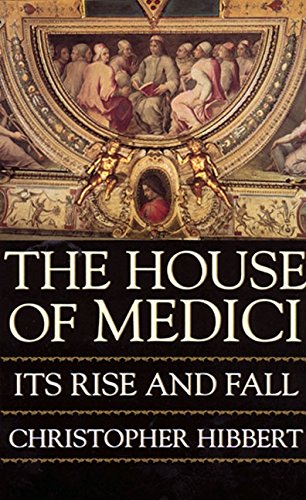
The House of Medici: Its Rise and Fall


I love to visit Italy, and I love to learn about its history. Since I am on a mission to read all of the books I received as gifts last year, I eagerly turned The House of Medici: Its Rise and Fall, by Christopher Hibbert. Published in 1974, it's not the latest scholarship, but I did enjoy it for the most part and read it fairly carefully until Part IV, 1537 - 1743. Like most people I am most interested in the rise of the family during the Renaissance, but I found my mind wandering while reading about the last of the Medici. I sort of felt like author did too, and the narrative became far less compelling in the last section. 

I also loved learning more about Florence, especially on the heels of reading City of Vengeance earlier this summer. I visited Florence in 2015 and although I loved seeing David in particular, I really expressed then and since that I had no desire to revisit the city because of the hordes of tourists. After reading so much about Florence, I'm reconsidering but would definitely go in the off season. I can deal with wind and rain better than I can crowds.

I was disappointed in the illustrations, which were just black and white images and some of them pretty grainy. Now, I am on the lookout for a more modern book, with color illustrations, on the same topic. Any suggestions?

I also want to watch, for the 3rd time, the marvelous TV series, Medici. I know it is not all historically accurate, but the production is great and fun to watch.


Sunday, October 24, 2021

Christ Stopped at Eboli


Every year I try to read at least one book by an Italian author to help me better understand the country and its history. I love to visit Italy, and I think this enriches those visits.

This year I chose Christ Stopped at Eboli, by Carlo Levi, on the recommendation of my friend, Maxene. The good news is that it was written in 1947 and so qualifies for the 2021 Back to the Classics challenge, and I'm putting it in the Classic by a New-to-You Author.

This is a non-fiction account of the year that the author spent in exile in the southern most region of Italy. Levi was a painter from Turin whose political activities in the 1930s earned him the wrath of the fascists who were coming to power in Italy during that time, and the punishment for these activities was banishment to a remote and rural village in mountaneous Lucania, now known as Basilicata. I think this is equivalent to the Soviets sending Alexander Solzhenitsyn to Siberia.

The title of the book comes from a saying that means that the civilizing affects of Christianity didn't make it to the southern most region of Italy--in other words, Christ and Christianity didn't affect the region of Italy south of the town of Eboli. The world in which Levi lived for a year was one of abject poverty, where the people were not only treated as feudal serfs but they saw themselves as almost less than human. Despite no money, no jobs, no industry, and farming that failed year after year because the crops were inappropriate for the landscape, the tax burden was never lifted and the people had to slaughter their precious goats, depriving their families of much needed milk, to pay their taxes. 

Levi was not only a painter but had some medical training and the village adopted him as their doctor. But, of course, Kavkaesque bureacracy got in the way and he was forced to stop treating the villagers. At one point, Levi created a plan to combat the ever-present malaria, but this too was quashed. Punishing Levi by further restricting his activities was more important than promoting the health and well-being of the residents of this region.

While many parts of the book and Levi's experiences were tough to read about, the writing as translated by Frances Frenaye was exquisite, and I really did enjoy reading about the various villagers and how Levi became a part of their lives and he became a part of theirs. At the end, when Levi is granted amnesty along with other political exiles, the villagers beg him not to leave but to stay and marry the village beauty because if he leaves he will never return.

This was an exceptioinally good book. It not only gave me perspective on the conditions in Italy between the world wars, but it also demonstrates in very real terms why so many people from this region immigrated to the US and Canada.

There is a film version from 1979 that received a BAFTA in 1983. I always say that I am going to watch the film version of books I enjoy, but maybe this time I really will!


Monday, October 19, 2015

Travelogue: Italy

Innocents abroad

I had an absolutely wonderful time on a recent two-week vacation in Italy in early October.

First stop, Venice

Room with a view....Venice. Yes, that's laundry drying!

What, no canal picture?  Well, this was the view from our hotel room and I think it captures the homey feel of the Venice we fell in love with.  Venice is a completely unique place--the canals, the gondolas, the palaces, the bridges all make this a water-based city that was fascinating.  But, the calle, the narrow auto-free streets, in which you can get lost while discovering a little restaurant that delivers a memorable meal that blows your socks off, is what I loved about Venice and made it so charming to me.

We purposely didn't plan to do a lot of typical sightseeing in Venice as we just wanted to enjoy the city itself.  So we didn't tour the Doge's Palace or St. Mark's Basillica.  We did walk through St. Mark's Square and walked over the Rialto bridge, but my favorite activities were riding the vaporetto (water bus) up and down the Grand Canal and around the outer perimeter of the city and walking around Dorsodoru and popping into the tiny art galleries and artisan workshops.

We did tour the three synagogues in the Jewish Ghetto, which was about two blocks from our hotel, we walked through the art gallery in Ca' Rezzonica, and we visited the Naval History Museum.  We found La Fenice opera house, which featured prominently in John Berendt's The City of Falling Angels, which I've now listened to three times!

And, we found some lovely little restaurants and my favorite new dish is Sarde in Saor (Sweet and Sour Sardines).

Next up is Florence

When I was in the early stages of planning this trip, Florence wasn't on the list.  Then, I started reading Irving Stone's The Agony and the Ecstasy about Michelangelo, and Florence went on the must-visit list, but with only about 36 hours in the city.

That turned out to be okay as Florence turned out to be my least favorite stop on the trip.  It is a beautiful city, and I loved being able to visit the Duomo and I was thrilled to see Michelangelo's David in the Accademia and his Doni Tondo Holy Family in the Uffizi.  However, the tourist crowds were almost overwhelming and I never felt that we ever really were able to get a feel for Florence as other than a tourist town.  I didn't dislike visiting Florence, by any means.  But, I'm not sure I would put it on the must-visit-again list.


Florence from Fiesole

Here is a view of Florence from Fiesole, an Etruscan town in the hills outside of Florence, where we went to dinner.  It was a welcome escape from the tourist crowds and gave us an opportunity to gain some perspective...and have a delicious dinner!

On to Sorrento

We chose Sorrento because of its proximity to Pompeii, which after Venice, was my number 1 destination for this trip.  I also wanted to enjoy a small town on the Mediterranean as opposed to the urban jungle that I've heard is Naples.
Room with a view...Sorrento

The day we traveled from Florence to Sorrento was a long day, involving a high-speed train to Naples and then a transfer to a slow, local train (35 stops) between Naples and Sorrento, which was very crowded and so we stood for 25 of the 35 stops. However, we wanted a feel for how locals live, and taking the local train definitely provided a bit more of that than did the tourist crowds in Florence.

Lemon tree, very pretty
Sorrento was lovely--blue skies, blue seas, lemon trees, sea breeze.  So refreshing and relaxing.  One day was devoted to loafing on the balcony of our hotel room, reading, watching the scooters buzz by, enjoying the teenage soccer team run drills across from the hotel.  We stopped in at the local supermarket and stocked up on goodies for the room, took the city bus, sipped prosecco, and enjoyed life.

A glimpse of the Mediterranean 


Looking north 

Pompeii

First of all, I was totally blown away by how big the town is/was.  We spent over four hours and saw about a quarter to a third of the town.  Many buildings were closed, but we saw most of what we wanted to...the theaters, some villas, some shops, the Forum, some baths.  It was crowded, it rained (for only about 30 minutes), the footing was tricky (made the cobblestones of Venice and Florence seem easy to navigate), but it was wonderful!

Bathhouse art
Storm brewing over Vesuvius


Cave Canem

I was happy to see that the reports of stray dogs hanging out in Pompeii were accurate.  These guys minded their own business and didn't seem scruffy, mangy, or malnourished.


All Roads Lead to Rome

Room with a view...in Rome.
Our final destination was Rome...again, the local train to Naples, and then a high-speed train up to Rome.  We stayed in a hotel on Piazza della Rotonda, with a view of the Pantheon.  Rome, like Venice, is unique--no other place like it on Earth. Almost every time you turn a corner, there is something breathtaking...a monument, a fountain, a church, a ruin, a Madonna painted on the corner of the intersection.


Cats rule.
Our first afternoon we went for a walk to get oriented and about dusk came upon a city block of ruins that was unexpected.  Turns out we stumbled into Largo di Torre Argentina, a square in Rome that hosts four Roman temples, and the remains of Pompey's Theatre, where Julius Caesar was murdered over 2000 years ago.  It is also a cat sanctuary and I counted over 50 cats roaming through the ruins--curiously, we saw quite a few stay cats hanging out in Sorrento.  They all seemed fat and happy.
Largo di Torre Argentina


I loved the fountains of Rome...

 And the ruins...

The adorable...

And the unexpected...


Our last stop, after we spent the morning touring the Sistine Chapel and the Vatican Museums, was to take the subway to the Spanish Steps and visit the Keats-Shelley House Museum, which contains the house where John Keats died at age 25 in 1821.

My heart aches and a drowsy numbness pains my senses as though of hemlock I had drunk.

Wednesday, August 19, 2015

The Uncle from Rome


I found out about The Uncle from Rome, by Joseph Caldwell, in the anthology Italy in Mind, which included the first chapter.  I read it a few months ago, and was hooked.  I needed to read the rest of the story!  So I did.

Here's the premise: Michael Ruane is an opera singer from New York who has spent his career as a comprimario--that is, one who is part of the supporting cast but never is the star of the show.  He is visiting Naples in order to sing in a production of Tosca and to produce and sing in a one-night performance of Curlew River by Benjamin Britten as a tribute to one of his former singing teachers.  This is his one opportunity to sing the lead role.

Michael is asked, make that begged, by the diva starring in Tosca to assume the role of the "uncle from Rome" at the wedding of the son of her former music teacher.  Michael agrees to do so, being fluent in Italian, and is swept away by the role.  He assumes that the role is for the wedding only, but the family embraces him, respects him, and pulls him into their crazy, soap-opera, pizza-fueled world.  And he lets them because he discovers how much he loves being a respected uncle.  

The family that he pretends to be now part of is classically dysfunctional and Michael relishes trying to solve their horrific problems--one son is threatening to kill the other son, the newlyweds are reeling from their own shotgun wedding, and the matriarch is blind to reality.

In addition to all of this, Michael's former lover recently died of AIDS and he is feeling empty and angry with himself for being unable to grieve as he wants and expects himself to do.  In the cast of Curlew River, Michael finds a young man, Piero, with a gorgeous voice who challenges him to let himself mourn, heal, and try on new, scary roles.  There is one incredible scene where Michael and Piero climb a hill and look out over Naples below them--Piero echoes Satan from the King James version of the Bible and says to Michael "I will give you all this if you bow down and worship me."

What makes The Uncle from Rome so interesting and satisfying as a novel is the way that Caldwell explores the idea of how the roles a person assumes can frame or even dictate the parameters of that person's life--whether as a lover, a diva, a bit player, a rejected lover, a mourner, a matriarch, a son, or an uncle...from Rome.

Once again, I enjoyed reading about Italian culture and place.  I learned more about the food, the customs, and especially enjoyed the opera world depicted, a world in which the relative merits of divas are hotly, passionately debated.   I doubt I would have discovered this book if I hadn't been looking for books to read that are set in Italy, but I am so glad I did find it.

The final scene is one of the best endings to a book that I've read in a long time.  All I will say is that Michael somehow manages to pull all the roles he is playing both on and off the stage into one shining moment that made my jaw drop and then made me laugh with relief.


Monday, August 03, 2015

Florence by Night


I'm currently slowly reading Irving Stone's 1961 best-seller The Agony and the Ecstasy about Michelangelo.

The book is excellent--well-written, a great way to learn about Renaissance art before my trip to Italy this fall, and an excellent guidebook to Florence.

I've been looking up places on my iPad and learning about the geography as I go. Stone also has some lovely lyrical descriptions that make me catch my breath, and so I have lots of ear-marked pages.

Here's one from the first section of the book, entitled "The Sculpture Garden," where Michelangelo Buonarroti as an eleven-year-old begins working as an apprentice to Ghirlandaio's fresco studio.  He steals out one night and crosses the Arno and climbs up to the Belvedere fort and looks down on Florence:
Florence, luminous in the full moonlight, so close that he felt he could touch the Signoria or the Duomo with his fingers, was a sight of such incredible beauty that he drew in his breath sharply.  No wonder the young men of the city sang their romantic ballads to their town, with whom no girl could compete.  All true Florentines said, "I will not live out of the sight of the Duomo." For him the city was a compact mass of pietra serena, the streets cut through with a mason's chisel, looking like dark rivers, the cobbled piazzas, gleaming white in the moonlight. The palaces stood sentinel, a couple of ranges higher than the modest houses clustered so tightly about them; and piercing the creamy gold sky the spires of Santa Croce, Santa Maria Novella, the magnificent three-hundred-foot thrust of the Signoria. Making a little group of its own were the great red dome of the cathedral, the glistening small white dome of the Baptistery, the noble pink flesh of the Campanile. Around all was the turreted, tower-studded city wall.

Saturday, June 20, 2015

When In Rome


As part of my prep for my trip to Italy this fall, I read a wonderful little mystery, When in Rome, by Ngaio Marsh. First published in 1971, it is quite dated in some ways--no cell phones, being the main gadget missing from the character's lives, and a preponderance of 1960's era swinger slang--but in terms of atmosphere and geography and setting, it was perfect.

This is a Roderick Alleyn mystery--my first time meeting this suave British police detective--but I'm sure it won't be my last.  He is charming, clever, and fun to be around.

The setting is Rome, of course. Dame Ngaio Marsh has set her story in the Basilica of San Clemente, but changed the name. Not exactly sure why, but I loved looking up places that Alleyn and the other characters visit in the course of the novel.

In a nutshell, the story revolves around a murder that happens during a special tour of the basilica by a motley crew of mostly British tourists with a Dutch couple thrown into the mix, and it reminded me a lot of an Agatha Christie mystery.

I enjoyed the mystery--didn't figure it out but loved how it worked out in the end.  Adored the setting and now have the Basilica of San Clemente on my must-see list for Rome.

I can recommend When In Rome for mystery lovers, for those who are nostalgic for the 1960's and that "mod swinging scene," and for those who dream of visiting Rome and exploring the layers of history in the Eternal City.

Basilica of San Clemente

Sunday, May 31, 2015

Reading Guide to Italy


I've been talking about a leisure trip to Italy for years now, and it looks like this Fall I will actually succeed. I've been to Milan a few times on business, but I had zero sightseeing time, so it's almost as if I haven't really visited Italy yet.

Anyway, I really like to read books about places I visit, fiction and non-fiction, so I've been quietly ignoring my reading lists for 2015, and compiling an alternate list of what I hope to read before my big adventure.

I just read book #15 in the Guido Brunetti series by Donna Leon, set in Venice, and which I love, but I wanted a broader fare:
An Italian Education by Tim Parks
Christ Stopped At Eboli by Carlo Levi
Ratking by Michael Dibdin
When in Rome by Ngaio Marsh
Italy in Mind, an anthology of writings from Lord Byron to Edith Wharton to Susan Sontag
Vivaldi's Virgins, by Barbara Quick
The Man Who Became Caravaggio, by Peter Robb
My Brilliant Friend, by Elena Ferrante
The Agony and the Ecstasy by Irving Stone (novel about Michelangelo)
The Italians, by John Hooper
The Shape of Water (Inspector Montalbano, Bk 1) by  Andrea CamilleriStephen Sartarelli (Translator)

I would like to reread Death in Venice, by Thomas Mann (one of my all-time favorite novellas), and something by Henry James (not The Aspern Papers, which I've already read and didn't care for).
I am totally open to other suggestions.  What evokes Italy, past and present, most for you?