Showing posts with label Florence. Show all posts

Sunday, September 04, 2022

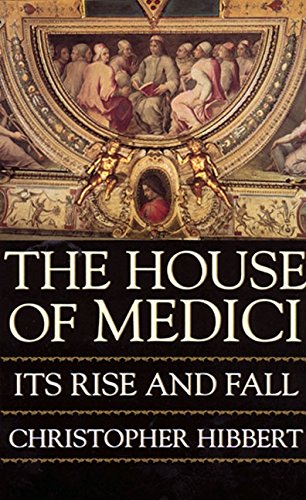
The House of Medici: Its Rise and Fall


I love to visit Italy, and I love to learn about its history. Since I am on a mission to read all of the books I received as gifts last year, I eagerly turned The House of Medici: Its Rise and Fall, by Christopher Hibbert. Published in 1974, it's not the latest scholarship, but I did enjoy it for the most part and read it fairly carefully until Part IV, 1537 - 1743. Like most people I am most interested in the rise of the family during the Renaissance, but I found my mind wandering while reading about the last of the Medici. I sort of felt like author did too, and the narrative became far less compelling in the last section. 

I also loved learning more about Florence, especially on the heels of reading City of Vengeance earlier this summer. I visited Florence in 2015 and although I loved seeing David in particular, I really expressed then and since that I had no desire to revisit the city because of the hordes of tourists. After reading so much about Florence, I'm reconsidering but would definitely go in the off season. I can deal with wind and rain better than I can crowds.

I was disappointed in the illustrations, which were just black and white images and some of them pretty grainy. Now, I am on the lookout for a more modern book, with color illustrations, on the same topic. Any suggestions?

I also want to watch, for the 3rd time, the marvelous TV series, Medici. I know it is not all historically accurate, but the production is great and fun to watch.


Friday, August 19, 2022

Mid-August Roundup - Reading, Walking, Learning

Dog days of summer--lots of rain in Colorado (hurrah!), a bit cooler weather, still no tomatoes. What's up with that? But don't you love my sunflower garden? The teddy bear sunflowers are finally coming out, and they are adorable!

Lots of walking. I've been closing my circles on my Apple Watch every day since Jan 1, and accomplished the July challenge (average 60 minutes of exercise per day), and I 'm track to do the August challenge (average burn 668 calories from exercise per day). Am I proud of this? You bet!

In addition to reading, I've been listening to Great Courses on Audible. Here's what I've listened to so far:

  • The Vikings, by Kenneth Harl - a 36-lecture course on the history and impact of the Vikings in medieval Europe. Absolutely, wonderful. The net-net is that Harl believes that the Viking raids, settlements, and assumption of power in certain areas was a major force in shaping Christian Europe. The Normans who invaded England in 1066 were essentially Vikings who had settled in Normandy and took control of the area. I did not realize that!
  • A History of Hilter's Empire, by Thomas Childers - a 12-lecture course that outlined the development of the Nazi party, its rise and fall. Again, incredibly interesting.
  • World War II: A Military and Social History, by Thomas Childers - I am just over half-way through this 30 lecture course. While I am getting more comfortable with the chronology and key points of the war in Europe, I am getting information that is largely new to me about the war in the Pacific and North Africa and the southern Mediterranean.
So why all this learning about WWII? My daughter and I are planning a trip to Germany in March/April. Because we are both interested in WWII, we want to visit a lot of the museums and historical sites from that time and the Cold War, so I wanted to do some pre-trip learning. I am also learning some German via Duolingo.

Now on to what I've been reading. 

The Midcoast, by Adam White - we're headed back to Maine for 10 days in September, so I wanted to read another novel set in Maine, and I saw this on a few blogs and thought I would give it a try. It was a solid 4-star novel, a debut novel, set in a very small town in Maine with an interesting story. Basically, the main character, Andrew, is a lot like Nick in The Great Gatsby in that he observes the rise and shattering fall of a family and how the facade of money and power can crumble when pushed even a little. The main character is an observer, not a player, without having much of a storyline himself. Not sure how this novel is doing overall in the market, but I think it could definitely use a better title, which I found dull and not enticing at all.


City of Vengeance, by D.V. Bishop - this is the first in a mystery series set in 16th century Florence and featuring Cesare Aldo, an officer working for the criminal courts in Florence, which bascially makes this a cop mystery. Absolutely loved the setting and Cesare is a great character with lots of potential for future stories. The writing was good and the mystery was interesting. Will definitely read the second in the series. Interestingly, I thought at the beginning of the book that it was going to be a take on The Merchant of Venice, as the first section deals with a gruff Jewish moneylender and his wayward daughter. The story didn't end up paralleling Merchant at all, but I was afraid we were straying into stereotypical grounds. Glad the author pulled back and told his own story without riding on Shakespeare's coattails. At 416 pages, this books squeaks under the wire to qualify for the Big Book Summer challenge.


The Diamond Eye, by Kate Quinn - WOW! I loved this book about a female, Russian sharpshooter during WWII. Not quite as good as The Rose Code, but wonderful nevertheless. I especially enjoyed the first part of the book, where Mila (aka Lady Death) is learning to be a soldier and developing her leadership skills (she eventually commands a platoon). The second part of the book deals with her visit to the US, Canada, and Great Britiain to drum up support for the US to aid the Allies and fight the Nazis. Mila Pavlichenko was a real person who wrote a memoir about her time in the Red Army and her trip to the US. The Author's Notes at the end is critical to enjoying/understanding the book, in my opinion, as she explains that 90% of the characters in the book are real people, and the only parts that she really fabricated were the larger story of Mila's estranged husband and the stalker who is trying to kill Roosevelt while she is visiting the White House. I particularly loved Mila's relationship with Eleanor Roosevelt, of whom I am a big fan! Reading this book while listening to the WWII Great Courses lectures was a perfect pairing.

Clocking in at 435 pages, this book also qualifies for the Big Book Summer challenge


Hope everyone has a good rest-of-August and happy reading, walking, and learning!

Monday, October 19, 2015

Travelogue: Italy

Innocents abroad

I had an absolutely wonderful time on a recent two-week vacation in Italy in early October.

First stop, Venice

Room with a view....Venice. Yes, that's laundry drying!

What, no canal picture?  Well, this was the view from our hotel room and I think it captures the homey feel of the Venice we fell in love with.  Venice is a completely unique place--the canals, the gondolas, the palaces, the bridges all make this a water-based city that was fascinating.  But, the calle, the narrow auto-free streets, in which you can get lost while discovering a little restaurant that delivers a memorable meal that blows your socks off, is what I loved about Venice and made it so charming to me.

We purposely didn't plan to do a lot of typical sightseeing in Venice as we just wanted to enjoy the city itself.  So we didn't tour the Doge's Palace or St. Mark's Basillica.  We did walk through St. Mark's Square and walked over the Rialto bridge, but my favorite activities were riding the vaporetto (water bus) up and down the Grand Canal and around the outer perimeter of the city and walking around Dorsodoru and popping into the tiny art galleries and artisan workshops.

We did tour the three synagogues in the Jewish Ghetto, which was about two blocks from our hotel, we walked through the art gallery in Ca' Rezzonica, and we visited the Naval History Museum.  We found La Fenice opera house, which featured prominently in John Berendt's The City of Falling Angels, which I've now listened to three times!

And, we found some lovely little restaurants and my favorite new dish is Sarde in Saor (Sweet and Sour Sardines).

Next up is Florence

When I was in the early stages of planning this trip, Florence wasn't on the list.  Then, I started reading Irving Stone's The Agony and the Ecstasy about Michelangelo, and Florence went on the must-visit list, but with only about 36 hours in the city.

That turned out to be okay as Florence turned out to be my least favorite stop on the trip.  It is a beautiful city, and I loved being able to visit the Duomo and I was thrilled to see Michelangelo's David in the Accademia and his Doni Tondo Holy Family in the Uffizi.  However, the tourist crowds were almost overwhelming and I never felt that we ever really were able to get a feel for Florence as other than a tourist town.  I didn't dislike visiting Florence, by any means.  But, I'm not sure I would put it on the must-visit-again list.


Florence from Fiesole

Here is a view of Florence from Fiesole, an Etruscan town in the hills outside of Florence, where we went to dinner.  It was a welcome escape from the tourist crowds and gave us an opportunity to gain some perspective...and have a delicious dinner!

On to Sorrento

We chose Sorrento because of its proximity to Pompeii, which after Venice, was my number 1 destination for this trip.  I also wanted to enjoy a small town on the Mediterranean as opposed to the urban jungle that I've heard is Naples.
Room with a view...Sorrento

The day we traveled from Florence to Sorrento was a long day, involving a high-speed train to Naples and then a transfer to a slow, local train (35 stops) between Naples and Sorrento, which was very crowded and so we stood for 25 of the 35 stops. However, we wanted a feel for how locals live, and taking the local train definitely provided a bit more of that than did the tourist crowds in Florence.
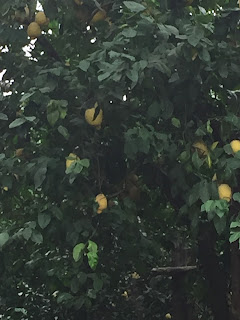
Lemon tree, very pretty
Sorrento was lovely--blue skies, blue seas, lemon trees, sea breeze.  So refreshing and relaxing.  One day was devoted to loafing on the balcony of our hotel room, reading, watching the scooters buzz by, enjoying the teenage soccer team run drills across from the hotel.  We stopped in at the local supermarket and stocked up on goodies for the room, took the city bus, sipped prosecco, and enjoyed life.

A glimpse of the Mediterranean 


Looking north 

Pompeii

First of all, I was totally blown away by how big the town is/was.  We spent over four hours and saw about a quarter to a third of the town.  Many buildings were closed, but we saw most of what we wanted to...the theaters, some villas, some shops, the Forum, some baths.  It was crowded, it rained (for only about 30 minutes), the footing was tricky (made the cobblestones of Venice and Florence seem easy to navigate), but it was wonderful!

Bathhouse art
Storm brewing over Vesuvius


Cave Canem

I was happy to see that the reports of stray dogs hanging out in Pompeii were accurate.  These guys minded their own business and didn't seem scruffy, mangy, or malnourished.


All Roads Lead to Rome

Room with a view...in Rome.
Our final destination was Rome...again, the local train to Naples, and then a high-speed train up to Rome.  We stayed in a hotel on Piazza della Rotonda, with a view of the Pantheon.  Rome, like Venice, is unique--no other place like it on Earth. Almost every time you turn a corner, there is something breathtaking...a monument, a fountain, a church, a ruin, a Madonna painted on the corner of the intersection.


Cats rule.
Our first afternoon we went for a walk to get oriented and about dusk came upon a city block of ruins that was unexpected.  Turns out we stumbled into Largo di Torre Argentina, a square in Rome that hosts four Roman temples, and the remains of Pompey's Theatre, where Julius Caesar was murdered over 2000 years ago.  It is also a cat sanctuary and I counted over 50 cats roaming through the ruins--curiously, we saw quite a few stay cats hanging out in Sorrento.  They all seemed fat and happy.
Largo di Torre Argentina


I loved the fountains of Rome...

 And the ruins...

The adorable...

And the unexpected...


Our last stop, after we spent the morning touring the Sistine Chapel and the Vatican Museums, was to take the subway to the Spanish Steps and visit the Keats-Shelley House Museum, which contains the house where John Keats died at age 25 in 1821.

My heart aches and a drowsy numbness pains my senses as though of hemlock I had drunk.

Monday, August 03, 2015

Florence by Night


I'm currently slowly reading Irving Stone's 1961 best-seller The Agony and the Ecstasy about Michelangelo.

The book is excellent--well-written, a great way to learn about Renaissance art before my trip to Italy this fall, and an excellent guidebook to Florence.

I've been looking up places on my iPad and learning about the geography as I go. Stone also has some lovely lyrical descriptions that make me catch my breath, and so I have lots of ear-marked pages.

Here's one from the first section of the book, entitled "The Sculpture Garden," where Michelangelo Buonarroti as an eleven-year-old begins working as an apprentice to Ghirlandaio's fresco studio.  He steals out one night and crosses the Arno and climbs up to the Belvedere fort and looks down on Florence:
Florence, luminous in the full moonlight, so close that he felt he could touch the Signoria or the Duomo with his fingers, was a sight of such incredible beauty that he drew in his breath sharply.  No wonder the young men of the city sang their romantic ballads to their town, with whom no girl could compete.  All true Florentines said, "I will not live out of the sight of the Duomo." For him the city was a compact mass of pietra serena, the streets cut through with a mason's chisel, looking like dark rivers, the cobbled piazzas, gleaming white in the moonlight. The palaces stood sentinel, a couple of ranges higher than the modest houses clustered so tightly about them; and piercing the creamy gold sky the spires of Santa Croce, Santa Maria Novella, the magnificent three-hundred-foot thrust of the Signoria. Making a little group of its own were the great red dome of the cathedral, the glistening small white dome of the Baptistery, the noble pink flesh of the Campanile. Around all was the turreted, tower-studded city wall.