Showing posts with label Shakespeare. Show all posts

Tuesday, July 23, 2024

Shakespeare and Judi Dench

I absolutely loved listening to Judi Dench and fellow Shakespearean actor Brendan O'Hea chat about their work, their industry, their colleagues and friends, and the man himself in Shakespeare: The Man Who Pays the Rent.

On GoodReads, both are listed as authors of the book, though O'Hea did the lion's share of the work in converting 90 hours of discussion into book form. Dench suffers from macular degeneration, so reading and, I assume, writing and revision are now not possible.

The book's title is what Judi and her husband, Michael Williams, said about Shakespeare. Both were members of the Royal Shakespeare Company, aka RSC, and acting, mostly in Shakespeare's plays, was their job. They often acted together and lived outside Stratford-upon-Avon.  But I digress.

As Brendan says, Judi has an incredible memory regarding the productions she has been in, and I relished not only hearing about the director's vision and coaching, but the costuming, the set designs, the backstage chatter, the audiences, the pranks, the reviews and reviewers.

I appreciated Judi's and Brendan's discussions, at times contentious, about the various characters and especially how Judi's understanding of them changed as she changed and matured. The book is primarily a deep dive into each of the characters Judi played, not necessarily in chronological order, in each of the plays she was in. It starts with Macbeth--I loved hearing about her playing Lady Macbeth with Ian McKellan as Macbeth. I've seen the video of this production, and it is haunting and incredible and the best Macbeth I've ever seen.

I was gratified to learn that Judi dislikes Merchant of Venice and Portia for all the reasons that I do. She was in several productions of Midsummer's Night Dream, playing Titania, of course, but earlier she was one of the fairies when she was just out of acting school. She was Maria as well as Viola in Twelfth Night, Juliet as well as Nurse in Romeo and Juliet, Isabella in Measure for Measure, Hermione and Perdita in the same production of Winter's Tale as well as Paulina later on, Katherine in Henry V, and the list goes on and on. Oh, I forgot, what a Cleopatra she was--I would love to have seen that production on the stage!

As Titania

In addition to remembering loads of specific details about the various productions, her ability to quote passages and not just from characters she played was outstanding.

However, three things really shine through and define Judi for me:

  • Her reverence for her job--as an actress, she saw her job as telling the story as Shakespeare wrote it. That's not to say she had a problem with modern settings/costumes, she didn't--but she believed that the words told the story and she never wanted to deviate from the words. She respected the audiences she played to and felt an obligation to tell the story to them as well as she could.
  • Her love of Shakespeare's genius--his words, his poetry, his understanding of the human condition in all its contradictions and complexity. She loves iambic pentameter and says its rhythm is the same as the human heartbeat. I loved her asides the passion or poetry or insight contained in a line would give her chills.
  • Her joie de vivre is intoxicating. 
Truly a 5-star listen. And truly, this is a book that needs to be listened to--just to hear Shakespeare's words said aloud!

Oh, and the hardcover is exactly 400 pages, so this counts as one of my Big Book Summer Challenge books.


Sunday, November 11, 2018

The Black Arrow - Robert Louis Stevenson


I have wanted to read The Black Arrow, by Robert Louis Stevenson, since I was a little kid. One of my older brothers must have read the book, or a Classic Comics version, or somehow learned the story and told me the basic outline because I remember playing it in the big maple tree in our front yard. One of my brothers nailed boards to the trunk for stairs and I would spend a lot of my play time up in the tree, pretending I was living with a pack of outlaws in Merry England in the trees and wearing Lincoln Green.

Yes, The Black Arrow is basically a Robin Hood story, set during the War of the Roses, and the hero, Dick Shelton, actually meets Richard III, when he was still Duke of Gloucester, before his brother Edward was crowned Edward IV. The outlaws are led by Ellis Duckworth, a worthy who is robbed of his lands by the evil, grasping Sir Daniel Blakeley--a shoe-in for the Sheriff of Notingham if there ever was one. Maid Marion is Joan Sedley, who Dick first meets when she is disguised as a boy and calls herself Jack--she is brave, witty, lovely, and devoted to Dick. To complete the cast, there is a fat friar, outlaws called Lawless and Greensheave, and all are, of course, first rate archers who shoot, you guessed it, black arrows, which are their calling card.


Not only is The Black Arrow a Robin Hood story, but it's also a Hamlet story. Dick discovers that Sir Daniel, his guardian, is responsible for his father's murder. He feels he must avenge his father but first has to prove that Sir Daniel is guilty. He loses opportunity after opportunity for vengeance with his dithering. Dick also kills one of Sir Daniel's men whom he discovers hiding behind the arras (aka curtain, but RLS insists it is an arras), spying on Joan and Dick during one of their rare trysts.

The story is definitely an adventure, complete with lots of fighting (swords, arrows, daggers), stolen ships and pirates, castles, chases, disguises, and derring-do.

The biggest problem is the language. RLS decided to employ the language of Shakespeare, in both dialogue and narrative, making it more difficult to read than it needed to be. While I can get what he was trying to do, with the Robin Hood/Hamlet/War of the Roses mashup, but it would have been less tedious had the characters spoken like Victorians instead of Shakespearean actors.

The portrait of Richard, Duke of Gloucester, is also straight out of Shakespeare's Richard III, showing him as an ambitious, ruthless, cold young man who will let nothing stand in his way. Grrrr.

I didn't read the version with the NC Wyeth illustrations, but I wish I had because they are so marvelous.


This is the final book in my Back to the Classics 2018 challenge, fulfilling the category, title with a color in it. I think this is the earliest in the year that I have ever finished this challenge. A good year for classics for me!


Monday, April 03, 2017

Hag-Seed


Hag-Seed, Margaret Atwood's retelling of Shakepeare's The Tempest, came to my attention because it was on the long list of the Tournament of Books for 2017, and I wanted to read a few of the contenders early in the year.  It turns out that Hag-Seed is also part of the Hogarth Press's Shakespeare Project in which popular modern authors revisit some of Shakespeare popular plays and do a modern rendition.

Here's what the Hogarth Press has to say about this project:
For more than four hundred years, Shakespeare’s works have been performed, read, and loved throughout the world. They have been reinterpreted for each new generation, whether as teen films, musicals, science-fiction flicks, Japanese warrior tales, or literary transformations. The Hogarth Press was founded by Virginia and Leonard Woolf in 1917 with a mission to publish the best new writing of the age. In 2012, Hogarth was launched in London and New York to continue the tradition. The Hogarth Shakespeare project sees Shakespeare’s works retold by acclaimed and bestselling novelists of today. The series launched in October 2015 and to date will be published in twenty countries.
Honestly, I don't often care for the results of projects like this, but since I really do like The Tempest I gave Hag-Seed a try, despite not much caring for the only other book I 've read by Atwood, The Blind Assassin.

Thankfully, it was worth the plunge.  I enjoyed everything about Hag-Seed.  I thought it imaginative, relevant, well-written with convincing characters and dialogue, and thoughtful.

The basic idea is that the Prospero character, Felix, is unfairly stripped of his director job at a Canadian theatre company, and goes into exile with the ghost of his dead daughter until circumstances provide him with the opportunity to teach his enemies a lesson and right the wrongs done to him.  The circumstances happen to be his staging of a production of The Tempest at a prison where he has been working as a literacy teacher, bringing Shakespeare to the inmates. I don't want to give away any spoilers, but the staging of the play is incredible.

There's a lot going on in Hag-Seed, and I'm not sure it would be nearly as enjoyable if I hadn't known The Tempest fairly well. I've read it multiple times and seen it on the stage three or four times, and seen several movie versions.  I hope they make a movie of this book, because I would absolutely love to see this production.

In addition to Felix and his set of inmates who play the rest of the characters--and his casting notes are priceless--I loved how Felix explained The Tempest, in the context of his own life.  What makes Shakespeare timeless is that reader after reader, generation after generation, can see their own situation in his words, and this book illuminates that beautifully.  Felix, teaching The Tempest in a prison because he is exiled from theatre company, has made imprisonment and revenge the major themes of his production. Half the time, reading Hag-Seed was like reading first rate lit crit, which I love to do.

Final note--I read part of the novel as an e-book and then checked out the audio version, and listened to part of it.  The reader's voice reminded me of Kevin Kline, who I think would be perfect in the role of Felix...should they ever make a movie of this marvelous book.

Has anybody else read any of the titles in the Hogarth Shakespeare Project? Vinegar Girl, Anne Tyler's take on The Taming of the Shrew, has some appeal as does Shylock is My Name, by Howard Jacobson.

Saturday, May 31, 2014

FutureLearn: Shakespeare and His World


A few days before my May road trip I finished a 10-week FutureLearn online course, "Shakespeare and His World," taught by Jonathan Bate (University of Warwick) and featuring objects owned by the Shakespeare Birthplace Trust in Stratford-Upon-Avon.

I absolutely loved it! The idea was to study one play each week and Professor Bateman delivers mini-lectures (between 3 and 12 minutes) on different facets of the play that illuminated life in Shakespeare's time and world.  The plays we studied were:

  • The Merry Wives of Windsor  - focus was on Shakespeare's Stratford (Falstaff's Windsor was remarkably similar)
  • A Midsummer's Night Dream - focus was on the birth of theatre, the origins of popular theatre and the rise of professional theatre
  • Henry V - focus was on Shakespeare's understanding of a world at war--fighting with the French in the 15th century had some parallels to fighting with Spain and the campaigns in Ireland in the late 16th century.
  • The Merchant of Venice - Venice in the play mirrors London during Shakespeare's day from a monetary and commerical point of view
  • Macbeth An introduction to old and new strands of thought; witchcraft debates, herbal medicines and new ideas about psychology.
  • Othello - Focus was on the links Shakespeare makes between Christendom and the Islamic world. 
  • Anthony and Cleopatra - In-depth discussion of how the classical world and culture permeated thought and ideals of the Elizabethan world.
  • The Tempest -Focus was on travel exploration, other cultures and origins of empire. 

At the conclusion of every week, there was an online test, which I found a bit tricky at times.  You really did have to pay attention to the lectures.  The good news is that you got three tries at each answer, with 3 points for getting it correct on the first try, 2 points on the second try, and 1 point on the third try.  I only got 100% one week, but passed all the tests.  I didn't opt for the certificate of completion--having it shipped to the U.S. would have made the already-pricey piece of paper ridiculously expensive, but I wouldn't mind have an badge to add to my website (hint, hint).

While I had read all of the plays before the course and studied some of them in high school and college and seen all but Anthony and Cleopatra on the stage at least once, I learned such an incredible amount about each one and have much greater appreciation for the depth of the individual plays and renewed amazement at the gift we have in the collected works.  Professor Bate is an excellent instructor--his knowledge and demeanor (i.e., scholarly enthusiasm) was perfect for me.

The next course I'm taking--it starts June 30--is "England in the Time of Richard the Third."  Here's the blurb:
Explore 15th century England through archaeology, history and literature against the backdrop of the excavation of Richard III.
Sounds fantastic, right?


Saturday, November 17, 2012

Romola & Shakespeare


I've just started Romola, by George Eliot.  It's the last of my Classics Challenge books for 2013, and I'll be hard pressed to finish it by the end of the year.  It's slow going and the temptation to put it down and read something easier is strong, but I'm determined to read all of George Eliot's novels and novellas and so I press on.  Just to give you a feel for its density, the editor felt the need to provide 177 notes for the first seven chapters and the Proem (i.e., prologue).  It's full of Latin phrases, references to Renaissance Italian figures, ancient texts, and Mediterrean geography, most of which is "Greek to me."

So how does this relate to Shakespeare?  The basic plot thus far could have easily been that of a Shakespearean comedy.  A stunningly gorgeous young Greek man, Tito Melema, is shipwrecked and makes his way to Florence on the day after Lorenzo d'Medici has died, leaving Florence all in uproar.  A locuacious and philosophical barber, Nello, finds him sleeping in a street or alley or parkbench, I can't remember, and takes him under his wing.  All that Tito has left after the shipwreck are some gems but he is also (so he says) of good family and well-educated.  Nello introduces him to Bardo de' Bardi, a blind scholar currently in disgrace because of his philosophies, who also happens to have a beautiful and devoted daughter, Romola.  Romola and Tito find each other irresistable, and Bardi sees in Tito all that his own prodigal son was not.  However, before Tito meets Romola, he happens upon a sleeping milkmaid, Tessa, a kisses her awake.  This is not a good sign of things to come, methinks.

There's a lot of The Tempest in the plot thus far, some Twelfth Night, some Comedy of Errors, some As You Like It. Hopefully, alls well that ends well, but I have a feeling there's some tragedy ahead for Romola.

Monday, June 29, 2009

Back to 1599: Looking at Henry the Fifth in Context


Henry the Fifth was first performed in March 1599, immediately after the theaters reopened after being closed for Lent. Hence, it is the first of the plays that James Shapiro examines in its historical context in his book A Year in the Life of William Shakespeare: 1599 (P.S.). I’ve often read that HV is one of Shakespeare’s weakest plays. It’s been more popular with modern audiences than at any other time since it was first produced—most likely because of the film version with Laurence Olivier, made at the express request of the British government to instill patriotism in the breasts of the movie-going public, and the film version with Kenneth Branagh, made during the British Falklands War. It’s always been a favorite of mine since it was the first Shakespeare play I ever saw—my father took me to the Olivier film when I was about 11 or 12—and I was thoroughly swept away by Olivier as HV. I’ve always been a bit baffled by the critics’s dismissal of HV, but Shapiro does a masterful job of showing it to be not only a capstone of the history plays, but as a catalyst in redirecting Shakespeare’s career as playwright, poet, and shaper of English culture and consciousness.

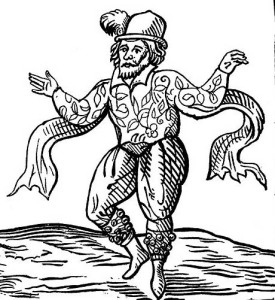
Kemp/Falstaff, the Globe, end of the War of the Roses Cycle

Shapiro says that as far back 1596, Shakespeare was trying to finish Henry the Fifth, which he had been thinking about for several years.
The scars of revision that Henry the Fifth bear—inconsistencies, locales that are specified then altered, characters that are introduced and then mysteriously disappear, repetitions that seem to be ghostly remnants of earlier drafts—testify to the extent to which Shakespeare’s conception of the play kept changing…As Shakespeare’s melancholy epilogue to Henry the Fifth acknowledges—with its backward glance at a decade’s worth of history plays with which he had entertained Shoreditch audiences—Henry the Fifth marked the end of one stage of his career and the unchartered beginning of another. (p. 20)


When the Chamberlain’s Men performed HIV, p2 at the Curtain, the play closes with an epilogue spoken by Will Kemp, that transitioned neatly into and referenced the bawdy jig that typically closed all Elizabethean plays, comedies as well as tragedies. In the original epilogue, “our humble author” promises to “continue the story.” According to Shapiro, this is the only time that Shakespeare ever shares with his audience what he planned to write next. However, when the Chamberlain’s Men were invited to perform that play at court, Shakespeare revised the epilogue because plays at court could not end with ribald jigs. In the revised epilogue, Shakepeare delivered his own words and in them makes no mention of what his next play will be about and no promise that Kemp will return as Falstaff. Most importantly, he suggests that “playwright and playgoers are bound in a partnership, sharers in a venture.” At this point, Shakespeare and most of the Chamberlain’s Men were building a new theatre of their own, the Globe, and his next play, the one he was currently working on when he wrote and delivered the revised epilogue, was Henry the Fifth, which does not include Falstaff directly (i.e., his death scene is described), Will Kemp in another role, or the typical closing bawdy jig. Shapiro suggests that Shakespeare in this revised epilogue to HIV,p2 prepares his audience for the new course that Henry the Fifth will set him and them (i.e., the playgoing public) on.


As an aside, HIV,p2 was published in 1601, two years after it was first performed, and this publication contains both epilogues. However, the printer left a bit of space between the court (aka Whitehall revised version) and the original Curtain version, indicating that he was aware that there were two separate epilogues. The 1623 folio also includes both versions but without the space between, melding them into a single epilogue. According to Shapiro, “modern-day editors, who ought to know better, have followed suit, leaving the confusion intact and obscuring why and how Shakespeare redirects his art at this time.” (p.36)

“Since at least the eighteenth century, critics have struggled to make sense of Shakespeare’s change of heart about Falstaff. Why would he abandon one of his great creations—especially after promising that we’d see Falstaff again?” Shapiro answers this by saying that
Shakespeare’s decision had nothing to do with character or plot but rather with Kemp and clowning. The parting of the ways between Shakespeare and Kemp—ironically if unintentionally mirrored in Hal’s icy repudiation of Falstaff—was a rejection not only of a certain kind of comedy but also a declaration that from here on in, it was going to be a playwright’s and not an actor’s theater, no matter how popular the actor. (p.37)


Given Shakespeare’s finely tuned poetic and ironic sensibilities, I can’t imagine that Hal’s rejection of Falstaff mirroring his own rejection of Kemp was lost on him. In fact, his rejection of Kemp might have inspired him to develop the rejection theme in HV, though in HIV,p2 (2.1.208-17), Prince Hal does tell the audience of his masterplan to come out and shine…does this mean that Shakespeare planned this breaking with Kemp as long ago as the writing of HIV,p2?

Ireland, the Death of Edmund Spenser, and the Earl of Essex

In 1598, Elizabeth sent a force to Ireland to subdue the latest uprising. B ecause she was tight with money and relied on conscripted forces instead of a regular (aka paid) army or mercenaries. The English were soundly beaten at the Battle of Blackwater, and the Earl of Essex (a young, brash, handsome, arrogant favorite/lover of the queen) was raising troops to return for vengeance. Shakespeare’s Henry the Fifth reflects many of the issues surrounding this proposed Irish expedition, including the morality of invading another country, the injustices and corruption associated with conscripting an army (also shown in HIV, p2), and the dangers of a military man being so successful that his ambitions are fueled to the point of insurrection, a theme that Shakespeare would fully explore in his next play, Julius Caesar.

Edmund Spenser was a marked contrast to Shakespeare—he totally embraced the role of poet to a patron, and was rewarded with lands in Ireland, which he lost during the 1598 uprising by the Irish against their English overlords. Shakespeare, while he allowed some patronage, pursued his own path as playwright within a group of players, rising to an ownership position of the troupe as well as the theater itself (i.e., the Globe that was currently under construction)—with his proceeds, he bought lands and a house in his hometown in the very English Stratford-upon-Avon. Spenser died unexpectedly in January, 1599 at the age of 46, and was interred at Westminster Abbey. Poets carried his hearse, and poems, instead of flowers, were tossed into his grave. According to Shapiro, “It’s unlikely that many of London’s writers would have missed the occasion…” to pen a poem in praise of Spenser but he asserts that Shakespeare probably did as he “had a strong aversion to heaping praise on the work of the living or the dead.” P. 70 Shapiro imagines that Shakespeare, who probably would have attended the funeral, might have wandered into the Chantry Chapel where HV and the remains of his wife, Queen Katherine, are buried, which is near where Spenser was being interred. Given that he is currently completing his play on HV, this seems more than likely. “Like Spenser, Henry V, who died at age thirty-five—Shakespeare’s current age—had not lived to fulfill his great promise.” In HVI, p1, written about ten years earlier, Shakespeare had staged HV’s funeral, in which mourners compare him to Julius Caesar. Now that Shakespeare was finally finishing HV itself, it seems more than coincidence that he produced JC next and that the two became even more an artistic extension of each other.

On February 20, Shakespeare and the rest of the Chamberlain’s Men performed in Richmond, and Shapiro speculates that Shakespeare most likely would have stayed in Richmond to hear a sermon ushering in Lent that was delivered by Lancelot Andrewes, “arguably England’s greatest preacher in an age notable for its oratory. For Shakespeare that morning in court would offer a chance to hear and study a remarkable performer.” (p.77) The title of Andrewes’s sermon was Preached before Queen Elizabeth at Richmond, On the 21st of February, A.D. 1599, being Ash Wednesday, at What Time the Earl of Essex was Going Forth, upon the Expedition for Ireland.

When scholars talk about the sources of Shakespeare’s plays, they almost always mean printed books like Raphael Holinshed’s Chronicles…But Shakespeare’s was an aural culture…Lost to us are the unrecorded sounds reverberating around him—street cries of vendors, church bells, regional and foreign accents, scraps of overheard conversations, and countless bits of speech and noise…Some of these made their way into Shakespeare’s writing…Only a tiny percentage of Elizabethan sermons were committed to print, so it’s a stroke of luck that Andrewes’s war sermon was one of them, for the evidence suggests that elements of it inspired (or uncannily paralleled) the play that Shakespeare was now completing. (p. 81)


It’s worth reading Shapiro’s analysis of the speech alongside HV’s St. Crispian’s Day speech in both style—the “thumping reiteration of ‘this time’ and ‘this day’”—and in the arguments that justify an “aggressive offensive war.” According to Shapiro, Ireland “haunts Shakespeare’s play….” and “seeps into the play at the most unexpected and even unintended moments.” (p. 88)

In fact, in the final act, Shakespeare speaks overtly and not in illusion to the imminent Irish campaign. Interestingly, this speech (Chorus, 5.0.22-35) also includes a reference to Caesar. “As we shift perspective from Henry’s triumphant return to Julius Caesar’s to Essex’s, then back to Henry’s, much gets blurred…” and is disquieting. (p. 89)

Back to the critics’ dismissal of HV as an important play. According to Shapiro, “Those seeking to pinpoint Shakespeare’s political views in Henry the Fifth will always be disappointed…” (p. 91) because “what they overlook is that all the debate about the war is the real story.” (p. 92) “Conquest, national identity, and mixed origins—the obsessive concerns of Elizabethan Irish policy—run deep through Henry the Fifth and sharply distinguish it from previous English accounts of Henry’s reign.” (p. 98)

Perhaps this is what I personally love about HV, now that I’ve read about it in context, it demonstrates in microcosm the genius of Shakespeare in taking a schoolboy’s story and adding depth and breadth and relevance to it both for his own contemporary audience and for those that followed. For that, I can forgive lapses in continuity.
Friday, April 10, 2009

Shakespeare Wrote for Money...according to Nick Hornby

Trolling my favorite blogs for airplane reading a few weeks ago, I pounced on a title that appealed to me on every level, Nick Hornby's Shakespeare Wrote for Money. I added it to my Amazon wish list and without really checking it out, I blithely spent my hard-earned Borders Bucks on it just before leaving for the airport last weekend.

Imagine my disappointment when I discovered that it was a collection of Hornby's columns in the Believer on what he read each month between August 06 and September 08. Not that the columns aren't interesting in and of themselves, and since this is my first taste of Hornby, though I did like the movie version of About a Boy (Full Screen Edition), it's not a complete loss. But, I wanted to read about Shakespeare!

Hornby got the book's title from his April 07 column in which he included notes about James Shapiro's A Year in the Life of William Shakespeare: 1599 (P.S.)
so I did get about a page of some Shakespeare discussion, mostly comparing it to Claire Tomalin's bio of Thomas Hardy.


Here's what Hornby had to say about Shapiro's book:
It's a brilliant book, riveting, illuminating, and original...full of stuff with which you want to amaze, enlighten, and educate your friends. 1599 was the year Shakespeare polished off Henry V, wrote As You Like It and Julius Caesar, and drafted Hamlet....Both Julius Caesar and Henry V are shown to be more about England's conflict with Ireland than we had any hope of understanding without Shapiro's expert illumination...The only thing you have to care about to love this book is how and why things get written. The "why" is relatively straightforward: Shakespeare wrote for money. He had a wife, a new theater, and a large theater company to support...the "how is more illusive...


I don't mean to 'dis Hornby, but the 1599 book is the one I really want to read. It's on my Amazon list and I may have to buy it before I've accumulated any more Borders Bucks.

An aside, having read a lot of Bill Bryson and none (up to now) of Nick Hornby, in his column on reading anyway, Hornby's voice sounds remarkably similar to Bryson's.

Saturday, September 27, 2008

The Winter's Tale

I'm inching towards completing my project of reading all of Shakespeare's plays in order. I'm looking at almost two years since I started this project, but having finished watching the BBC's The Winter's Tale earlier this week, the end is definitely in sight.

My assessment of the play is that Shakespeare is taking another run at Othello--this time however, Leontes plays both the part of Othello (the jealous husband) and Iago (the one who puts distrust in his heart). Having Leontes's own imagination and insecurity be at the root of his jealousy is closer to the norm of the human condition. Harkening back to Julius Caesar, "The fault, dear Brutus, is not in our stars, But in ourselves, that we are underlings." I've loved this quote since I first read it in 10th grade, and in The Winter's Tale Shakespeare drives it home again.

In this Othello story, however, Shakespeare saves Hermione instead of letting Leontes really kill her as Othello kills Desdemona. She is the angel resurrected, the mother restored, the home restored...it bothered me though, that her son really was gone. She regained her daughter, and Leontes regained his wife, but their son was lost to them.

I wonder whether there will ever be an attempt to do a film version of this play. More than most, people seem to either love it or dislike it (i.e., disparage it as a problem play--two stories held together by a tenuous connection). I'm toying with the idea of reading Pandosto, Shakespeare's source for the story, but that idea will probably fall by the wayside this time round.

Thursday, June 12, 2008

Playing: Colorado Shakespeare Festival

I just got my tickets for four of this summer's plays--we'll be enjoying Macbeth, Love's Labour's Lost, The Three Musketeers (not Shakespeare, of course, but it looks like an excellent production), and The Complete Works of William Shakespeare (Abridged), which is one night only (August 11): http://www.coloradoshakes.org/ We're skipping Henry VIII--I haven't read it or seen it yet, and I've heard it's one of the weaker plays anyway.

The Colorado Shakespeare Festival at the University of Colorado campus in Boulder is one of my all-time favorite summer activities. From the picnic on the lawn before the play, to wearing trash bags during the occasional downpour, to marvelling at how good the plays are, year in and year out, the whole experience is always fun.

The CSF is celebrating their 50th anniversary this year, and we've been regulars for the past twenty years, only missing a couple of years in their when their schedule and ours just didn't mesh.